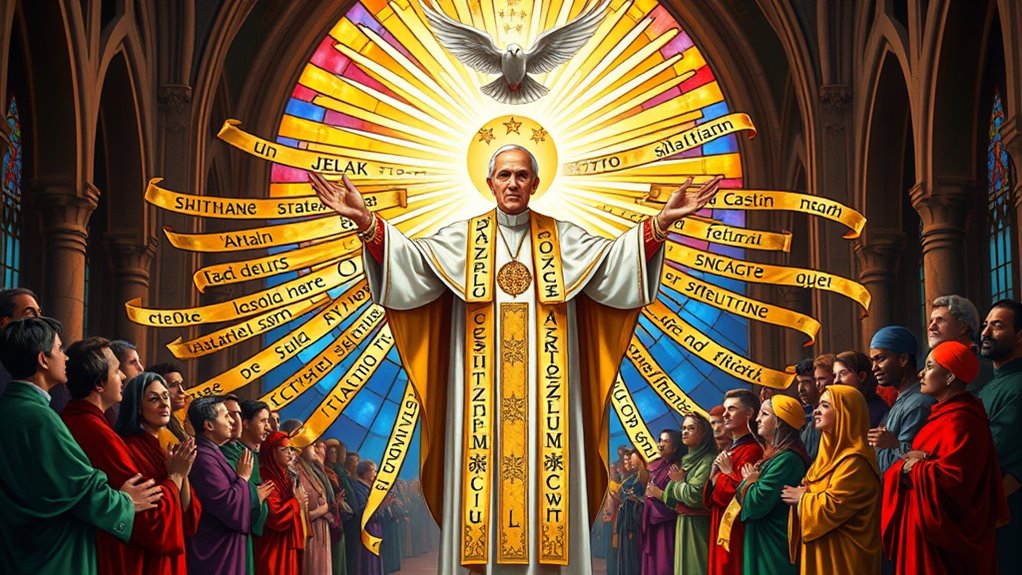
Pope Leo XIV has emphasized that authentic human freedom is realized through acceptance of God’s will rather than pure self-determination. Drawing on his theological training as an Augustinian and his episcopal motto “In illo Uno unum,” the pontiff teaches that saying yes to divine purpose liberates individuals from isolation and discord. This vision connects personal spiritual fulfillment with the broader unity he champions for the contemporary church. His early addresses position obedience to God as the pathway to genuine autonomy, echoing themes from Vatican II and his namesake Leo XIII’s social teachings, while a fuller exploration reveals how this framework addresses modern challenges.
On May 8, 2025, the Catholic Church witnessed a historic shift when Cardinal Robert Francis Prevost became the first American-born pontiff, taking the name Leo XIV in honor of Pope Leo XIII and his legacy of social teaching. The new pope’s selection reflects both continuity with recent papal priorities and a renewed emphasis on unity in an era marked by division.
Cardinal Robert Francis Prevost made history as the first American pope, choosing the name Leo XIV to honor social teaching traditions.
Pope Leo XIV brings extensive administrative experience to the papacy, having served as Prior General of the Augustinian order from 2001 to 2013 and as bishop of the Diocese of Chiclayo in Peru for nine years. Most recently, he held the position of Prefect of the Dicastery for Bishops from 2023 to 2025, where he evaluated episcopal candidates worldwide. His elevation to cardinal came in 2023 under Pope Francis, whose influence remains evident in the new pontiff’s vision.
During his inaugural Mass, Leo XIV described the church as a “beacon that illuminates the dark nights,” setting a tone of measured hope. His episcopal motto, “In illo Uno unum,” emphasizes Christian unity and communion, themes he identified as essential responses to what he called “too much discord” in the contemporary world. The new pope has designated the Second Vatican Council as the church’s “guiding star” and aligned himself with Pope Francis’s 2013 apostolic exhortation Evangelii gaudium, particularly its focus on global diversity and championing the poor.
Leo XIV’s social priorities mirror those of his papal namesake, with particular attention to migrant rights, economic disadvantage, and vulnerable populations. He has articulated opposition to armed conflict and nationalism while emphasizing reconciliation as central to the church’s mission. In addressing contemporary challenges, the pope has warned about artificial intelligence and its implications for human dignity, suggesting that the social encyclical Rerum novarum remains relevant for understanding modern technological developments.
The pope’s theological emphasis centers on love and unity as core dimensions of papal authority. His first initiatives suggest a papacy dedicated to bridge-building between the church and the modern world, continuing the intellectual engagement that characterized both Leo XIII and the Second Vatican Council’s modernizing principles. His leadership also signals a commitment to servant leadership as a biblical model for shepherding the people of the church.