
The Bible does not mention Christmas by name, but the Gospels of Matthew and Luke provide detailed accounts of Jesus’s birth in Bethlehem. Luke describes a Roman census prompting Mary and Joseph’s travel from Nazareth, shepherds visited by angels, and the baby placed in a manger. Matthew records the magi bringing gifts of gold, frankincense, and myrrh. Christians view this birth as fulfilling Old Covenant prophecies from Micah and Isaiah, and as the beginning of God’s plan for human redemption through Jesus’s eventual death and resurrection. Further exploration reveals how these biblical accounts shape the theological meaning behind the celebration.
Key Takeaways
- The Bible does not mention Christmas by name; it records Christ’s birth in Matthew and Luke’s Gospels.
- Jesus was born in Bethlehem, placed in a manger, visited by shepherds and later by magi bearing gifts.
- The birth fulfilled Old Testament prophecies from Micah and Isaiah written centuries earlier about the Messiah’s coming.
- Christians view the incarnation as God becoming visible through Christ to enable humanity’s redemption from sin.
- The virgin birth is considered foundational to Christian faith, making Christ’s death and resurrection meaningful for salvation.
What Does the Bible Say About Jesus’s Birth?

The biblical account of Jesus’s birth appears primarily in the Gospels of Matthew and Luke, offering details that have shaped Christian tradition for two millennia.
The Gospels of Matthew and Luke provide the foundational narratives of Jesus’s birth that define Christian understanding today.
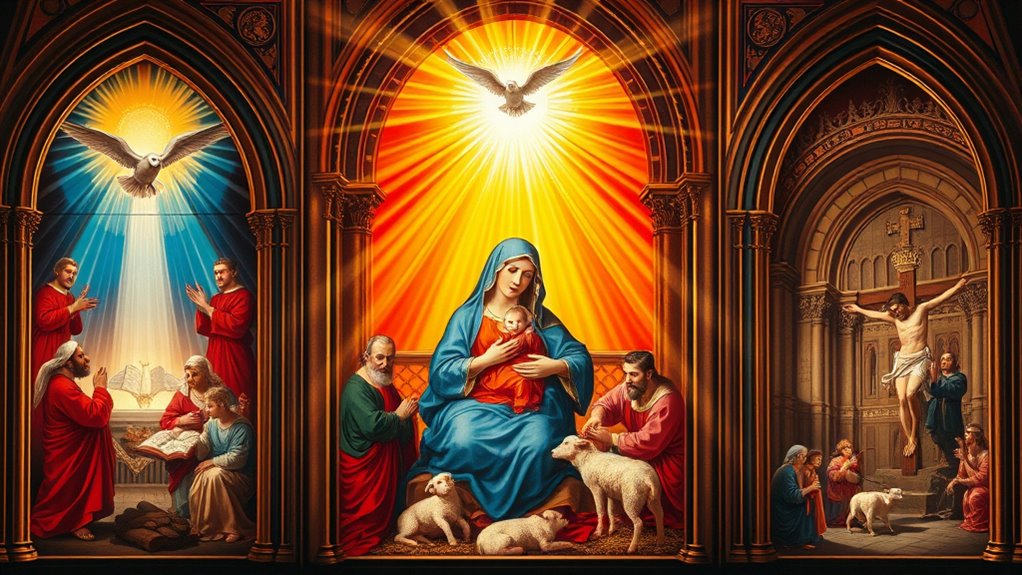
According to Luke, a Roman census required Joseph and Mary to travel from Nazareth to Bethlehem, Joseph’s ancestral town as a descendant of King David. There, Mary gave birth to her firstborn son, placing him in a manger because no guest room was available. The baby was wrapped in cloths, a detail emphasized in the angels’ announcement to the shepherds. This event is placed within a broader historical timeline that scholars date to the first century AD, reflecting the New Testament’s composition between 45-100 AD.
An angel announced the birth to shepherds watching their flocks, proclaiming the arrival of a Savior and Messiah in the town of David. The shepherds found the child as described, then spread word of what they had witnessed.
The birth fulfilled prophecies written centuries earlier, including Isaiah’s virgin birth prediction and Micah’s identification of Bethlehem. Matthew’s account includes the visit of the magi, who presented gifts of gold, frankincense, and myrrh, likely occurring up to two years after the birth.
Why Is Jesus’s Birth Significant for Christians?

Beyond the historical details of Jesus’s birth, Christians view the event as pivotal to their understanding of salvation and God’s relationship with humanity. The incarnation made God’s invisible nature visible, allowing people to understand divine character through Christ’s life and teachings. Christians believe Jesus’s birth enabled his eventual death as a ransom for sinners, with his sinless life serving as payment for human redemption. The doctrine of the Trinity also underlines how Jesus is both distinct and fully divine, a truth Christians affirm through the divine nature shared within the Godhead.
The virgin birth, alongside the resurrection, forms one of two foundational pillars of Christian faith. Without it, the crucifixion would lack meaning and the resurrection would be impossible. The birth also fulfilled Isaiah’s prophecy made 700 years earlier, validating Scripture’s reliability.
Ultimately, Christians see Jesus’s arrival as demonstrating God’s mercy to all nations and offering eternal life to those who believe. According to Scripture, eternal life is granted only through belief in Jesus, not automatically to all people. The incarnation represents the summit of God’s redemptive purpose, not merely a display of divine power.