


Saint Polycarp of Smyrna (c. 69-155 AD) served as bishop for nearly six decades and learned directly from the Apostle John, making him one of three Apostolic Fathers who bridged the apostolic age and early Church. While both Catholics and Protestants revere him as a Church Father rather than an apostle—a distinction reserved for Jesus’s original disciples—his martyrdom in 155 AD and sole surviving letter to the Philippians demonstrate unwavering commitment to apostolic teaching. His life exemplifies the transmission of authentic Christian doctrine from the first generation of believers to subsequent centuries.
Saint Polycarp of Smyrna stands as a pivotal bridge between the age of the Apostles and the early Church, having learned the faith directly from those who walked with Christ. Born between 69 and 70 AD to Christian parents, he became a disciple of St. John the Evangelist and received ordination as a teenager. Some accounts suggest he was born a slave and adopted by a man named Callisto, who instructed him in Scripture, memorization, and prayer.
As one of three recognized Apostolic Fathers alongside Ignatius of Antioch and Clement, Polycarp held conversations with eyewitnesses of Christ and absorbed their teachings. The Apostles appointed him bishop of Smyrna, located in what is now Izmir, Turkey, where he served for approximately 60 to 70 years. During his lengthy tenure, he zealously preserved Apostolic doctrine, spread the Gospel among pagans, and courageously opposed early heresies. His patient preaching particularly aided widows and slaves.
Polycarp maintained significant relationships throughout his ministry. His pupil Irenaeus later became Bishop of Lyon. In 107 AD, his friend Ignatius visited him while traveling to martyrdom in Rome. Polycarp also served as representative to Pope Anicetus regarding disputes over the date of Easter, demonstrating his role in addressing early Church controversies.
Of his writings, only a letter to the Church of Philippi survives, though it reveals extensive knowledge of New Testament texts. His words consistently echoed Scripture, cementing his reputation as a gracious shepherd unwavering in truth.
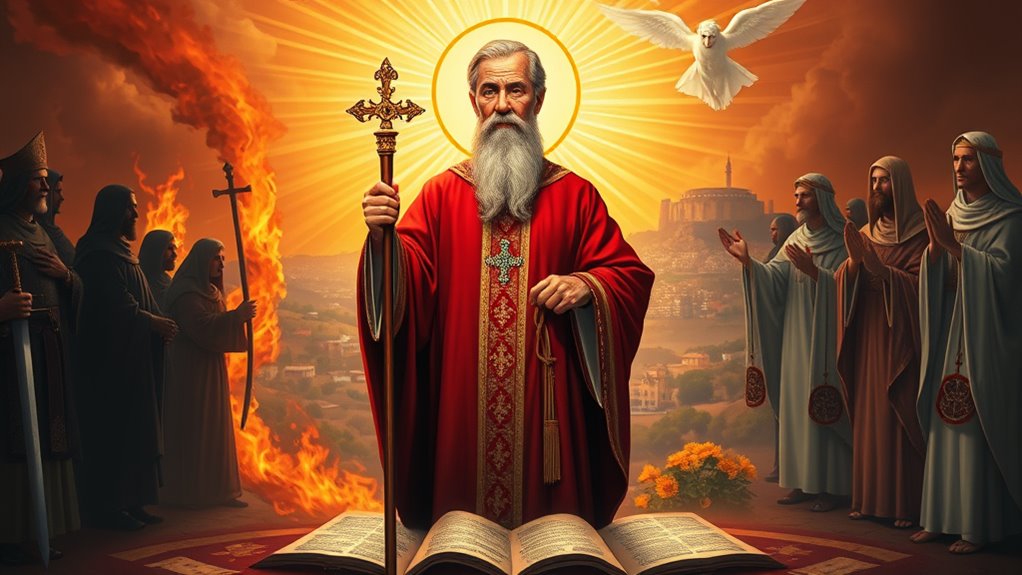
At age 86, under Emperor Antoninus Pius, authorities arrested Polycarp and brought him to the Smyrna stadium. When he refused to recant his faith, executioners attempted to burn him, but flames reportedly failed to harm him. He was killed by sword on February 23, 155, becoming the twelfth martyr in Smyrna. The account appears in the Martyrium Polycarpi, the earliest post-New Testament martyrdom record.
Polycarp defined what it meant to be a martyr—one who dies for faith in Christ. As the last surviving person who personally knew the Apostles, his death marked the end of a direct connection to Christianity’s foundation, yet his witness continues to encourage believers today. Angels in Scripture reveal that spiritual beings serve God as messengers and minister to believers, and Polycarp’s life reflects that ministry in angels as messengers.