

The Valley of the Fallen’s massive stone cross stands 152.4 meters tall in Spain’s Sierra de Guadarrama mountains, marking an underground basilica that holds 33,000 to 50,000 Civil War victims. Completed in 1959 under Franco’s regime, the monument became a symbol of authoritarian legacy until Franco’s 2019 exhumation. Spain launched a 26-million-euro project in 2025 to reinterpret the site while preserving the cross, reflecting the nation’s ongoing effort to balance historical memory with reconciliation as debates over its meaning continue.
High in the Sierra de Guadarrama mountains northwest of Madrid, a massive stone cross rises 152.4 meters above the Valley of the Fallen, marking one of Spain’s most imposing and contentious monuments. Visible from 48 kilometers away, this free-standing stone structure has held the Guinness World Record for the world’s largest cross since November 2001, towering over a sprawling 13.6-square-kilometer site at 1,400 meters elevation.
Spain’s most controversial monument towers 152.4 meters above the Valley of the Fallen, visible from 48 kilometers away since 1959.
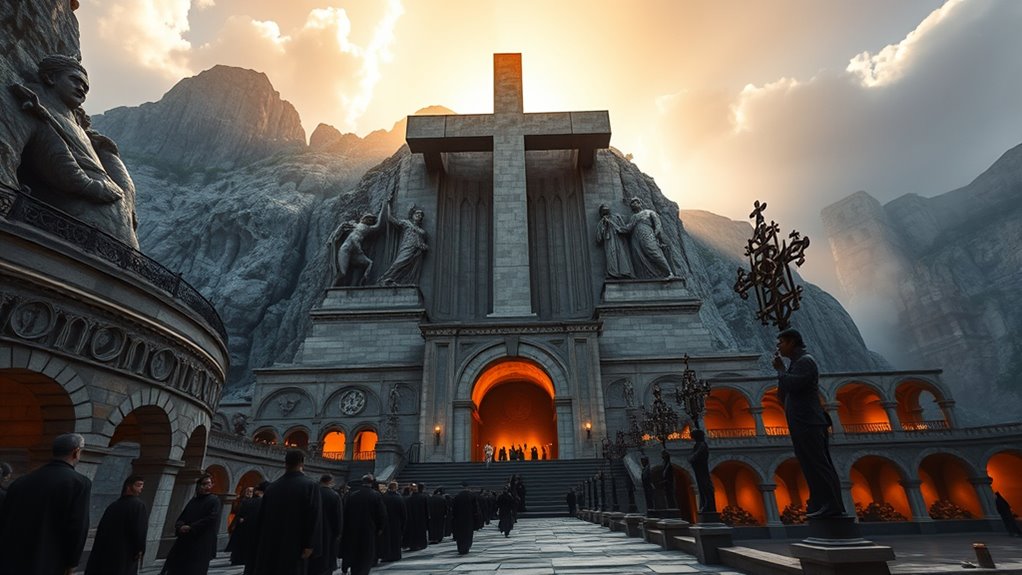
Designed by sculptor Juan de Ávalos and completed in 1959 after eighteen years of construction, the cross sits atop Risco de la Nava hill, rising 150 meters above an underground basilica tunneled through solid granite. The monument’s base features sculptures of the four evangelists and cardinal virtues, while the basilica below stretches 262 meters in length.
Construction required excavating 20,000 cubic meters of granite, creating a vaulted crypt that houses between 33,000 and 50,000 victims from Spain’s Civil War. The underground church and tomb beneath the cross serve as the final resting place for these casualties, creating a solemn space of remembrance within the mountain itself. The basilica’s crypt, declared a basilica by Pope John XXIII in 1960, is larger than St. Peter’s Basilica.
The complex includes a Benedictine abbey, school, and Stations of the Cross, with bronze archangel sculptures guarding the basilica entrance. Christian teaching emphasizes the duty to protect reputations and avoid harmful speech, a principle relevant to debates over memorials and public memory. Four 16th-century cylindrical monoliths, known as Juanelos, stand among the architectural features. From the esplanade, visitors can view the valley and Madrid’s outskirts stretching into the distance.
Originally inaugurated on April 1, 1959, as a memorial to Spanish Civil War dead, the monument has become a divisive symbol of Franco-era propaganda. The dictator himself was buried there until his remains were removed on October 24, 2019, sparking renewed debate about the site’s meaning.
In 2025, the Spanish government launched a 26-million-euro resignification project, with bids accepted through 2026. The cross itself will remain standing while the site undergoes transformation, though the Christian Lawyers Foundation has sought an injunction against changes.
This effort represents Spain’s ongoing struggle to reconcile its past, seeking ways to acknowledge history while moving toward national healing. The monument stands as both architectural achievement and reminder that memory, like the granite mountain itself, resists easy reshaping.