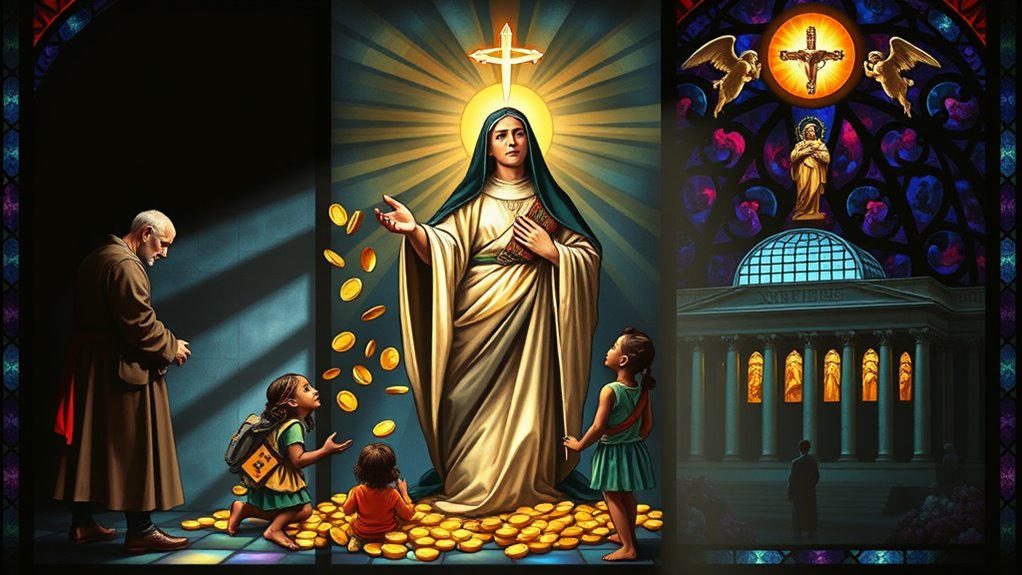
St. Katharine Drexel, born into Philadelphia banking wealth in 1858, inherited millions from the Drexel family fortune but chose the path the rich young man in Matthew 19 rejected. After meeting Pope Leo XIII in 1887, she founded the Sisters of the Blessed Sacrament in 1891, dedicating her life and inheritance to Native Americans and African Americans. She established 50 Indian missions, numerous Black Catholic schools, and Xavier University in New Orleans, spending over $12 million before her death. Her canonization in 2000 recognized sacrificial generosity that transformed American Catholic missions through total surrender of material security for discipleship.
When a wealthy young man approached Jesus seeking eternal life, he received an unexpected answer: sell everything, give to the poor, and follow. The Gospel account in Matthew 19:16-22 records that the man walked away sorrowful, unable to surrender his great possessions. Jesus remarked afterward on the difficulty of the rich entering the kingdom of heaven, comparing it to a camel passing through a needle’s eye. The story has remained a stark example of choosing material security over total discipleship.
The rich young man chose his possessions over discipleship, walking away sorrowful when Jesus asked him to sell everything.
Catherine Mary Drexel, born November 26, 1858, in Philadelphia, faced a similar choice with vastly different results. Her father Francis Drexel had built an international banking fortune, and Catherine inherited millions. She lived as an heiress with opportunities for marriage into high society, yet her parents had instilled strong philanthropic values, tithing one-tenth of their income to charity.
Catherine’s missionary interests developed after reading *A Century of Dishonor*, which detailed mistreatment of Native Americans. She visited the Dakotas, met Sioux leader Red Cloud, and began funding schools on South Dakota reservations. During an 1887 European tour, she met Pope Leo XIII and requested missionaries for Wyoming. The Pope challenged her directly: “Why don’t you become a missionary?” The question marked a pivotal shift in her thinking about personal vocation.
After discernment with Bishop James O’Connor, Catherine wrote her commitment on Saint Joseph’s feast day in 1889, dedicating the remainder of her life to Indians and Colored people. Newspaper headlines proclaimed, “Gives Up Seven Million!” She became a novice with the Sisters of Mercy in Pittsburgh, then professed final vows in February 1891 and founded the Sisters of the Blessed Sacrament.
Over her lifetime, Mother Katharine established 50 Indian missions in 16 states and black Catholic schools in 13 states. She founded Xavier University in New Orleans in 1915, the first Catholic historically black university in the United States. By her death, she had expended over $12 million of her inheritance on missions. Pope John Paul II canonized her on October 1, 2000. She exemplified faithful stewardship and sacrificial generosity in line with biblical principles of giving, modeling joyful and regular financial commitment to serve the poor and marginalized.