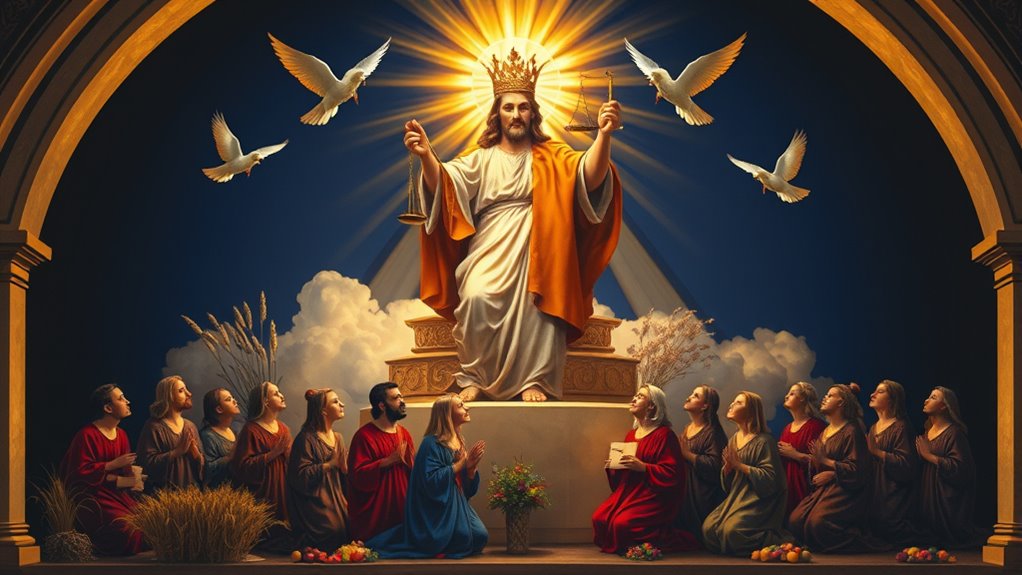



The Bible describes four forms of love using Greek terms that each capture distinct relational dimensions. Agape represents unconditional, sacrificial love that flows from willful choice and appears 106 times in the New testament, demonstrated most powerfully through Christ’s death. Philia signifies friendship love between equals who share mutual loyalty and values, exemplified by David and Jonathan’s bond. Eros denotes romantic passion celebrated in Song of Solomon and affirmed for marriage in Proverbs 5:18-19. Storge describes natural familial affection arising within households. Scripture teaches that agape must anchor the other loves, transforming them through divine empowerment rather than feelings alone.
The Four Biblical Loves: Agape, Philia, Eros, and Storge Defined
The Bible’s teaching on love emerges through four distinct Greek terms, each describing a different dimension of human connection and devotion. Agape represents sacrificial, unconditional love rooted in willful choice rather than emotion, appearing 106 times in the New Testament.
Philia denotes friendship love between equals, exemplified by David and Jonathan’s bond, emphasizing mutual loyalty and shared values.
Storge describes familial affection that develops naturally within households through duty and familiarity.
Eros refers to romantic passion and physical attraction, though notably absent from New Testament texts.
Together, these terms map the spectrum of human relationships, with scripture prioritizing agape’s moral commitment above other forms. The Bible also frequently uses the word “heart” to refer to the inner life — including thoughts, emotions, will, and moral center — rather than the physical organ, highlighting the role of inner disposition in how love is expressed and received (inner life).
Agape Love: God’s Unconditional and Sacrificial Love
Among the four biblical expressions of love, agape stands apart as the most celebrated and challenging, representing a love that originates not from human emotion but from divine character.
First Corinthians 13:4-7 defines its qualities: patient, kind, not envious or boastful, keeping no record of wrongs.
This unconditional love operates independently of reciprocation, requiring believers to act in others’ best interests regardless of circumstances.
Jesus demonstrated agape through his willingness to suffer and die for humanity.
According to Christian teaching, believers cannot generate this love through human strength alone but receive it through the Holy Spirit, enabling them to extend sacrificial devotion to neighbors and enemies alike.
The Holy Spirit empowers believers to practice sacrificial love in everyday life.
Philia Love: The Deep Bond of Friendship and Brotherhood
Soul-friendship, the ancient Greeks believed, represents one of life’s most enduring gifts, and the biblical concept of philia captures this profound truth. The Greek word appears nine times in Proverbs in the Septuagint, describing the deep affection and loyalty between close companions.
Scripture offers vivid examples: David and Jonathan’s covenant bond in 1 Samuel 18, Jesus weeping for Lazarus in John 11, and the disciple John leaning against Christ at the Last Supper. Romans 12:10 encourages believers to “be devoted to one another in brotherly love,” establishing philia as essential for spiritual growth and Christian community, transcending ordinary friendship through shared faith. This brotherly love reflects humility as dependence on God expressed through serving others rather than seeking status.
Eros Love: Passionate Romance Within Biblical Marriage
Unlike the friendship of philia or the sacrificial commitment of agape, eros represents the passionate, romantic dimension of love that draws a husband and wife together in physical and emotional intimacy.
Scripture celebrates this form of love through the Song of Solomon, where bride and groom express delight in one another. Proverbs 5:18-19 encourages married couples to remain faithful while delighting in each other. Genesis 2 establishes the foundation for intimate union, explaining why a man leaves his family to join with his wife. Biblical teaching emphasizes that eros finds its proper expression within marriage, where romantic passion combines with selfless commitment. The Bible also presents marriage as a divine covenant relationship, grounded in passages from Genesis and reiterated in Malachi.
Storge Love: Natural Affection for Family and Familiar Things
Within the family circle, a quieter form of love operates, one rooted not in choice but in natural bonds. Storge (pronounced “store-jay”) describes the affection parents feel toward children and siblings share with one another.
The Greek term στοργή appears in Romans 12:10 as *philostorgos*, meaning devoted familial love. C.S. Lewis noted this dependency-based bond builds through familiarity, shared memories, and unconditional acceptance. It extends beyond blood relatives to close friends and pets.
The Bible warns against *astorgos*—lacking natural affection—in Romans 1:31 and 2 Timothy 3:3, underscoring storge’s importance in healthy relationships. This affection is reflected in Scripture through examples of family loyalty and care, such as Deborah’s leadership and other familial roles.
Why Agape Must Come First: Ordering Your Loves Biblically
Hierarchy matters in the Christian understanding of love, and Scripture consistently places agape—God’s selfless, willful love—at the foundation of all other affections. Matthew 22:37-39 establishes the priority: love God first with complete devotion, then neighbor as self.
Without this ordering, natural loves like storge and eros can become enslaving, meeting only personal needs rather than reflecting divine character. Christ modeled this supremacy through his sacrificial death for undeserving sinners (Romans 5:8), demonstrating that agape operates independently of the recipient’s merit.
When believers prioritize agape, other loves flourish properly, producing patience and enduring commitment rather than feelings-based instability. This ordering echoes the biblical emphasis on faith expressed through belief, obedience, perseverance as the way we trust and live out God’s love.
What C.S. Lewis Reveals About Subordinating Natural Loves to Agape
Drawing from decades of scholarly reflection, C.S. Lewis warned that natural loves cannot maintain purity without divine assistance. He compared them to a garden requiring constant weeding and pruning, or a petty princeling unable to rule without the Emperor’s backing.
Lewis argued that feelings alone fail to sustain affection, friendship, and romance—these loves promise permanence but falter without Agape’s support. Through subordination, natural loves become modes of Charity while retaining their distinct forms.
This transformation mirrors the Incarnation, where Christ’s Manhood was taken into Godhead. Agape operates through deliberate choice, enabling believers to love even the unlovable. The Holy Spirit is central to this process, empowering and guiding believers by regenerating hearts to love as God commands.