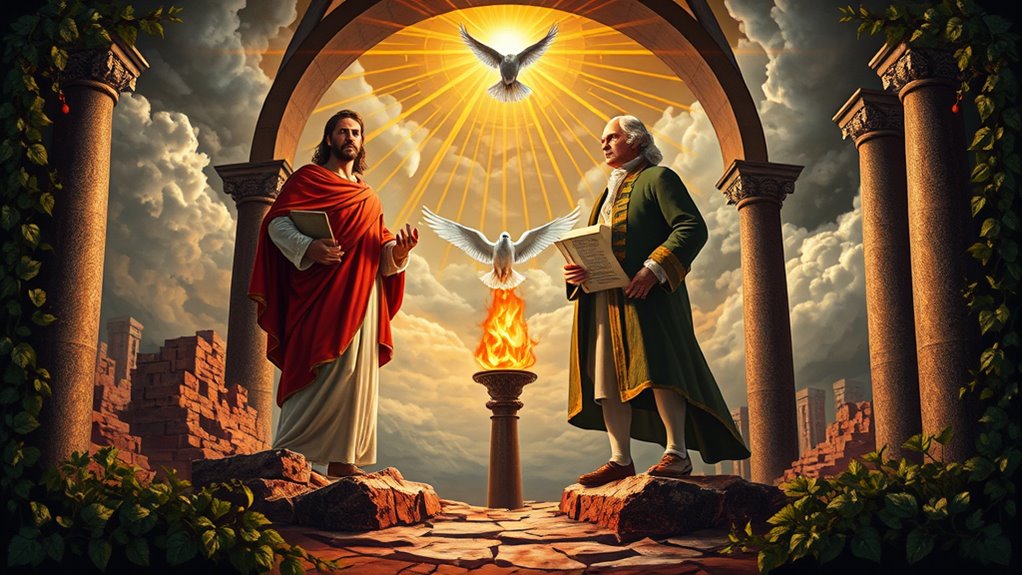

The Bible teaches that the Holy Spirit is the third person of the Trinity, fully divine and equal with the Father and Son, as shown in passages like Acts 5:3–4 and Matthew 28:19. The Spirit convicts people of sin, initiates regeneration by giving new spiritual life, and transforms believers from spiritual death to union with Christ. He possesses divine attributes including omniscience and omnipresence, exercises personal qualities like will and emotion, and works continuously in believers until their final glorification. The following sections explore these dimensions more thoroughly.
Key Takeaways
- The Holy Spirit is fully divine, possessing eternal attributes, omniscience, omnipresence, and omnipotence alongside the Father and Son.
- The Holy Spirit is a distinct person who exhibits intellect, emotions, and will, not merely an impersonal force.
- The Spirit initiates regeneration, bringing spiritually dead individuals to new life and transforming hearts of stone into flesh.
- The Holy Spirit convicts people of sin, opens hearts to faith, and transforms unbelievers into devoted followers of Christ.
- The Spirit produces ongoing transformation in believers, leading them toward righteousness and away from habitual sin.
The Holy Spirit’s Divine Nature and Role in the Trinity

The Bible presents the Holy Spirit as fully divine, possessing the same eternal and infinite attributes that belong exclusively to God. Hebrews 9:14 identifies the Spirit as eternal, while omniscience, omnipresence, and omnipotence mark the Spirit’s deity. Peter explicitly equates lying to the Holy Spirit with lying to God in Acts 5:3-4, establishing direct identification with the divine nature. The Spirit shares equal status with the Father and Son in Matthew 28:19‘s baptismal formula, indicating co-equality within the Trinity.
Yet the Spirit remains a distinct person, appearing in bodily form as a dove at Christ’s baptism and actively governing the church through appointments and discernment. This personhood includes intellect, emotions, and will, demonstrated when the Spirit is grieved by sin or provides comfort. The Spirit, like the Father and the Son, is understood to share one divine essence as taught in the doctrine of the Trinity and historic creeds, reflecting shared divinity among the three persons.
The Holy Spirit’s Work in Believers: Regeneration to Glorification

Regeneration marks the Holy Spirit’s initial transformative work in bringing spiritually dead individuals to new life in Christ. Scripture describes this sovereign act as removing hearts of stone and giving hearts of flesh (Ezekiel 36:25–27), a spiritual resurrection uniting believers with Christ (Ephesians 2:4–6). John 3:3–8 employs new birth terminology, while Titus 3:5 calls it “washing of regeneration and renewal.” The Spirit convicts of sin, righteousness, and judgment (John 16:8), as seen when He opened Lydia’s heart (Acts 16:14) and transformed Saul of Tarsus (Acts 9:1–9). Following regeneration, believers experience ongoing renewal (Colossians 3:10, Ephesians 4:21–24) and practice righteousness rather than habitually sinning (1 John 3:9). This process culminates in glorification, when believers fully realize their position seated in heavenly places with Christ (Ephesians 2:6). Many of these biblical teachings were preserved and transmitted across centuries, contributing to the canon that developed between approximately 1500 BC and 100 AD, including the Septuagint translation.