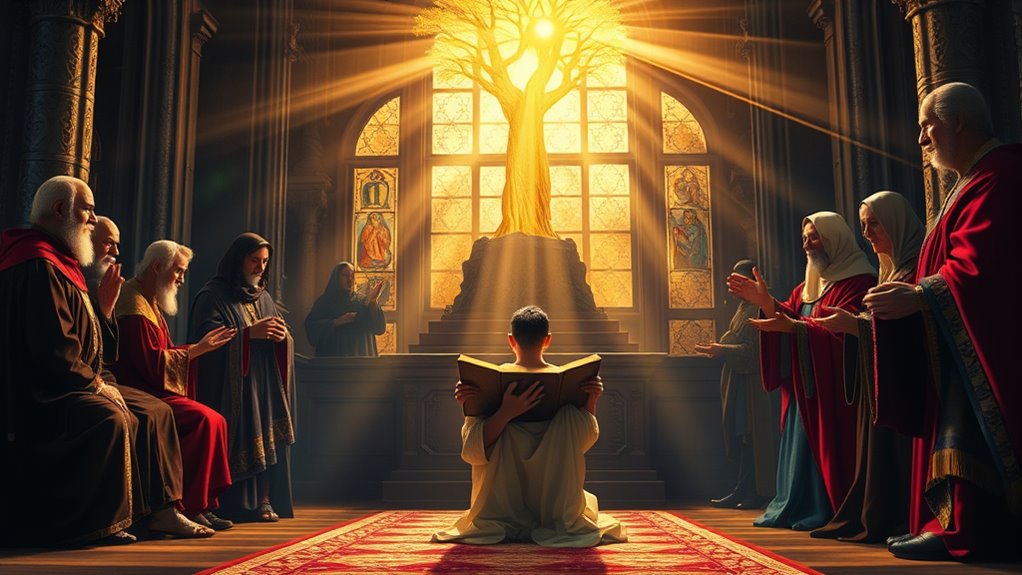
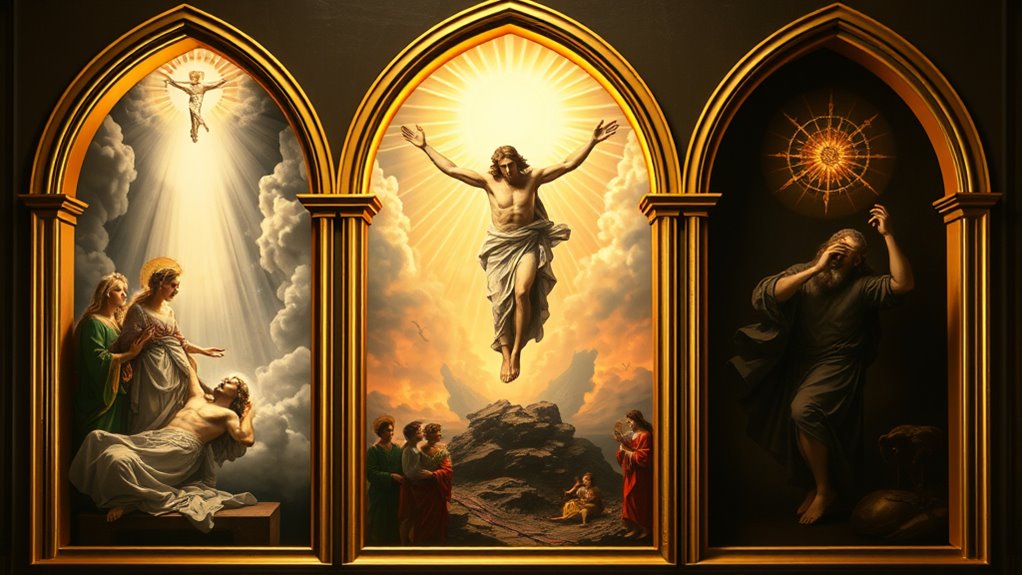
The Bible describes death as a passage rather than an ending, where the soul separates from the body and enters an immediate conscious state. According to Scripture, believers pass into Christ’s presence in Paradise, as suggested by Paul’s desire to “depart and be with Christ” in Philippians. Unbelievers enter Hades, a temporary place of torment illustrated in Luke 16’s account of the rich man and Lazarus. Both states remain interim until the final resurrection reunites bodies and spirits. The pages ahead explore these teachings in greater detail.
Key Takeaways
- Death is a passage point, not an ending; believers immediately enter conscious presence with Christ in Paradise.
- Eternal life is a free gift through faith in Jesus Christ, defined as knowing God and Jesus.
- At death, the soul separates from the body and the spirit returns to God.
- Unbelievers enter Hades, a temporary state of conscious torment, until final resurrection.
- Physical bodies will transform from perishable to imperishable, based on Jesus’ resurrection as foundation.
What Does the Bible Say About Death and Eternal Life?

According to Christian scripture, death marks not an ending but a passage point in human existence, with the Bible presenting eternal life as accessible through faith in Jesus Christ.
The Gospel of John records Jesus teaching that believers who hear his word cross over from death to life, with eternal life defined as knowing God and Jesus Christ. This gift comes freely, contrasted with the wages of sin being death.
The biblical text emphasizes security for believers, stating that no force can remove them from God’s hand.
Scripture describes a physical transformation where perishable bodies become imperishable, with mortality yielding to immortality. Jesus’ own resurrection serves as the foundation for this promise, demonstrating continued existence beyond physical death.
The Christian hope rests on the doctrine that Jesus is both fully God and fully human, a central affirmation of historic faith and the Trinity.
What Happens Immediately After Death According to the Bible?

While the promise of eternal life addresses the ultimate destination of believers, biblical texts also describe what occurs in the moments and period immediately following physical death. According to Scripture, physical death separates the soul from the body, with the spirit returning to God. For believers, this separation leads to immediate conscious presence with Christ in Paradise, as Paul expressed his desire to “depart and be with Christ” in Philippians 1:23.
The account of Lazarus in Luke 16 illustrates this instant passage to heaven. Conversely, unbelievers enter Hades, a temporary domain of conscious torment described in the story of the rich man. Both destinations involve awareness rather than unconscious sleep, with souls remaining in these intermediate states until the final resurrection reunites body and spirit. Golgotha, the traditional site of Jesus’ crucifixion and burial, is historically identified with the Church of the Holy Sepulchre and underscores the connection between Jesus’ death and the promises of resurrection and immediate postmortem presence with God, as seen in early Christian testimony about Golgotha.