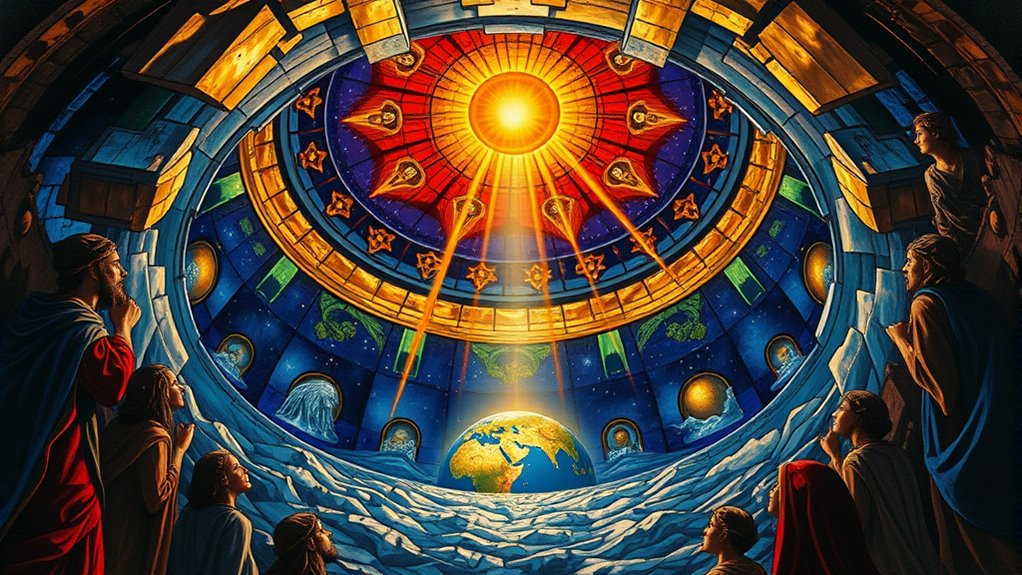
The firmament, from the Hebrew word rāqîaʿ meaning “to beat out,” appears in Genesis 1 as the structure God created on the second day to separate waters above from waters below. Ancient Near Eastern cultures envisioned it as a solid dome, and the Septuagint translators used stereoma, meaning “solid,” to convey this understanding. Modern translations render it as “expanse” or “sky,” reflecting evolving interpretations from the Copernican revolution onward. The firmament served as heaven itself, housing celestial bodies and defining the boundaries of God’s created order, a concept that extends throughout Scripture.
Key Takeaways
- The firmament (Hebrew rāqîaʿ) was created on the second day to separate waters above from waters below.
- God called the firmament “Heaven” and later placed the sun, moon, and stars within it.
- The Hebrew word suggests something beaten or spread out, translated as “firmament” in King James and “expanse” in modern versions.
- Ancient interpretation understood the firmament as a solid dome-like structure separating earth from celestial waters above.
- Birds fly beneath the firmament while celestial bodies were set within it, establishing atmospheric and cosmic boundaries.
What Does the Firmament Mean in Genesis 1?

The Hebrew word *rāqîaʿ* (רקיע) appears in the opening chapter of Genesis as a central element of the creation narrative, describing what God made on the second day to separate waters above from waters below.
On the second day, God formed the *rāqîaʿ* to divide the waters above from the waters below.
Derived from a verb meaning “to beat or stamp out,” the term suggests an expansion or spreading action. God designated this firmament as “Heaven,” establishing a foundational cosmic structure before creating terrestrial life.
The passage appears nine times in Genesis 1 alone, emphasizing its significance in the creation sequence. According to verses 14-16, celestial bodies were later positioned within this firmament, while birds flew below it, distinguishing atmospheric space from the celestial domain.
This structural arrangement provided both physical and spiritual boundaries in the biblical cosmology. The firmament’s role in declaring God’s handiwork extends beyond Genesis into the Psalms, where the heavens proclaim divine glory and craftsmanship. The King James Version renders *rāqîaʿ* as “firmament,” highlighting the implied firmness or fixed structure present in the Hebrew root. Scholars note that parts of the Old Testament were written in Biblical Aramaic, reflecting linguistic diversity during the exile period.
How Did Firmament Interpretation Evolve From Ancient to Modern Times?

Ancient peoples across the Near East envisioned the sky as a solid barrier, with Egyptian cosmology depicting it as a bronze or metal shell protecting earth from primordial waters above.
Hebrew scripture’s raqia aligned with this understanding, describing a dome-like structure beaten out like metal. The Septuagint translators used stereoma, meaning “solid,” reinforcing this interpretation.
Early church fathers maintained this view until the Copernican revolution challenged traditional cosmology. In 1554, John Calvin proposed firmament referred to air or clouds rather than solid material, marking a pivotal shift.
Modern translations generally render raqia as “expanse” or “sky,” though biblical scholars acknowledge the original Hebrew implied solidity. This evolution reflects changing scientific understanding while preserving the text’s phenomenological language describing observable sky. God explicitly defined the raqia as “heaven(s)” in Genesis 1:8, establishing the fundamental identification of this created structure. The firmament serves as the location where God placed the sun, moon, and stars, making these celestial bodies visible components of the sky’s expanse. Jesus likely spoke Aramaic in the same cultural-linguistic milieu as the biblical authors.