

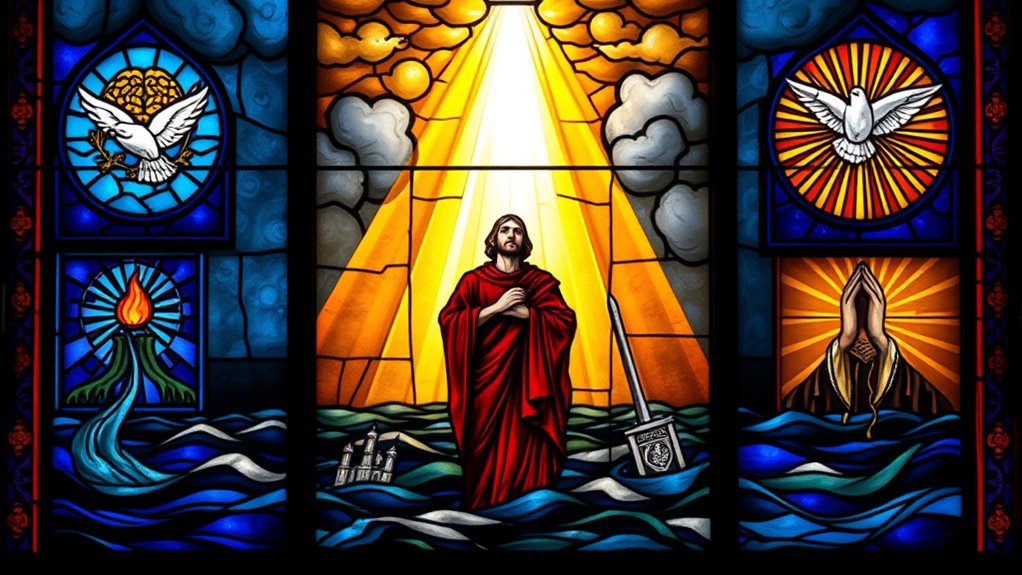
The Bible treats the mind as central to spiritual life, not peripheral to it. Hebrew and Greek terms — including *leb*, *nous*, and *dianoia* — describe inner reasoning, orientation, and understanding. Matthew 22:37 commands loving God with heart, soul, and mind. Romans 12:2 calls for ongoing mental renewal. Scripture also frames the mind as a battlefield, where thoughts are either surrendered to Christ or shaped by opposing forces. Each of these dimensions rewards closer examination.
Key Takeaways
- The Bible commands believers to love God with their mind, treating intellectual devotion as a core spiritual obligation (Matthew 22:37).
- Scripture places the mind at the center of spiritual conflict, urging believers to take every thought captive to Christ (2 Corinthians 10:5).
- Romans 12:2 calls for ongoing mental renewal, transforming thinking patterns away from cultural conformity toward Christlike perspective.
- A mind set on the Spirit produces life and peace, while a mind set on the flesh produces death (Romans 8:6).
- Isaiah 26:3 promises complete, absolute peace—”shalom shalom”—to those whose minds remain steadfastly fixed on God.
What Does the Bible Mean by “the Mind”?

When the Bible speaks of “the mind,” it does not use the term with the scientific precision modern readers might expect. The International Standard Bible Encyclopedia acknowledges this directly. Biblical writers drew from several overlapping terms, each capturing a different dimension of human thought and inner life.
The Bible’s language for “the mind” resists modern precision, drawing instead from rich, overlapping terms.
The Hebrew word *leb*, typically translated “heart,” frequently carries the meaning of “mind” in the Old Testament. In the New Testament, Greek terms extend this further.
*Nous* denotes understanding and reasoning. *Dianoia* describes reflective, conscious perception. *Kardia*, meaning “heart,” sometimes refers to the inner self in ways that parallel the mind.
Together, these terms present the mind as the seat of affection, moral decision-making, intention, and spiritual discernment — a unified inner life rather than a single isolated faculty. The Greek word *phroneo*, often translated “mind,” emphasizes expressed perspective and mental orientation rather than intellect alone.
The English word “mind” itself carries a deep etymological root, as its primary sense describes extending or inclining eagerly toward an object, suggesting that the mind is fundamentally active and forward-reaching by nature. A significant portion of the Old Testament was originally written in Hebrew, reflecting the linguistic context in which many of these terms developed.
Why God Commands You to Love Him With Your Mind

Among the most searching commands in all of Scripture is found in Matthew 22:37, where Jesus instructs his followers to love God with all their heart, soul, and mind.
Mark 12:30 extends the list to include strength, suggesting that no faculty is excluded from this obligation.
Thayer’s Greek Lexicon identifies the Greek word *dianoia*, translated “mind,” as the faculty of understanding and reasoning.
Loving God with the mind, then, means directing one’s full intellectual capacity toward knowing him.
Romans 12:2 reinforces this by commanding believers to avoid conforming to worldly patterns through the renewal of the mind.
Philippians 2:5 adds that believers are to adopt the mindset of Christ himself.
Thinking and loving, Scripture suggests, are never truly separate activities.
The question about the greatest commandment was posed by a Pharisee, and Jesus gave his answer as an authoritative declaration that drew directly from the foundational creed of Israel in Deuteronomy 6:4–5.
2 Corinthians 10:5 calls believers to destroy arguments raised against the knowledge of God, showing that intellectual engagement is itself an act of obedience.
Within the Christian tradition this intellectual devotion reflects belief in the unity of the divine persons, affirming that Jesus as the Son of God participates fully in the one divine essence.
Why the Bible Calls the Mind a Spiritual Battlefield

Scripture places the mind at the center of spiritual conflict, not on the margins of it. Romans 8:6-7 explains that a flesh-governed mind produces death and hostility toward God, while a Spirit-governed mind produces life and peace. The difference between those two outcomes begins with thought.
According to 2 Corinthians 10:5, believers are instructed to take every thought captive to the obedience of Christ. This suggests that thoughts are not neutral ground. The weapons used in this conflict are described as mighty in God for pulling down strongholds that oppose both God and believers.
Satan, the Bible indicates, works through deception and lies planted directly within human thinking. Regular practices like daily Bible reading and prayer help guard the mind against such deception by strengthening discernment and obedience through discipline. Ephesians 6:16-17 describes spiritual armor specifically designed to defend the mind.
Romans 12:2 frames transformation as something that starts with mental renewal. The battlefield, Scripture consistently suggests, is largely internal. Ephesians 6:12 makes clear that this struggle is not against flesh and blood but against cosmic powers and spiritual forces of evil operating in unseen realms.
How God Renews and Transforms the Believer’s Mind

God uses Scripture as the primary instrument, prompting believers to read, memorize, and meditate on His Word daily. The Holy Spirit works internally, reshaping thinking patterns so that believers increasingly align with Christ’s perspective rather than cultural defaults.
Prayer invites the Spirit to guide the thought life, while church fellowship reinforces that internal work. Practically, believers identify distorted beliefs, replace them with specific scriptural truths, and guard against inputs that pull thinking backward. Reading aloud and multiple readings can deepen understanding and reveal new insights, especially when following a consistent reading plan.
The result, Romans 12:2 suggests, is a person capable of discerning God’s will clearly and living with genuine, quiet purpose. The fallen mind carries a deep hostility toward the absolute supremacy of God, resisting the truth that He is infinitely more worthy of praise than anything a person might achieve or become.
Renewal is not a single moment of decision but an ongoing continual process, as Paul’s language in Romans 12:2 emphasizes transformation that unfolds progressively through the Spirit’s patient work of exposing lies and teaching truth again.
How Fixing Your Mind on God Produces Perfect Peace

Renewing the mind, as Romans 12:2 describes, sets the stage for a deeper outcome that Isaiah 26:3 names directly: perfect peace.
That verse connects peace to a mind kept steadfast on God rather than on surrounding circumstances.
The term “mind” in Scripture includes thoughts, desires, and one’s overall mental posture.
Romans 8:6 reinforces this, contrasting a mind set on the flesh, which produces death, with one set on the Spirit, which produces life and peace.
Practically, this focus develops through prayer, Scripture reading, solitude, and gratitude.
Turning worry into prayer immediately redirects anxious thoughts toward God’s promises.
Trust functions as the foundation holding this posture in place.
When attention stays fixed on God’s faithfulness, internal stability follows naturally, even when outcomes remain uncertain.
Peter’s experience walking on water illustrates what happens when focus shifts away from God, as sinking began immediately when he turned his attention to the stormy wind and waves rather than to Jesus.
The Hebrew behind “perfect peace” is shalom shalom, a deliberate repetition signaling completeness and absolute wholeness rather than a partial or circumstantial calm.
Ancient observations like lunar eclipses and the Earth’s roundness in historical writings show how careful interpretation of texts can align scripture with factual understandings.