

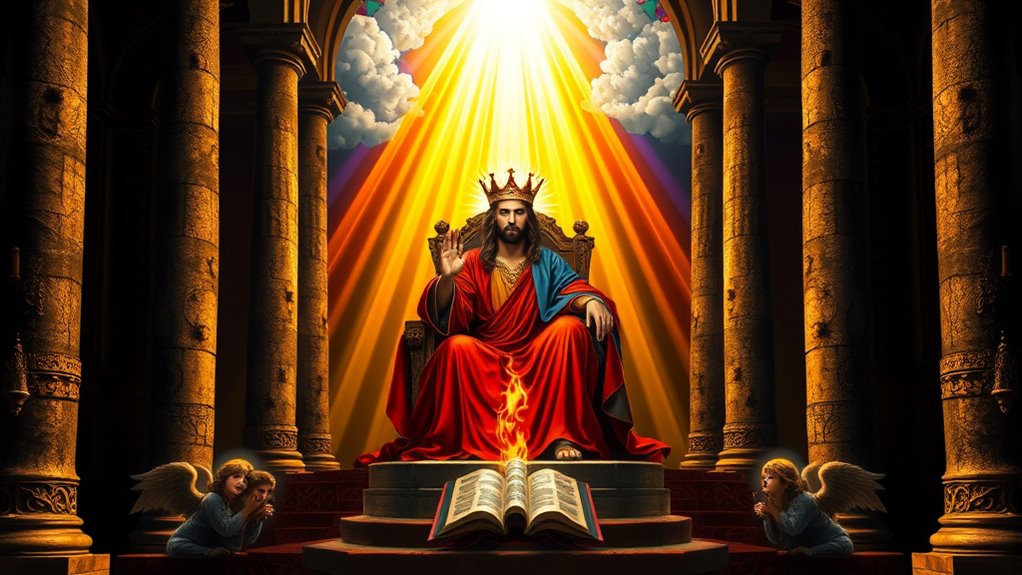
The Davidic Covenant is a divine promise recorded in 2 Samuel 7, where God told King David that a descendant from his lineage would rule an eternal kingdom. Psalms 89 and 132 confirm this as a formal testament, with “forever” language signaling permanence beyond any single reign. That promise survived exile, political collapse, and centuries of uncertainty, and the New Testament presents Jesus as its fulfillment through lineage, resurrection, and royal authority — a connection worth tracing carefully.
What Is the Davidic Covenant, Exactly?
At the heart of the Old covenant’s royal tradition stands a specific promise God made to King David, recorded in 2 Samuel 7 and later echoed in 1 Chronicles 17. God promised to establish David’s house, throne, and kingdom as enduring institutions.
Importantly, the narrative reverses expectations: David wanted to build God a house, but God instead promised to build David one. Here, “house” means dynasty, not a physical structure.
Psalms 89 and 132 later confirm this promise as a formal covenant, grounded in divine faithfulness and framed around permanence, using repeated “forever” language throughout. This covenant is widely understood as unconditional and gracious, meaning its fulfillment rests entirely on God’s faithfulness rather than David’s or his descendants’ obedience.
The covenant also carries profound prophetic significance, as God promised that the Messiah would come from David’s lineage, connecting this ancient royal promise directly to the person and work of Jesus Christ in the New Testament. A renewed emphasis on Godly discipline and spiritual formation in the Old Testament context helps explain how covenant promises shaped Israel’s life and hope.
What Did God Actually Promise David?
Having established the Davidic covenant as a formal divine commitment, it helps to look closely at what God actually said to David in 2 Samuel 7. God made five specific promises: a great name among nations, a secure place for Israel, an offspring from David’s own lineage, an established kingdom for that offspring, and a throne made permanent. The words “house,” “kingdom,” and “throne” each carried distinct meaning — dynasty, ongoing rule, and legitimate authority. Importantly, God used “forever” language repeatedly, signaling something beyond a single reign. This enduring quality is precisely what later drew prophets and readers toward messianic interpretation. The covenant connects back to Israel’s broader covenantal promises to the patriarchs, reinforcing continuity with Abraham, Isaac, and Jacob. The covenant also included disciplinary provisions for sin, making clear that while individual descendants could face consequences for wrongdoing, the dynasty itself would never be revoked the way Saul’s kingship had been. David himself interpreted these promises as instruction for mankind, using the Hebrew word אָדָם in 2 Samuel 7:19 to signal that the covenant carried significance far beyond Israel alone.
Does the Davidic Covenant Come With Conditions?
On the surface, the Davidic covenant looks straightforward: God makes a promise, and it stands. But 2 Samuel 7:14 introduces discipline language, noting that disobedient kings would face correction. First Kings 2:4 links dynasty stability to the obedience of David’s sons.
Scholars generally distinguish between these individual-reign conditions and the covenant’s permanent guarantee. Most theological frameworks describe the conditions as governing participation in blessings, not the covenant’s existence. Psalm 89 and 2 Chronicles 6 confirm the promise remains intact despite human failure.
The dominant conclusion: obedience shapes how the covenant is experienced, but not whether it ultimately survives. Jeremiah 33:20–21 compares the covenant’s permanence to the unbreakable day/night cycle, underscoring that its fulfillment rests entirely on God’s faithfulness rather than human compliance. Christians are called to balance faithful correction and mercy when discussing covenant faithfulness in community grace and truth.
How Does Jesus Fulfill the Davidic Covenant?
The New Testament does not treat the Davidic covenant as a promise left behind in Israel’s past; it presents Jesus as the one in whom those promises land. Matthew 1:1 calls him “son of David,” and Romans 1:3–4 confirms his Davidic descent while tying his messianic identity to the resurrection.
Acts 2:29–36 presents David as speaking prophetically about Jesus’ exaltation. Luke 1:33 states his kingdom “will have no end.” The fulfillment moves through lineage, resurrection, and royal authority—covering what 2 Samuel 7 originally promised: an enduring house, kingdom, and throne held by David’s descendant. Revelation’s visions likewise contrast earthly power with divine kingship, reminding readers of ultimate vindication.
The Davidic Covenant carries no conditional stipulations, meaning its fulfillment rests entirely on divine faithfulness alone, not on human obedience or national faithfulness.
Isaiah 9:6–7 attributes divine titles and eternal rule to the child of David, with the prophetic vision that God himself would come as king to ensure covenant fulfillment when no human descendant could meet its conditions.
Why This Covenant Still Fuels Messianic Hope Today
Across more than three thousand years of religious history, the Davidic covenant has continued to function as a live framework for messianic hope rather than a closed chapter in Israel’s past.
The promise made in 2 Samuel 7 introduced language of permanence — throne, house, kingdom, forever — that outlasted every political collapse, including the Babylonian exile.
Jewish and Christian communities alike have returned to this covenant when interpreting their present circumstances and future expectations. Its durability rests not on the success of any single king, but on the unresolved gap between an ideal promise and an incomplete history. The covenant’s ultimate resolution is found in Jesus Christ, whom the New Testament identifies as Son of David and the fulfillment of God’s eternal kingdom promise.
Prophets writing both before and after the fall of Jerusalem — including Isaiah, Jeremiah, Ezekiel, and Zechariah — continued to anticipate a future righteous Davidic king who would rule with justice and righteousness, demonstrating that the covenant’s force was never considered broken even amid catastrophic national loss.
Early church responses and interpretive traditions helped move communities toward a monarchic continuity reading that linked royal promises to enduring messianic expectation.