The Bible emerged from the collaborative efforts of at least forty authors writing across fifteen centuries, from approximately 1400 B.C. to 100 A.D. These writers, including Moses, David, Paul, and John, composed texts in Hebrew, Aramaic, and Greek, drawing from eyewitness accounts, historical records, and oral traditions. Archaeological discoveries have confirmed over 100 biblical characters, while external sources like Josephus and Tacitus provide independent historical verification. This remarkable preservation offers deeper insights into ancient faith and history.
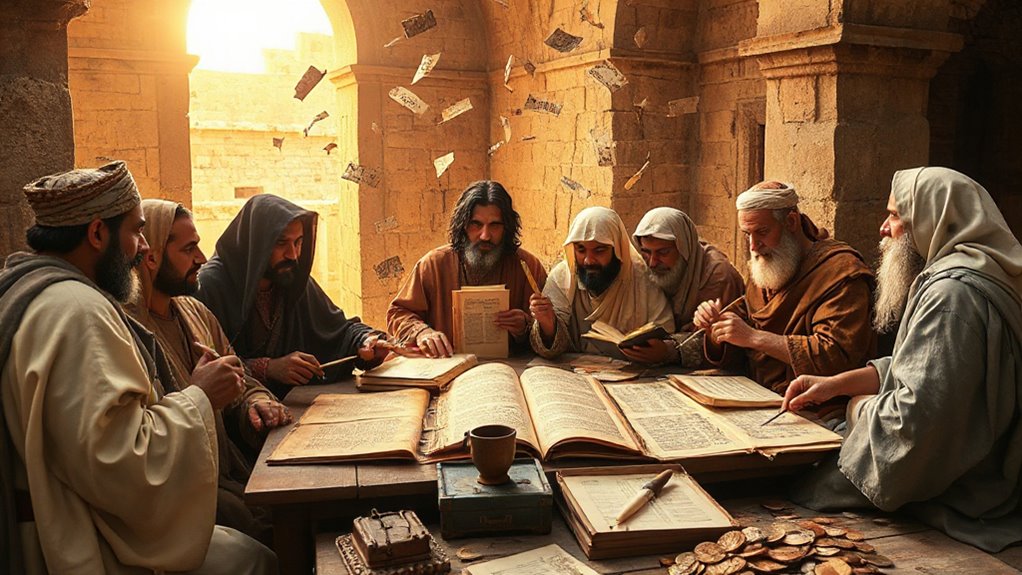
While many books emerge from a single author’s mind, the Bible represents an extraordinary literary collaboration spanning more than fifteen centuries and involving at least forty different writers across diverse cultures and languages. Scholars date many New Testament writings to the mid-1st century CE. This collection of sixty-six books, composed from approximately 1400 B.C. to around 100 A.D., brings together the writings of historical figures including Moses, David, Samuel, Jeremiah, Daniel, and New Testament apostles like Paul and John.
The Bible stands as history’s most remarkable literary collaboration, uniting forty writers across fifteen centuries into one unified collection.
The authors wrote in Hebrew, Aramaic, and Greek, reflecting the diverse regions and time periods in which they lived. Many Old Testament books stem from preserved historical records and eyewitness testimony, while Chronicles and Ezra-Nehemiah represent compilations of earlier documents synthesized by later editors and scribes.
The New Testament emerged within a century of Jesus’ crucifixion, anchored in eyewitness accounts and oral traditions that were carefully preserved in written form. Luke explicitly documented his methodology of gathering eyewitness testimony to provide an accurate historical account.
Archaeological discoveries continue to corroborate biblical narratives. The Caesarea inscription confirms Pontius Pilate’s existence, while over one hundred biblical characters have independent historical evidence supporting their timeframe and roles. External sources, including writings by Josephus and Tacitus, mention Jesus and early Christians, lending credibility to the biblical historical framework.
Traditional religious understanding views the Bible as divinely inspired, with human authors conveying God’s message through their distinct writing styles and perspectives. Early Christian communities accepted New Testament documents based on apostolic authorship or close association with apostles, combined with their alignment with established doctrinal truth.
The theological consistency across diverse authors and centuries is often cited as evidence of unified divine origin.
Modern scholars acknowledge that while many biblical accounts align well with historical evidence, other portions may reflect theological traditions or literary construction rather than strict historical reporting. Critical scholars recognize that the Bible represents a collaborative work that was redacted and edited over centuries, affecting its overall consistency. The authorship of Hebrews remains debated, with suggestions including Paul, Barnabas, Apollos, Luke, or Priscilla and Aquila.
Despite ongoing scholarly discussions about specific details, the Bible’s composition represents a remarkable preservation of ancient texts, historical records, and religious traditions that continue to influence billions of people worldwide through its enduring message and historical significance.
Frequently Asked Questions
How Do We Know Which Books Should Be Included in the Bible?
Early Christians determined biblical inclusion through several practical criteria over four centuries. Books needed apostolic origin or connection, widespread acceptance across Christian communities, consistency with emerging orthodox doctrine, and regular liturgical use.
Church councils like Hippo in 393 CE formalized these decisions rather than creating them. Different Christian traditions ultimately recognized slightly varying canons, reflecting ongoing theological development and regional ecclesiastical practices.
Why Are There Different Versions of the Bible Across Denominations?
Different Bible versions exist across denominations due to translation philosophy differences, theological preferences, and historical developments.
Protestant churches often favor the King James Version or New International Version, while Catholic Bibles include additional deuterocanonical books and use translations like the New American Bible.
Translation approaches range from literal word-for-word accuracy to thought-for-thought readability, with denominations selecting versions that align with their doctrinal emphases and congregational needs.
What Role Did Politics Play in Determining Biblical Canon?
Politics markedly influenced biblical canon formation through imperial authority and church hierarchy. Emperor Constantine’s fourth-century conversion elevated Christianity’s status, aligning scripture selection with Roman political structures. Greek concepts of authority shaped canonical terminology and standards.
Rising church leadership mirrored imperial government models, consolidating power through doctrinal uniformity. Political affiliations and ideological biases affected inclusion decisions, often marginalizing minority voices in favor of orthodox texts that supported centralized authority.
How Accurate Are Modern Bible Translations Compared to Original Texts?
Modern Bible translations achieve remarkable accuracy compared to original texts, with scholars estimating New Testament textual uncertainties at only 0.1%. The Dead Sea Scrolls confirm exceptional Old Testament preservation over millennia.
Translations like the NASB and ESV prioritize literal accuracy, while others like the NLT emphasize readability. Modern translators utilize vast manuscript collections and critical editions, making contemporary Bibles more reliable than historical versions despite inevitable linguistic differences.
Were Any Important Religious Texts Deliberately Excluded From the Bible?
Yes, numerous important religious texts were deliberately excluded from the Bible. The Book of Enoch, widely read in early Christianity, was omitted due to controversial content and lack of apostolic authorship.
The Gospel of Thomas was rejected for promoting secret wisdom, while the Gospel of Mary was excluded despite highlighting Mary Magdalene’s significance.
Church leaders prioritized texts with apostolic connections and orthodox theological consistency when finalizing the biblical canon.