
Nearly 2 million Poles brave January’s freezing temperatures each year to participate in the Three Kings Procession, a public celebration of Epiphany that has grown from a single Warsaw parade in 2009 to 941 locations nationwide. Participants wear paper crowns and follow costumed biblical figures through city streets, combining Catholic liturgy with folk tradition in what has become one of Europe’s largest religious gatherings. The event transforms communities into mobile Nativity scenes, offering families an accessible way to experience biblical stories while fostering shared cultural identity across generations through this distinctive winter ritual.
Each January, as winter settles over Poland’s cities and towns, nearly two million people gather in the streets wearing paper crowns and carrying songbooks, transforming central squares and historic boulevards into open-air stages for one of Europe’s largest public religious celebrations. The celebration’s public scale echoes traditions of communal religious observance and Old Testament practices linking worship with communal support. The Orszak Trzech Króli, or Three Kings Procession, has grown from a single Warsaw parade in 2009 to span 941 locations across Poland and abroad, drawing about 50,000 participants in Warsaw alone.
From a single Warsaw parade to 941 locations, Poland’s Three Kings Procession has become Europe’s largest public Epiphany celebration.
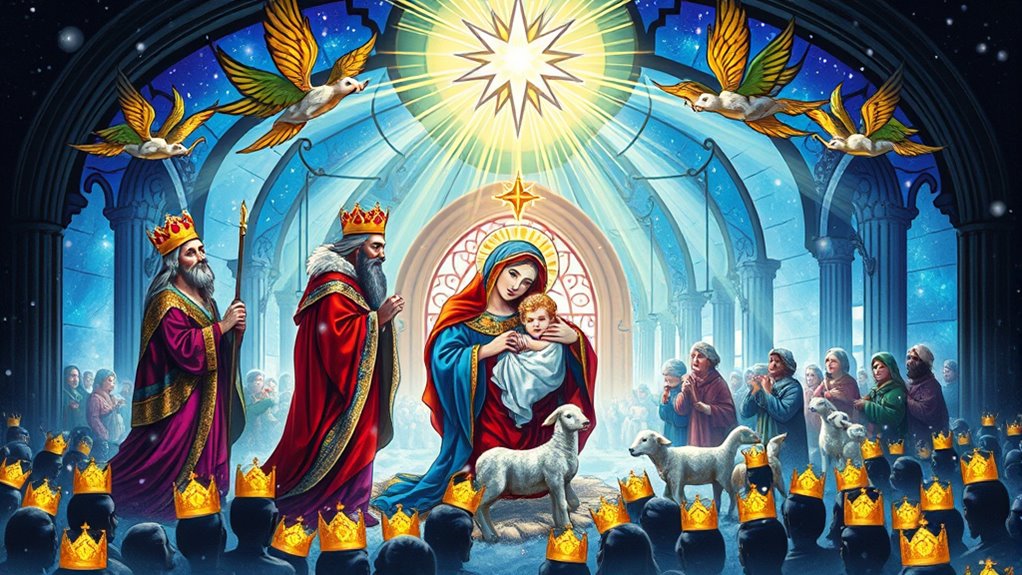
The event commemorates Epiphany on January 6, when Christians mark the manifestation of Christ to the nations through the visit of the Magi. The biblical figures Caspar, Melchior, and Balthazar symbolically represent different continents and peoples honoring the newborn Jesus.
Polish processions dramatize this narrative through costumed participants portraying the three kings, angels, shepherds, Roman soldiers, and the Holy Family, creating mobile Nativity scenes that wind through city centers.
The contemporary format originated in 2008 when a Warsaw teacher, theater director, and school principal decided to move a school Nativity play into public streets. Early processions in Warsaw and Toruń were held on Sundays near Epiphany before the feast day became a national public holiday in 2011, which accelerated the tradition’s nationwide spread.
Organizers drew partial inspiration from Epiphany parades in Spain and Mexico while blending local customs. The first documented procession occurred in Barcelona, Spain in 1855, though it was held on January 5 rather than January 6.
The Fundacja Orszak Trzech Króli coordinates events in partnership with parishes, schools, and municipalities. Logistics involve distributing roughly 600,000 paper crowns, 150,000 songbooks of Christmas carols, and 200,000 stickers in a single edition.
In Kraków and other cities, separate processions representing the three kings follow stars and converge at central Nativity scenes to offer symbolic gifts.
Beyond spectacle, the processions serve as public catechesis, making biblical themes accessible to families and children. Events often incorporate Holy Mass, blessings, communal carol singing, and charity collections for children and the poor.
The combination of Catholic liturgy and folk customs creates a shared winter ritual that merges religious instruction with cultural celebration, drawing participants despite cold weather to witness and enact a centuries-old story. This year’s slogan, “Rejoice in Hope,” aligns with the Church’s jubilee year theme and draws from a 17th-century Polish Christmas carol.