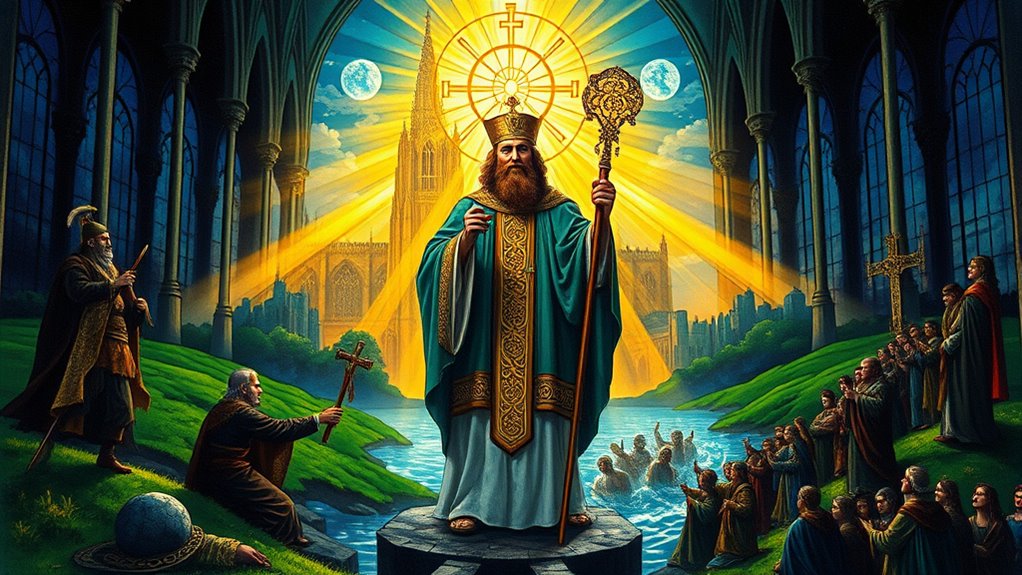
Saint Patrick was born around AD 390 in Roman Britain, rejected Christianity as a teenager, then was captured by Irish raiders in 403 and enslaved as a shepherd for six years. His isolation sparked a profound spiritual transformation that turned superficial faith into deep conviction. After escaping via a 200-mile journey guided by a dream, he spent twenty-one years preparing for ministry, then returned to Ireland around 432 as an ordained bishop. He baptized tens of thousands, built hundreds of churches, and integrated Christianity with Celtic culture before his death around 461, establishing foundations that shaped Ireland’s religious identity for centuries ahead.
From Privileged Roman Youth to Enslaved Irish Shepherd
Patrick’s early life unfolded in the relative comfort of Roman Britain, where he was born around AD 390 to a middle-class Christian family in a coastal village. His father served as deacon and his grandfather as pastor, positioning the family within both religious and social hierarchies. Despite this background, Patrick dismissed Christianity at sixteen, living as a rebellious teenager.
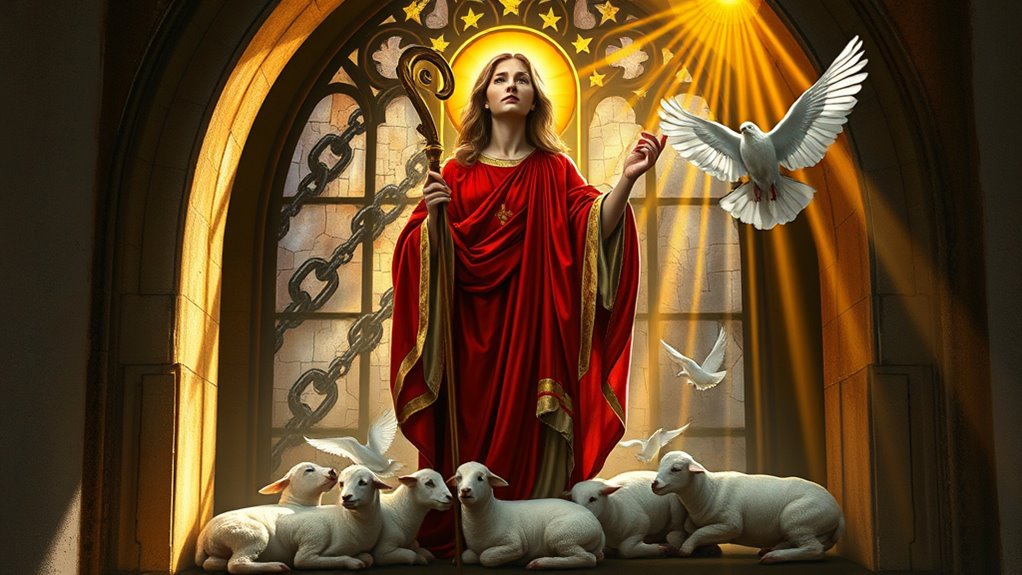
In 403 CE, Irish raiders abruptly ended his privileged existence, capturing him alongside thousands of others. Sold to chieftain Miliucc in northwest Ireland, Patrick became a shepherd in the Antrim hills, enduring isolation, hunger, and exposure in the unforgiving wilderness. The story of Patrick’s life reflects themes of covenantal promises and calling that echo broader narratives about chosen communities and their roles in history.
How Six Years in Chains Forged Patrick’s Faith
The mountains of Antrim became an unexpected classroom where forced labor and extreme isolation slowly rebuilt a young man’s understanding of God. Patrick’s nominal Christian upbringing had provided theoretical knowledge but little depth. Now, tending sheep across remote hillsides day after day, he turned to prayer with increasing frequency.
Solitude amplified both his suffering and his spiritual reflection. Rather than succumbing to bitterness over enslavement, he chose devotion. Six years of hardship transformed superficial belief into unshakeable conviction. This period forged the resilient faith that would later enable his return as Ireland’s relentless missionary, launching a Gospel movement across Europe. In those years he came to embrace a profound sense of life’s value and compassion for the suffering, grounded in God’s compassion and a commitment to care for others.
Patrick’s Daring 200-Mile Escape Back to Britain
After six years of enslavement in the mountains of Antrim, a vivid dream interrupted Patrick’s nightly rest with unexpected instruction. A voice announced a ship awaited him two hundred miles distant, though he had never traveled that route.
Despite facing execution if captured, Patrick departed his inland post and walked alone through unfamiliar territory toward the coast. No one stopped or questioned him during the multi-day trek.
Upon reaching the bay, he found the vessel exactly as foretold and convinced the sailors to grant him passage. His family in Britain welcomed him home like a son returned from the dead. Many later compared his experience to other instances of biblical dreams where God used visions to guide and preserve his servants.
Twenty Years of Preparation: From Escaped Slave to Ordained Bishop
Twenty-one years separated Patrick’s escape from his eventual return to Ireland as a bishop. After reuniting with family in Britain, he devoted himself to studies and spiritual formation.
Though grown in a Christian household, his faith had been distant before captivity. He felt unqualified due to limited education, as his own writings reveal. Opposition arose when he sought ordination, critics citing his irregular preparation. Yet his years in slavery provided unexpected advantages:
- Fluency in the Irish language
- Deep knowledge of Irish customs
- Cultural understanding of the people
- Spiritual resilience forged through hardship
Bishop Germanus of Auxerre ordained him priest, and Pope Celestine I consecrated him Bishop of Ireland around 431-432. His story illustrates how spiritual formation and personal hardship can prepare someone for a life of ministry.
Why Patrick Returned to Ireland to Convert His Former Captors
Patrick’s decision to return to Ireland stemmed from a spiritual calling he received years after his escape from slavery. In a vision, he heard the voices of pagan Irish children reaching out to him, igniting his determination to convert them.
His motivation was explicitly theological: Patrick cited the Great Commission as his sacred duty to carry the gospel to the ends of the earth. The former captive viewed his years of enslavement as God’s instrument for preparing him, providing intimate knowledge of Irish language and druidic beliefs essential for his missionary work among those who had once held him captive. He also engaged with contemporary biblical debates about sexuality and relationships, placing particular emphasis on lesbian relationships as he formulated pastoral responses in his ministry.
How Patrick Transformed Ireland Into Christianity’s European Stronghold
Upon his return to Ireland as bishop, Patrick faced the formidable task of converting an island dominated by druidic power and tribal warfare.
Patrick’s mission required courage—confronting an Ireland steeped in druidic tradition and torn by constant tribal conflict.
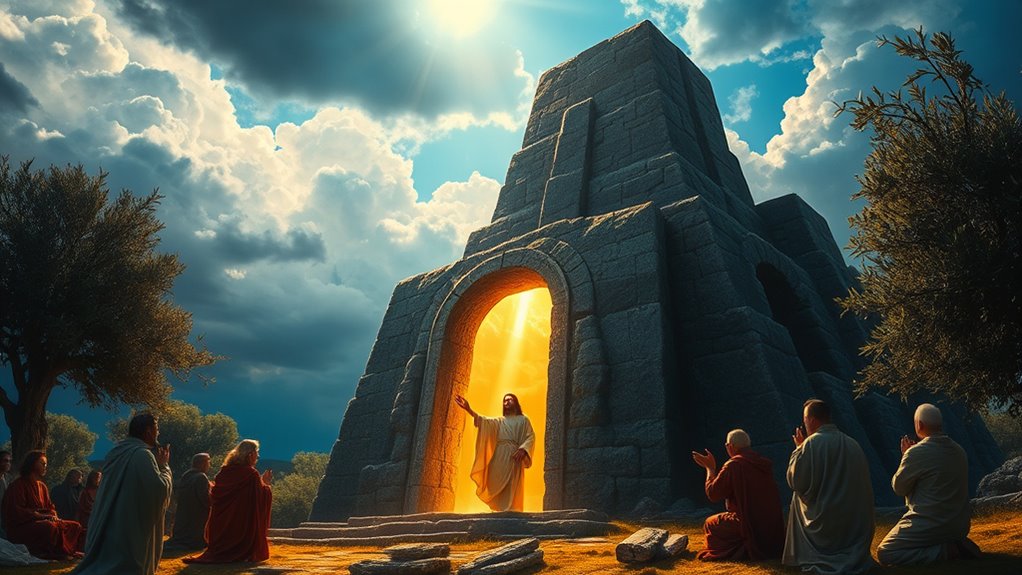
In spring 433, he confronted High King Laoghaire at Tara, where he triumphed over druids in a contest of spiritual power versus magic. Though Laoghaire never converted, he permitted gospel preaching and guaranteed Patrick’s safety across Ireland.
Patrick’s transformative accomplishments included:
- Baptizing tens of thousands and building hundreds of churches staffed with Irish clergy
- Founding Ireland’s first cathedral at Armagh in 444, establishing it as Christianity’s administrative center
- Training native priests who incorporated Christianity into Celtic tribal customs
- Dislodging paganism entirely by his death around 461
Patrick’s work exemplified Biblical principles of compassion and practical service as he cared for and taught communities across Ireland, emphasizing compassion and service in both word and deed.