




Scholars have not settled on April 3, AD 33 as a confirmed date for the crucifixion. Humphreys and Waddington identified it as an astronomical match, supported by lunar eclipse data and seismic records from Dead Sea sediment cores. However, a majority of modern scholars, citing Luke 3:1, Phlegon, and Josephus, favor AD 30 instead. Both dates remain historically credible. The full weight of textual, astronomical, and calendar evidence tells a more layered story.
What Scholars Actually Believe About the Crucifixion Date
Scholars have narrowed the crucifixion of Jesus to one of two likely years: AD 30 or AD 33. Most historians place the event within AD 26–36, during Pontius Pilate‘s governance of Judea. Astronomical research further limits possibilities to AD 27, 30, 33, or 34.
While the majority of modern scholars favor AD 30, AD 33 remains the traditional date supported by the greatest number of historical Christian scholars. Protestants, Catholics, and secular historians largely agree on these two candidates. No significant denominational divide separates them.
The precise day, however, remains debated, with Thursday, Friday, and Wednesday each having scholarly supporters. Scholarly consensus places the crucifixion on Nisan 14 or 15, corresponding to one of these proposed days of the week.
John’s Gospel references attendance at at least three Passovers during Jesus’s public ministry, a detail that bears significantly on which year is most plausible. This three Passover minimum makes a crucifixion date of AD 30 difficult to maintain if Jesus’s ministry began in late AD 28 or AD 29. Recent scholarly work also emphasizes the role of astronomical calculations in narrowing the possible years.
The Astronomical Case for April 3, AD 33
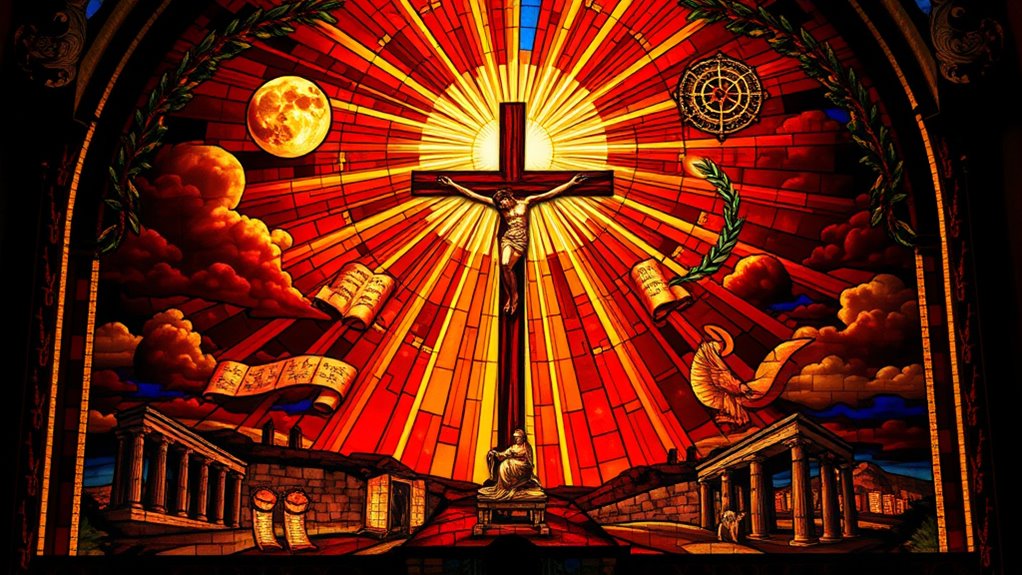
Several lines of scientific evidence converge on a single date: Friday, April 3, AD 33. Oxford researchers Colin Humphreys and W. Graeme Waddington reconstructed the first-century Jewish calendar using astronomical calculations, pinpointing that date as a historically plausible Passover crucifixion. NASA models confirmed a lunar eclipse visible in Jerusalem that evening, causing the moon to appear blood red, matching biblical descriptions in Acts 2:20 and Joel 2:31. The eclipse occurred roughly three hours after the proposed time of death. Dead Sea sediment cores further revealed dust storm evidence between 30 and 33 AD, supporting accounts of unusual atmospheric darkness. Their findings were formally published in Nature in December 1983, contributing their astronomical methodology to the broader scholarly record. According to eclipse timing data, the moon rose in full umbral eclipse for approximately the first ten minutes after moonrise, with atmospheric refraction enhancing the blood-red coloration visible to observers in Jerusalem. This alignment of data also resonates with broader biblical themes of judgment and renewal that scholars often note when interpreting end-times imagery.
Why AD 30 Remains Credible Despite the Evidence
Despite the compelling astronomical case for AD 33, three independent lines of evidence keep AD 30 alive as a serious contender.
First, Luke 3:1 anchors Jesus’ baptism to Tiberius’ fifteenth year. If his co-regency began AD 11, that year falls in AD 26, allowing a full three-and-a-half-year ministry ending at Passover AD 30.
Second, historian Phlegon, cited by Origen, records midday darkness during Tiberius’ eighteenth year, matching AD 30 precisely.
Third, BYU Studies, Josephus, and Clement of Alexandria independently support an AD 30 crucifixion.
Majority scholarly opinion still favors AD 30, making it difficult to dismiss entirely. The Gregorian-Hebrew solar calendar identifies the crucifixion as Friday, April 5, Nisan 14, 30 AD, lending additional structural support to this date.
A survey of one hundred scholars conducted by Blinzler in 1969 found that fifty-three favored AD 30, while only twenty-four supported AD 33, confirming that the weight of expert opinion has long leaned toward the earlier date.
This discussion should also be read in light of how Scripture treats Israel and Iran, since biblical chronology and regional histories inform interpretive frameworks.
Why John’s Passover Count Conflicts With the Synoptic Gospels
One of the more puzzling features of the Gospel accounts is that John and the Synoptics—Matthew, Mark, and Luke—appear to place the Passover on different days. The Synoptics identify the Last Supper as the Passover meal on 15 Nisan, with crucifixion following on Friday.
John, however, describes Friday as the “Preparation of Passover,” suggesting Jesus died while lambs were still being slaughtered. John 18:28 reinforces this, noting Jewish leaders avoided defilement to eat Passover after the Last Supper.
Scholars propose two harmonizations: Jesus instituted a “New Passover” early, or different Jewish groups followed separate calendars entirely. Some scholars further argue that the term “Passover” was used interchangeably with Feast of Unleavened Bread, encompassing an extended festival period rather than a single evening meal. Harold Hoehner and others have documented that Galileans and Pharisees reckoned the day sunrise to sunrise, while Judeans and Sadducees reckoned it sunset to sunset, allowing Passover sacrifices to fall on two consecutive days. This debate also intersects with discussions about the Antichrist motif in Revelation and how symbolic calendars and liturgical timing were used in early Christian apologetics.
What the Strongest Evidence Actually Points To
The calendar dispute between John and the Synoptics, though unresolved, does not prevent historians from weighing the broader evidence for when exactly the crucifixion occurred.
Astronomical calculations narrow the viable years to AD 27, 30, 33, and 36. Most scholars favor AD 30; a significant minority supports AD 33. Humphreys and Waddington identified April 7, AD 33 as an exact astronomical match for Friday, Nisan 14. A Jefferson Williams geological study also linked a measurable seismic event to April 3, AD 33.
Neither date is certain, but both AD 30 and AD 33 remain credible, evidence-supported possibilities worth continued scholarly attention. The political context surrounding Sejanus’ execution in AD 31 has led some scholars, including Hoehner, to argue that Pilate’s passive behavior during the trial of Jesus better fits the post-Sejanus climate of AD 33.
Non-Christian ancient sources such as Josephus and Tacitus independently attest to the crucifixion of Jesus, lending external historical weight to the broader timeline scholars are working to refine. The crucifixion’s historicity is further confirmed by non-Christian ancient sources, making the question of its precise date a matter of calibrating evidence that no serious historian disputes. The discussion also intersects with Jesus’ relationship to Israel’s covenantal promises, which shaped first-century Jewish expectations about the Messiah.