


The Bible does not mention evolution, but Genesis 1 and 2 describe God creating all living things according to their kinds over six days. Christians interpret these passages differently: Young Earth Creationists read the days as literal 24-hour periods roughly 6,000 years ago, Old Earth Creationists view them as long epochs spanning billions of years, and Theistic Evolutionists believe God used evolutionary processes to create life. Each interpretation carries distinct implications for understanding human origins, the nature of sin, and Christ’s redemptive work, shaping how believers engage both Scripture and scientific evidence.
Key Takeaways
- The Bible does not directly address biological evolution, as Genesis focuses on God’s creative power rather than scientific mechanisms.
- Genesis describes God creating all life, with humanity uniquely made in God’s image, emphasizing divine purpose over process.
- Christians hold different views: Young Earth rejects evolution, Old Earth accepts age but not common ancestry, Theistic Evolution affirms both.
- Literal Genesis readings support doctrines of original sin and redemption, while evolution compatibility depends on how historically one interprets Genesis.
- Catholic teaching requires belief in creation ex nihilo and human monogenism, allowing flexibility on six-day interpretation and evolutionary processes.
The Genesis Creation Account: What It Says and What It Means

The opening chapters of Genesis present two complementary accounts of creation that have shaped theological understanding for millennia, though their relationship has sparked considerable scholarly discussion.
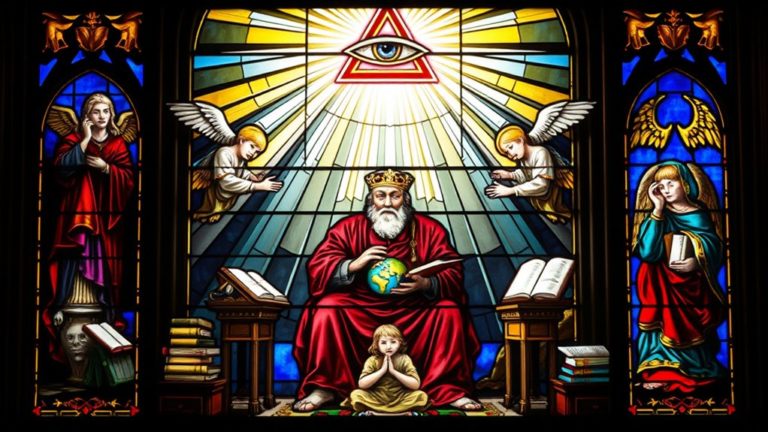
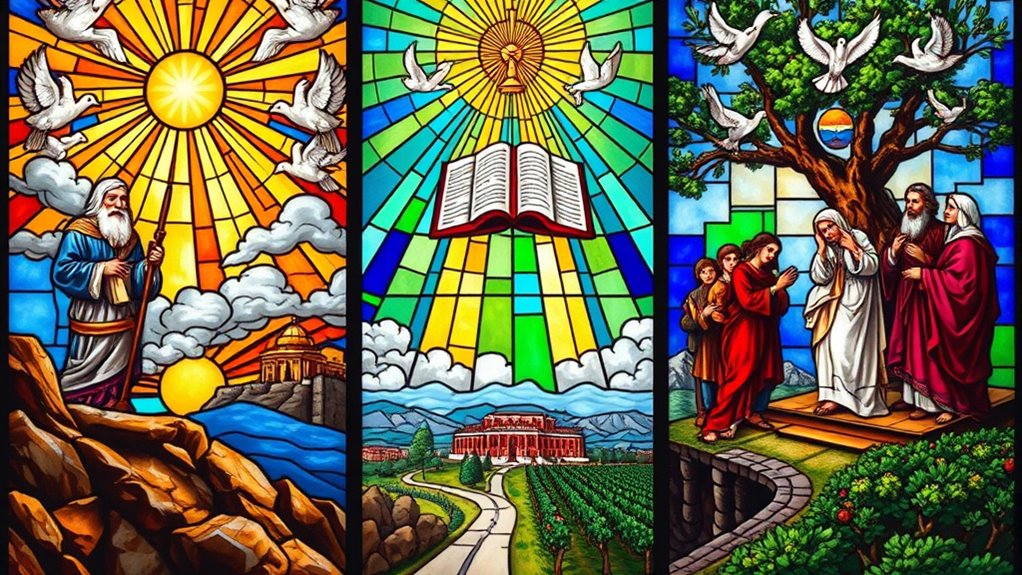
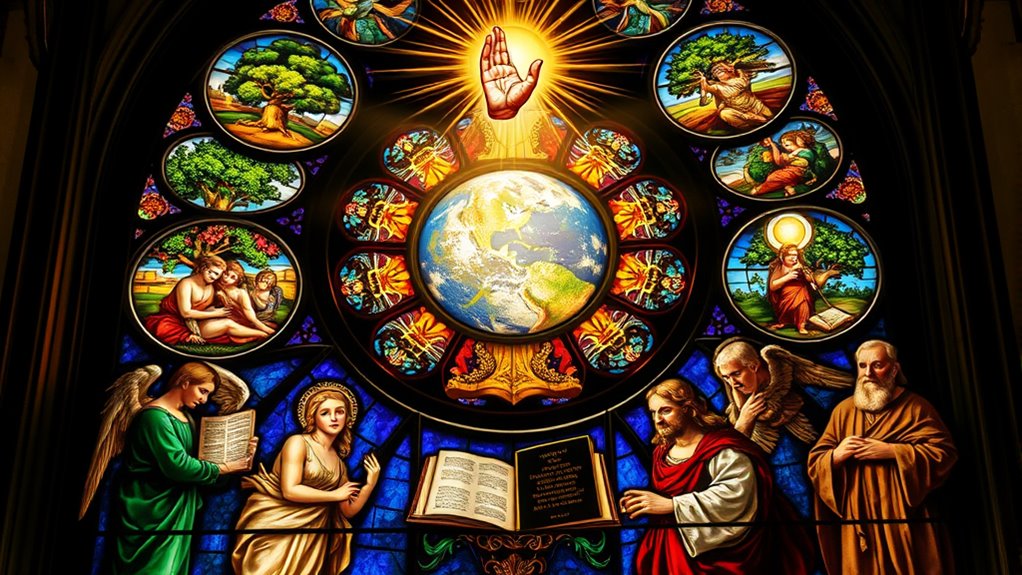
Genesis 1:1 declares “In the beginning, God created the heavens and the earth,” then describes six days of creation through divine speech, culminating with humanity made in God’s image.
Genesis 2:4 shifts focus to the sixth day, detailing how God formed man from dust, planted the Garden of Eden, and created woman from man’s rib.
Scholars note differences in divine names—Elohim versus YHWH Elohim—and narrative style, with the first account emphasizing transcendent power and the second highlighting intimate craftsmanship.
Rather than contradicting each other, these accounts offer panoramic and close-up perspectives on humanity’s origins and relationship with the Creator.
Scholars also place these texts within a long timeline of composition spanning many centuries, reflecting developments in Israel’s religious literature and context composition timeline.
Young Earth, Old Earth, and Theistic Evolution: Christian Views Compared

Understanding what Genesis says about creation naturally leads to the question of how Christians should interpret its meaning in light of modern scientific discoveries.
Young Earth Creationists hold that the universe was created in six literal days approximately 6,000 years ago, a position historically maintained by most Christian and Jewish traditions for millennia.
Old Earth Creationists accept scientific dating of 13.7 billion years for the universe and 4.6 billion for Earth, viewing Genesis days as long periods while rejecting common ancestry.
Theistic Evolutionists believe God used evolutionary processes to create life, accepting mainstream scientific consensus including common descent.
Each view carries distinct implications: Young Earth positions struggle with geological evidence, Old Earth models accept naturalistic timelines, and Theistic Evolution raises questions about Genesis historicity and God’s direct creative action.
Scholars note that biblical genealogies can be interpreted in ways that allow for longer timelines and partial genealogies which may extend the chronology beyond a strict 6,000-year reading.
Why Genesis Creation Interpretation Shapes Core Christian Doctrines

At the heart of Christian theology, how believers interpret Genesis creation accounts directly influences their understanding of human nature, sin, and redemption.
Those who read Genesis 1-3 as literal history affirm that God created a perfect world without death or suffering approximately 6,000 years ago over six 24-hour days. This view supports doctrines like the Imago Dei, original sin, and Christ’s redemptive work reversing Adam’s fall. Catholic teaching maintains creation ex nihilo and human monogenism regardless of day-length interpretation. Meanwhile, some Protestant and Orthodox traditions see the six “days” as long periods, following Augustine’s simultaneous creation model. Early Church Fathers varied widely, with Clement of Alexandria proposing dateless production. These interpretive differences shape whether believers prioritize Scripture or scientific consensus when explaining human origins. Jesus’ Jewish identity and first-century Jewish context also inform how the Gospels engage creation themes and covenantal language, reflecting Jewish traditions that shaped early Christian thought.