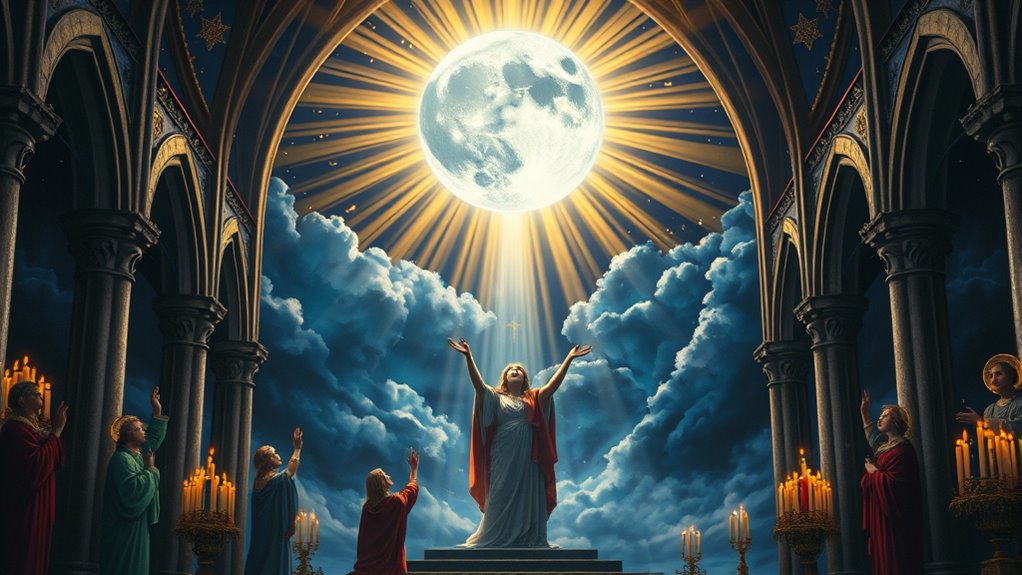
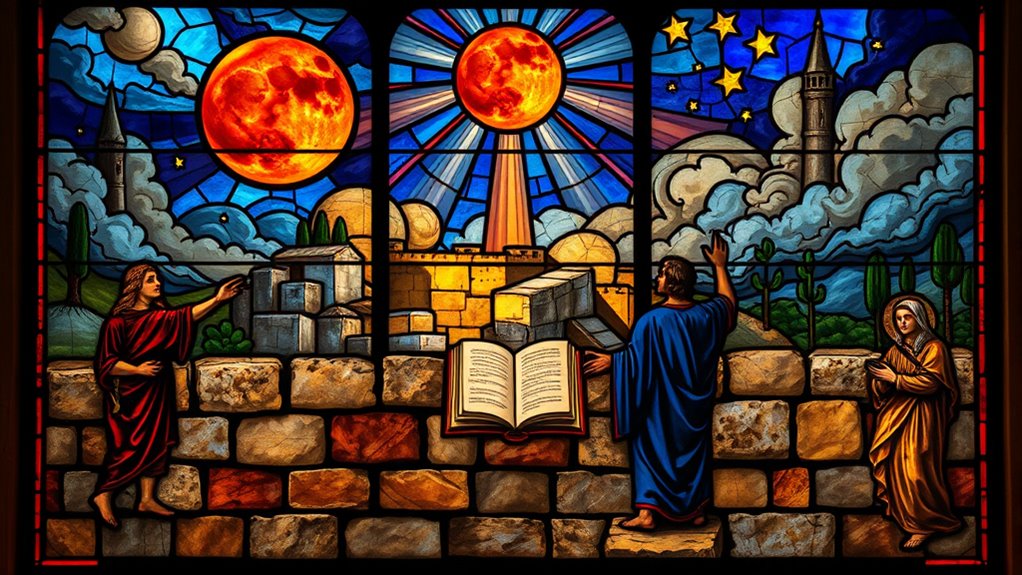
The Bible references blood moon imagery in Joel 2:31, Revelation 6:12, and Acts 2:20, each connecting a moon turned to blood with divine judgment and approaching prophetic events. Scripture embeds this imagery within broader sequences of signs, including darkened skies and earthquakes, rather than presenting it as an isolated event. Significantly, the phrase “blood moons” never appears in the King James Bible. Understanding the science, history, and theology behind this imagery reveals far more than the phrase itself suggests.
Key Takeaways
- The phrase “blood moons” never appears in the Bible; Scripture instead describes the moon turning to blood in Joel 2:31 and Revelation 6:12.
- Biblical blood moon imagery is embedded within broader sequences of signs, including darkened suns, earthquakes, and falling stars.
- Scripture suggests a prolonged supernatural phenomenon lasting approximately 18 months, contrasting sharply with brief natural lunar eclipses.
- Blood imagery in Scripture consistently symbolizes sacrifice, atonement, and divine justice rather than ordinary astronomical events.
- Treating isolated lunar eclipses or tetrads as standalone prophetic fulfillments lacks the required sequential prophetic grounding Scripture demands.
What Does the Bible Actually Say About Blood Moons?
Several key Bible passages form the foundation of what Scripture actually says about blood moons.
A handful of Scripture passages reveal what the Bible genuinely teaches about blood moons.
Joel 2:31 describes the moon turning to blood before the “great and terrible day of the Lord.” Revelation 6:12 echoes this, placing a blood-red moon alongside a darkened sun and a major earthquake following the sixth seal. Acts 2:20 repeats Joel’s prophecy directly, while Matthew 24:29 connects moon imagery to events after the tribulation.
Notably, the phrase “blood moons” never appears in the King James Bible.
The biblical event also differs from ordinary lunar eclipses, which last under two hours. Scripture instead points toward a prolonged, supernatural phenomenon lasting approximately 18 months, emphasizing miraculous cosmic disturbance rather than natural astronomical causes. NASA has documented that 142 lunar tetrads occurred between 1999 BCE and 3000 CE, of which only eight fall on Biblical Jewish feast days.
Throughout Scripture, blood symbolizes sacrifice and cleansing from unrighteousness, lending the blood moon imagery a deeper theological weight connected to themes of atonement and divine justice.
What Actually Causes a Lunar Eclipse to Look Like Blood?
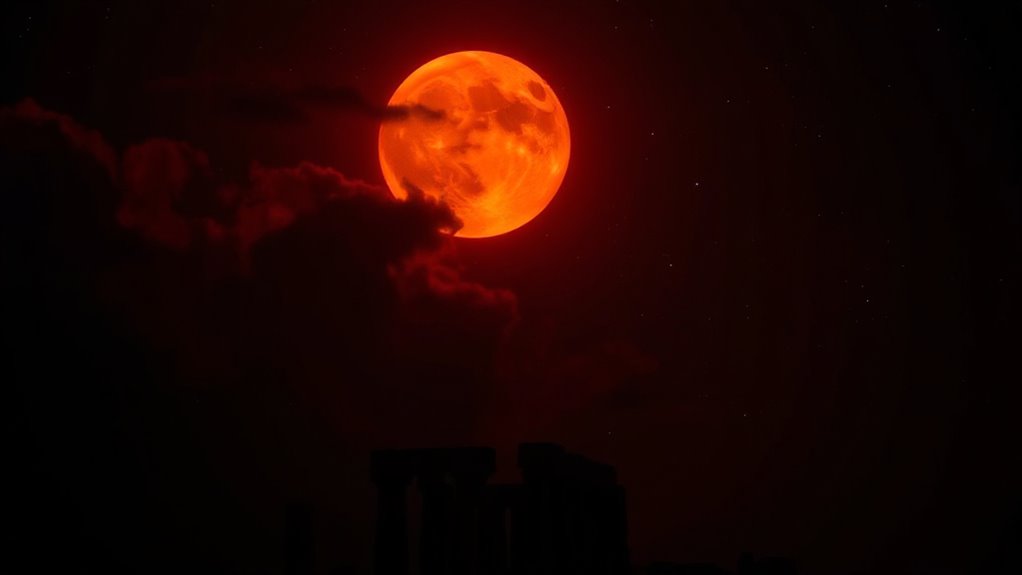
Understood in the light of basic physics, the blood-red color of a totally eclipsed Moon comes down to a single principle: Earth’s atmosphere filters sunlight before redirecting it onto the lunar surface.
During totality, the Moon passes completely into Earth’s shadow, blocking direct sunlight entirely. However, Earth’s atmosphere bends light around the planet through refraction, much like a prism separates color. Shorter blue and violet wavelengths scatter away, while longer red and orange wavelengths pass through more successfully. This filtered, reddish light curves around Earth and falls onto the Moon.
Atmospheric conditions further shape the result. Higher concentrations of dust, volcanic ash, or moisture deepen the red toward brown or darken it considerably. A major volcanic eruption before an eclipse can noticeably intensify these effects.
Total lunar eclipses only occur during a full Moon, when Earth is positioned directly between the Moon and the Sun. Depending on atmospheric conditions at the time, totality can last anywhere from about 30 minutes to over an hour.
Why Blood Moons Alone Cannot Confirm Prophetic Fulfillment
Striking as they appear in the night sky, blood moons consistently attract prophetic speculation, yet biblical prophecy rarely points to a single sign in isolation. Joel 2:31, Revelation 6:12, and Matthew 24:29 each embed the blood moon within a sequence involving earthquakes, darkened suns, and falling stars.
Scholars like Seventh-day Adventist historians note that the 1755–1833 pattern—encompassing the Dark Day of 1780, a blood-red moon, and the 1833 meteor shower—fulfilled this sequence collectively. A lone eclipse, however dramatic, satisfies only one condition. Lunar eclipses also occur regularly and predictably align with Jewish festivals due to the lunar calendar’s structure, reducing their rarity. John Hagee’s tetrad theories, while widely circulated, lack the sequential prophetic grounding that Scripture consistently requires. Adventist leaders, including Mark Finley, have specifically cautioned against new prophetic theories that latch onto every eclipse or disaster as a standalone fulfillment.
Of the four lunar eclipses in the 2014–2015 tetrad, only one was briefly visible from Israel, appearing partially before sunrise on September 28, 2015, which considerably undermines the claim that these signs were uniquely directed at the Jewish people and their land.