The Bible mentions Leviathan six times across Job, Psalms, and Isaiah. Job 41 offers the most detailed portrait, describing an armored, fire-breathing sea creature that no human can subdue. Psalms present Leviathan as a chaos symbol that God decisively crushes, while Isaiah uses the figure metaphorically for powerful political enemies. The Hebrew name likely means “the sinuous one,” reflecting its serpentine form. Those who explore further will find its meaning runs deeper still.
Key Takeaways
- Leviathan appears six times in the Bible, primarily in Job, Psalms, and Isaiah, described as a powerful, fire-breathing sea creature.
- In Job 41, God uses Leviathan’s terrifying strength to contrast human weakness with divine sovereignty and power.
- The Hebrew name means “the sinuous one,” reflecting its serpentine, coiling nature and links to ancient chaos mythology.
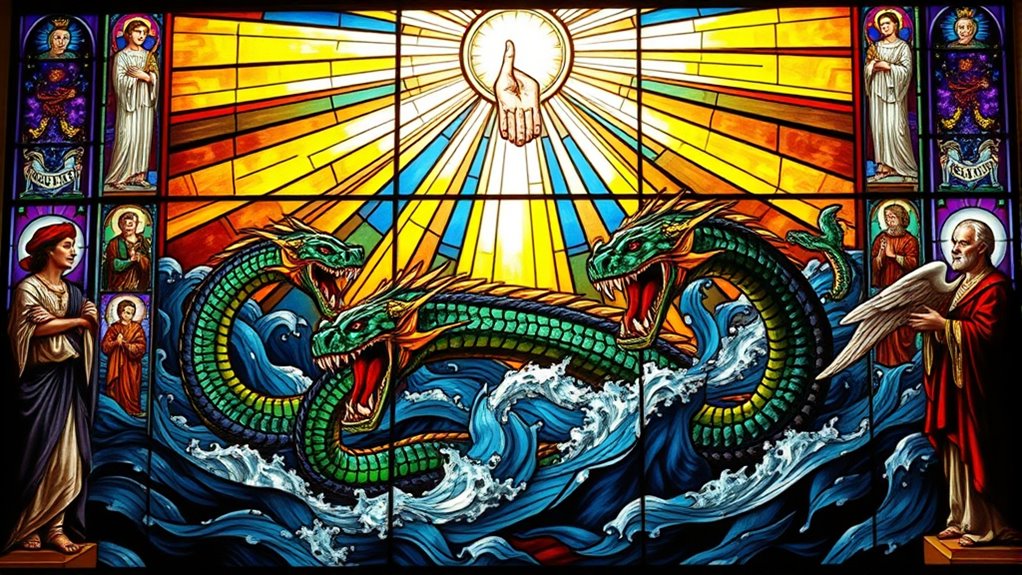
- Psalms portray God crushing Leviathan’s multiple heads, symbolizing divine victory over primordial chaos and disorder.
- Isaiah uses Leviathan as a metaphor for powerful political enemies, while prophecy anticipates its ultimate defeat on judgment day.
Where Does Leviathan Appear in the Bible?
Four appearances come from the poetic books: Job 3:8, Job 41:1, Psalm 74:14, and Psalm 104:26.
The remaining two appear in Isaiah 27:1 and Isaiah 51:9.
Importantly, Job 41 provides the most detailed description of the creature, while the Psalms place it within a creation context.
Isaiah uses the figure symbolically, often representing powerful earthly enemies opposing God’s people.
This pattern of usage across distinct literary genres points to a carefully developed image rather than a scattered mythological reference. In Mesopotamian myth, leviathan was depicted as a multi-headed sea-serpent opposing the gods, a concept that informed later biblical and apocalyptic literature.
The Hebrew term liwyātān derives from a root meaning “twist” or “coil,” yielding the sense of the sinuous one and designating a kind of serpent.
What Does Leviathan Look Like in the Bible?
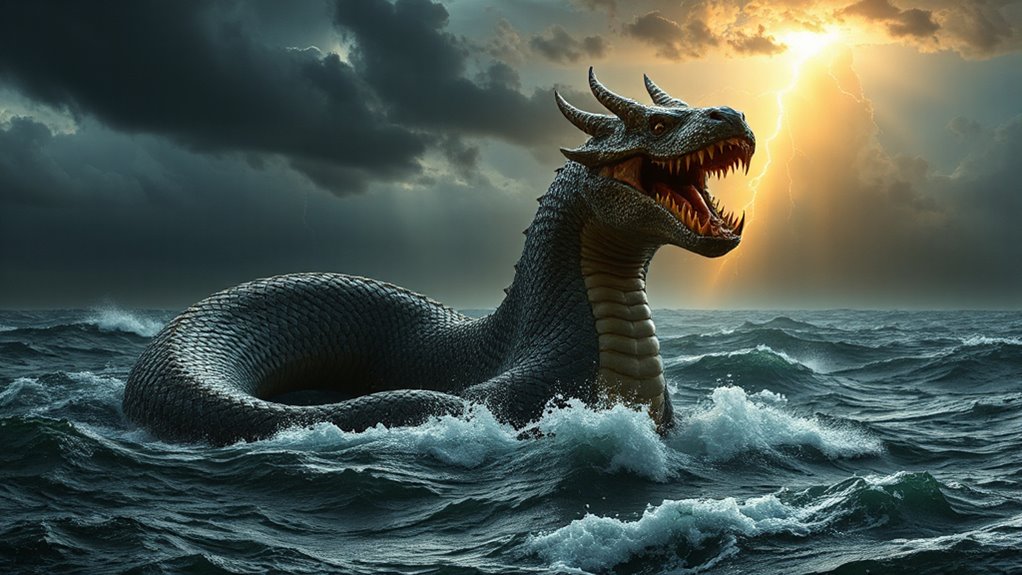
Several vivid physical details scattered across Job, Psalms, and Isaiah combine to form a consistent, if fearsome, portrait of Leviathan.
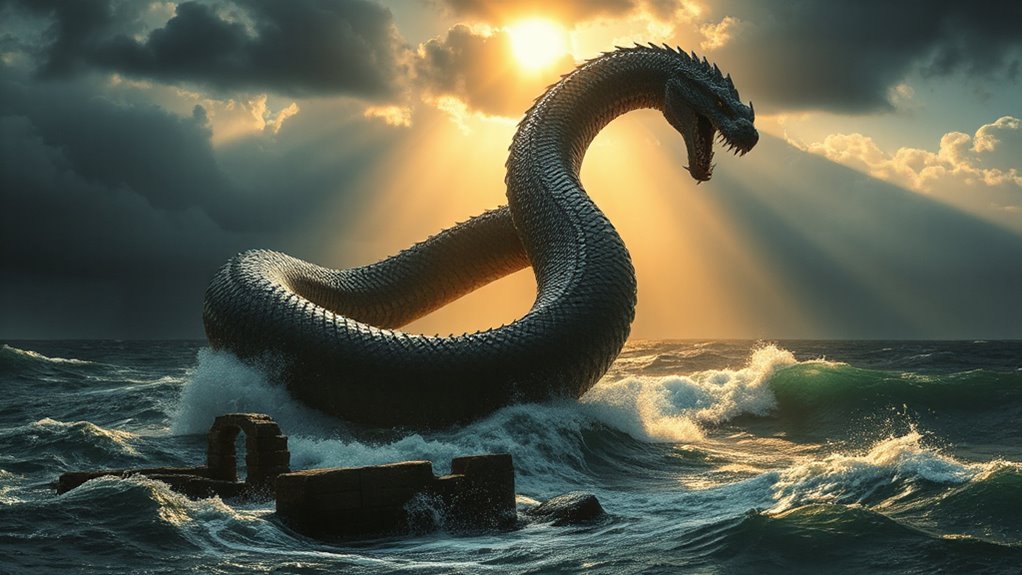
Job 41 describes scales forming impenetrable armor across its back and chest, tightly interlocked so that no air passes through. Its teeth are fearsome, its chest hard as rock, and it reportedly bends iron like straw. The creature also breathes fire, a detail that resists easy naturalistic explanation.
Isaiah 27:1 calls it both a “fleeing serpent” and a “twisting serpent,” emphasizing its sinuous, coiling form. This imagery reflects the creature’s name, which derives from a root meaning “to twist, coil”.
Psalms 74:14 presents a multiheaded sea creature, while the Greek Septuagint consistently renders the name as dragon. Together, these descriptions picture an enormous, armored, serpentine beast dwelling in deep waters, embodying chaos and overwhelming power.
Leviathan’s biblical portrayal bears a striking resemblance to the Ugaritic sea monster Lôtān, a servant of the sea god Yammu who was defeated by the storm god Hadad in the Baal Cycle myths. This connection places the biblical creature within a broader ancient Near Eastern tradition of chaos monsters overcome by divine power.
What Does Leviathan Symbolize in the Bible?

Beyond its striking physical appearance, Leviathan carries a range of symbolic meanings throughout the Hebrew Bible.
Most broadly, it represents chaos threatening cosmic order, particularly in Psalms and Job, where it embodies the primordial disorder God defeats and restrains. Psalm 74:13–14 describes God crushing Leviathan’s multiple heads, a victory that establishes divine authority over creation’s wildest forces.
Prophetic texts extend this symbolism further. Isaiah 27:1 uses Leviathan as a metaphor for powerful political enemies, such as Babylon, that oppose God’s people.
Christian theologians later identified the creature with demonic forces, even the Devil himself. This association finds its roots in ancient Near Eastern parallels, where the Ugaritic Baal Cycle describes Lotan, a seven-headed dragon whose defeat by a deity mirrors the biblical imagery of God’s triumph over Leviathan.
Looking forward, Jewish and early Christian traditions anticipate Leviathan’s final defeat on a coming day of judgment, offering readers a quiet assurance that chaos does not have the last word. In Job 41, God’s lengthy description of Leviathan serves to contrast human weakness with divine sovereignty, reminding readers that only the Creator holds ultimate authority over such an overwhelming force.