


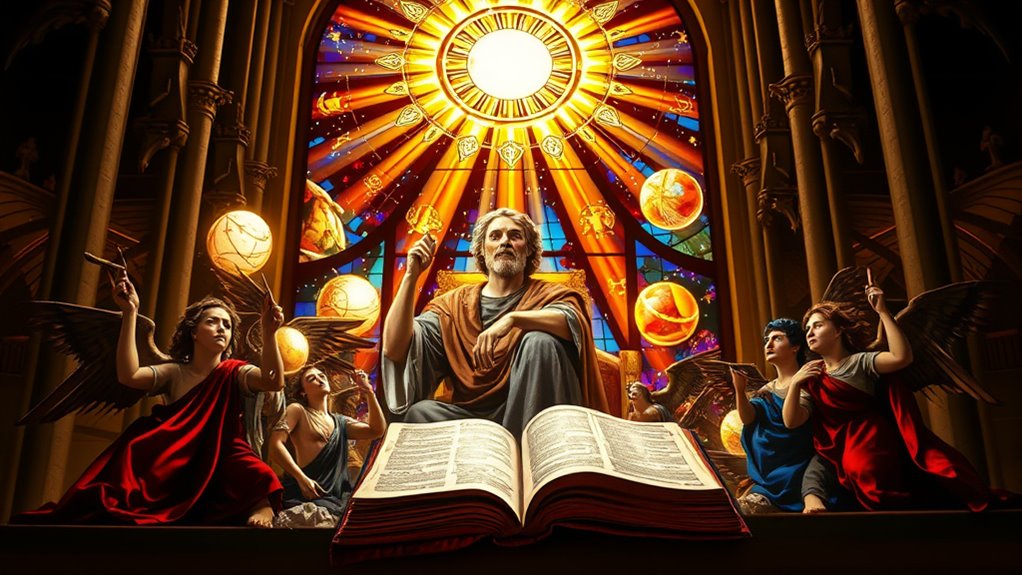
The Bible treats stars as part of God’s ordered creation rather than as guides to human destiny. Genesis 1:14 assigns celestial lights a timekeeping role, not a personality-shaping one. Psalm 147:4 establishes God’s authority over every star by name. Deuteronomy 18:10–12 and Isaiah 47:13–15 directly prohibit divination and mock stargazers who claim predictive power. Scripture consistently frames human destiny as belonging to God alone, and the passages ahead explain exactly what that means for astrology today.
Key Takeaways
- The Bible assigns stars and celestial bodies a timekeeping role in Genesis 1:14, not a personality-shaping or destiny-determining purpose.
- Scripture references constellations like Orion and the Pleiades in Job to inspire awe and worship, not astrological interpretation.
- Deuteronomy 18:10–12 explicitly forbids divination and interpreting omens, practices closely associated with horoscopes and astrological guidance.
- Isaiah 47:13–15 directly mocks Babylonian stargazers, declaring their star-based predictions powerless to deliver or protect anyone from judgment.
- The Bible places human destiny in God’s hands, framing astrology as a misplaced substitute for trust, prayer, and Scripture.
What the Bible Says About Stars, Signs, and Astrology

When the Bible speaks of stars and the sky, it does so with a purpose that differs significantly from astrology.
Scripture presents celestial bodies as part of God’s ordered creation, not as tools for predicting personal fate.
The heavens declare God’s glory, not our destiny — created to point upward, not inward.
Genesis 1:14 states that lights in the sky were made for “signs and seasons,” meaning they mark time and organize calendars.
Psalm 147:4 notes that God numbers and names every star, establishing divine authority over them.
Job 9:9 and Job 38:31-32 reference Orion and the Pleiades by name, yet these appear in contexts of worship and wonder, not fortune-telling.
The Bible consistently places meaning in God’s purposes rather than in star-based determinism, drawing a clear line between reverent observation and astrological interpretation.
When the Bible uses the word “star,” it frequently refers to wandering stars, which are what modern readers would recognize as planets such as Mercury, Venus, Mars, Jupiter, and Saturn.
Astrology as divination is expressly forbidden in Scripture, with Deuteronomy 18:10-14 listing it among prohibited practices that Israel was commanded to avoid.
Jesus and his contemporaries would have been familiar with Aramaic usage in everyday life, reflecting the multilingual context in which biblical references to stars were made.
Does the Bible Forbid Astrology and Horoscopes?

Several passages in the Bible address astrology and related practices directly, and the overall message is one of clear prohibition. Deuteronomy 18:10–12 lists divination, fortune-telling, and interpreting omens among forbidden practices. Leviticus 19:26 adds a similar warning, and Leviticus 19:31 prohibits consulting mediums. Many Christian commentators place astrology and horoscopes within this same category, describing them as forms of divination rather than harmless entertainment. Isaiah 47:13–15 reinforces this position by mocking Babylonian stargazers and declaring their inability to save anyone from judgment. The broader biblical concern is misplaced trust. Seeking guidance from stars, rather than from God, is consistently framed as a spiritual error. The dominant Christian conclusion drawn from these passages is that horoscopes and astrological guidance should be avoided by believers. Psalm 19:1 reminds believers that the heavens exist to declare the glory of God, not to serve as a source of personal guidance or fortune-telling. Sites like Christian Homekeeper, founded by Sylvia Britton and described as unapologetically Christian in view, reflect this position by grounding all life guidance in scripture rather than astrological sources. Additionally, many scholars note that the biblical canon contains approximately 31,102 verses across 66 books, underscoring the extensive scriptural basis for this teaching.
Does God or Astrology Control Your Destiny?

At the center of the biblical worldview stands a God who governs human affairs, not a system of stars and planets.
Scripture consistently places destiny in God’s hands rather than in zodiac signs or planetary positions.
Ephesians 2:10 describes believers as God’s handiwork, with paths prepared in advance, leaving little room for astrological authority.
Genesis 1:14 assigns celestial bodies a simpler role: marking seasons and signs, not shaping personalities or futures.
Biblical teaching treats astrology as a substitute for divine trust, redirecting guidance toward prayer and Scripture instead.
Isaiah 47:13–14 questions whether astrologers can actually deliver on their promises.
The dominant biblical answer to questions of destiny is straightforward: God directs the path, while the stars simply declare His glory.
Deuteronomy 18:10–14 forbids divination and sorcery, practices that include seeking guidance through any means outside of God.
The zodiac itself traces back to ancient Babylonian astronomy, where the sky was divided into twelve segments, each named after a constellation and tied to a time of year.
Ancient observations like lunar eclipses and star visibility changes contributed to early understandings of the heavens that contrast with astrological claims.