
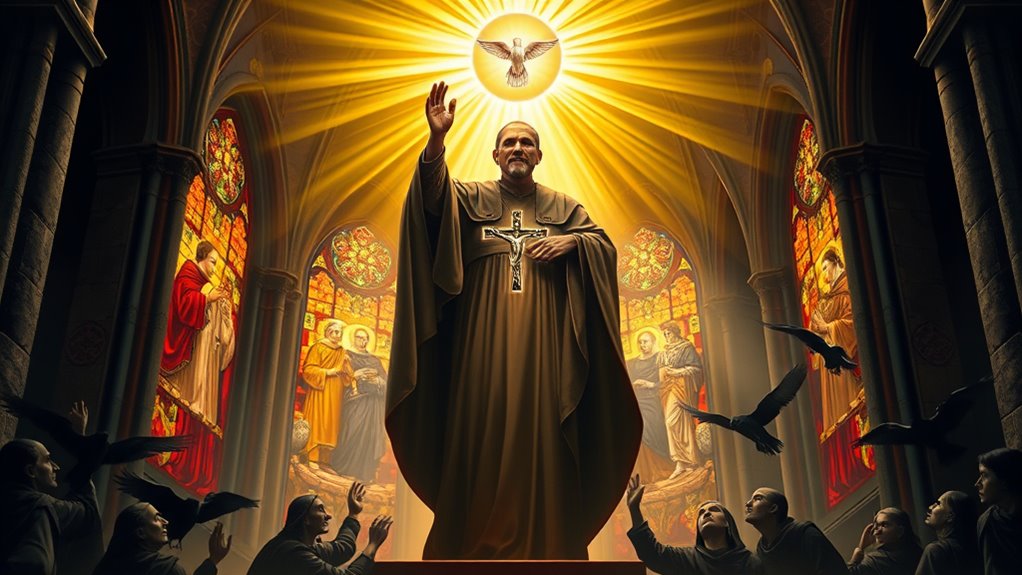
The St. Benedict Medal became a recognized shield against darkness through centuries of Benedictine monastic tradition rather than a single founding moment. Its protective reputation grew from the 11th century onward, deepened by legends of divine intervention and the spiritual weight of its Latin inscriptions. Pope Benedict XIV formally approved the medal in 1742, cementing its place as an official Catholic sacramental. The medal’s full symbolic layers and practical uses reveal even more about its enduring spiritual purpose.
What the St. Benedict Medal Is and Where It Comes From
Among the most recognized objects in Catholic devotional life, the St. Benedict Medal is a sacramental used in Roman Catholic and related Western Christian traditions. It carries symbols and inscriptions connected to Saint Benedict of Nursia, the founder of Benedictine monasticism.
The medal is associated with protection, spiritual strength, and resistance to evil and temptation. Its devotional background developed through Benedictine monastic practice rather than from any artifact tied directly to Benedict’s lifetime.
A manuscript from 1415 offers an early reference to its associated prayer formula, suggesting the tradition matured gradually before reaching wider Catholic use. The medal received its first formal approval from Benedict XIV on 23 December 1741.
The Jubilee Medal of Montecassino was struck in 1880 to mark the 1400th anniversary of Saint Benedict’s birth.
Scholars note that devotional practices like the medal’s prominence evolved alongside broader Christian traditions and historical developments.
The 11th-Century Origins of the St. Benedict Medal’s Power
The St. Benedict Medal’s protective tradition traces to the 11th century, rooted in Benedictine monastic culture rather than Saint Benedict’s own 6th-century lifetime. One key tradition involves Brunone of Egisheim-Dagsburg, later Pope Leo IX, who reportedly recovered from serious illness after receiving the medal. His subsequent entry into Benedictine life deepened the medal’s spiritual reputation.
Early devotional use centered on three core principles:
- Protection came through prayer, not magical properties
- Cross-signs and Latin inscriptions formed the basis of early protective tokens
- Efficacy depended on faith and proper spiritual disposition
This framework shaped how the medal’s power was understood for centuries. In 1742, Pope Benedict XIV formally approved the medal and granted indulgences to those who carried it with faith. The medal’s reputation for spiritual protection grew so strong that it became widely known as the devil chaser, a title reflecting the thousands of miracles attributed to its intercession worldwide. A Christian understanding of leadership and moral responsibility emphasized in scripture also reinforced the medal’s role as a symbol of servant leadership and accountability to God.
What the Symbols on the St. Benedict Medal Actually Mean
Packed onto a small metal disc, the symbols of the St. Benedict Medal form a layered system of meaning.
The front shows Benedict holding a cross and a book, representing Christ’s saving power and monastic discipline. A broken cup recalls a poisoning legend tied to divine protection.
Benedict holds a cross and book — symbols of salvation and discipline — while a broken cup whispers of miraculous protection.
The reverse carries even more detail. Letters along the cross arms abbreviate Latin phrases: “Crux Sacra Sit Mihi Lux” and “Non Draco Sit Mihi Dux.”
The border encodes a rejection of temptation: “Vade Retro Satana.” The symbols and writings on the medal remained unknown for a long time until a discovery at the Abbey of Metten in Bavaria in 1647 linked them to a manuscript from 1415.
The word “PAX,” meaning peace, crowns the design, summarizing the medal’s spiritual purpose in three letters. The medal’s official name is “Medal of the Holy Cross”, described as a sign emphasizing love for Christ. Angels are described in Scripture as created spiritual beings who serve God and often act as messengers, minister to believers, and execute divine tasks.
When the Church Made the St. Benedict Medal Official
Devotion to the St. Benedict Medal existed for centuries before the Church formally recognized it. On March 12, 1742, Pope Benedict XIV issued a papal brief approving the medal after review by the Congregation of Indulgences. The approval confirmed an older tradition rather than created a new one.
Key details from the 1742 authorization:
- The approval specifically recognized the medal’s cross, figure of St. Benedict, and inscribed letters.
- Indulgences were granted for carrying the medal with genuine faith and devotion.
- Benedictines in Bohemia, Moravia, and Silesia held exclusive blessing privileges initially.
The medal itself features two sides rich with meaning, with the reverse containing prayers written as initials intended for wearers to commit to memory.
Today, those seeking to obtain the medal can find options ranging from the German Nickel Silver variety to ornate crystal-adorned versions.
The medal has been embraced by many as a sacramental that signifies entrance into the community of faith and a visible reminder of spiritual protection.
How Catholics Use the St. Benedict Medal as a Shield Today
Centuries after Pope Benedict XIV’s 1742 approval, Catholics continue to incorporate the St. Benedict Medal into daily life as a sacramental, not a charm.
Many wear it on a chain or carry it in a pocket, purse, or rosary.
Others place it in homes, cars, businesses, and farms as a sign of requested blessing and protection.
Devotional sources recommend that a priest or deacon bless the medal before use.
Catholics often pair it with specific prayers asking St. Benedict’s intercession against temptation and evil.
The protection sought comes through faith and Christ, not from the metal itself.
The medal’s engraved letters are understood to stand for Latin prayers of exorcism against Satan, giving the medal its distinctive character as both a devotional object and a spiritual weapon.
The Benedictine Order has given the Church over 57,000 known saints and 35 popes throughout its long history.
Believers are encouraged to seek the Holy Spirit’s guidance in prayer and discernment when using sacramentals.