
The Bible does not mention artificial intelligence by name, since its authors wrote thousands of years before modern technology existed. However, scripture addresses timeless principles—wisdom, stewardship, idolatry, and human dignity—that apply directly to AI. Themes like the *imago Dei* and common grace from Matthew 5:45 help Christians evaluate the technology honestly. Those principles, when examined carefully, reveal both the promise and the spiritual risk that AI quietly carries.
Key Takeaways
- The Bible does not mention AI directly, but its timeless principles on wisdom, stewardship, and ethics apply to emerging technologies.
- The Imago Dei doctrine affirms human uniqueness, providing a theological foundation for evaluating what AI can and cannot replicate.
- Scripture warns against idolatry, meaning dependence on AI that surpasses dependence on God violates biblical teaching in Exodus 20:3-5.
- God’s sovereignty encompasses all human innovation, including AI, so its existence poses no threat to divine authority or purpose.
- AI can serve as a tool amplifying the gospel through common grace but cannot replace the Holy Spirit or spiritual formation.
What the Bible Actually Says About AI
Despite being one of the most widely read texts in human history, the Bible contains no direct mention of artificial intelligence. This absence is largely a matter of historical context. The scriptures were written thousands of years before modern technology existed, so their authors addressed timeless principles rather than specific inventions.
Still, scholars and theologians find meaningful connections between biblical teaching and AI through themes like wisdom, creation, and stewardship. No verse names AI directly, yet interpretations link human innovation to broader ethical responsibilities outlined throughout scripture.
Importantly, the book of Revelation contains no specific AI prophecies, according to available analyses. The Bible instead offers enduring principles that believers apply to emerging technologies, including artificial intelligence, as those technologies continue to develop. For example, AI tools have demonstrated meaningful potential to help fulfill the Great Commission by enabling broader gospel reach across language and cultural barriers.
Theological frameworks such as the imago Dei — the image of God — provide a foundational lens through which to evaluate AI, particularly as machine capabilities increasingly challenge what it means to be uniquely human in reasoning, stewardship, and relationship.
Why Pride and Idolatry Make AI Genuinely Dangerous
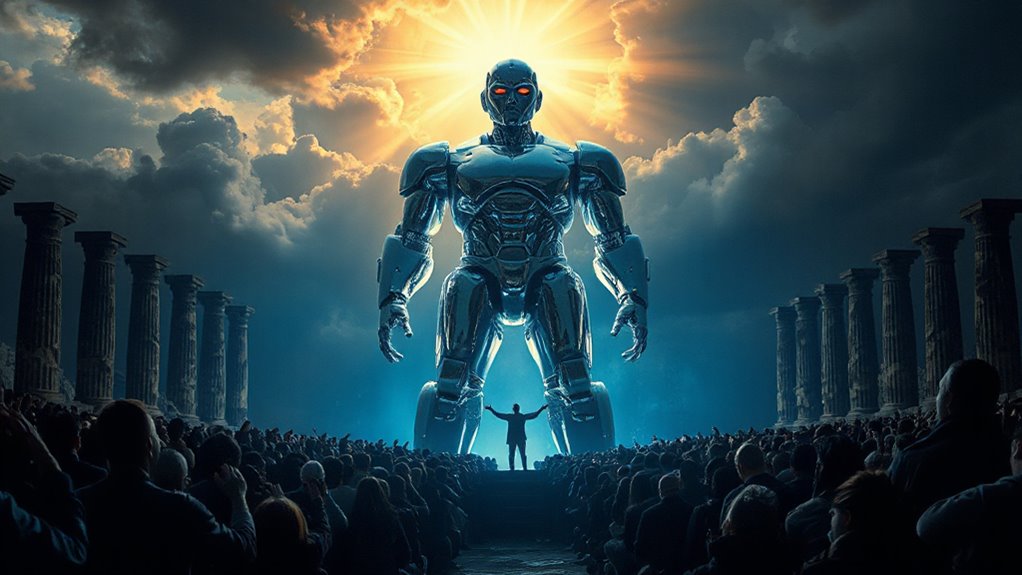
Idolatry enters when dependence on AI surpasses dependence on God, mirroring patterns condemned in Exodus 20:3-5 and Romans 1:25. Revelation 21:8 warns that such misplaced worship carries eternal consequences.
The Tower of Babel offers an early parallel: advanced capability pursued for self-glorification rather than divine purpose. Theologians argue the danger is not AI itself, but the spiritual posture humans bring to it. Scripture consistently affirms that humility and surrender to Christ is the only remedy for the pride that drives humanity toward self-made gods.
Psalm 115 warns that those who make idols become like them, and the same danger applies to AI: a culture that trusts coded, automated idolatry risks being shaped and diminished by the very systems it has built.
Does AI Threaten God’s Sovereignty or Human Purpose?
When artificial intelligence reshapes economies, rewrites creative work, and raises questions about what makes humans unique, a natural question follows: does any of this threaten God’s authority over creation? Scripture answers clearly: no.
Ephesians 1:11 states God works out everything according to His purpose, and Job 42:2 confirms no plan of His can be thwarted. Proverbs 16:1 extends this control to every human output, including AI-generated responses.
Theologians describe this arrangement as compatibilism, meaning God’s sovereignty operates alongside genuine human responsibility. Joshua 24:15 illustrates this balance, showing humans making real choices within God’s governed order.
Silicon Valley, like every institution before it, operates inside boundaries God already knows. AI introduces new tools; it introduces no new limits on God. God’s sovereign presence extends across all of creation, meaning no domain of human innovation, including technology, falls outside His covenantal solidarity with His people and His world. Scripture affirms that God knows thoughts before they are thought, meaning the ideas encoded into every algorithm and model fall entirely within His awareness before any engineer conceives them.
How Christians Can Use AI Without Replacing God
From the factory floor to the surgeon’s suite, tools have always shaped how humans work without defining who they are. Christians are encouraged to approach AI the same way — useful, but bounded. Theologians and Christian thinkers suggest treating AI like a capable seminary intern: helpful for editing sermons, brainstorming titles, catching typos, and organizing information, but never the final voice.
The concern is not capability but dependency. When someone asks AI before praying, or skips meditating on Scripture for instant answers, convenience quietly replaces trust. Galatians 6:9 and broader biblical teaching caution against bypassing the slow, formative work God often uses to build character. Regular spiritual disciplines like daily Bible reading and prayer are crucial to prevent that drift toward convenience and dependency, since daily Bible reading is strongly linked to spiritual growth.
AI, viewed as common grace per Matthew 5:45, can amplify the gospel. It simply cannot carry the Spirit behind it. Some have gone so far as to worship technological progress itself, as seen in groups like the Way of the Future Church, a sobering reminder that AI can become an idol just as quickly as it becomes a tool. Beyond outright worship, everyday reliance on AI for spiritual questions reflects a broader pattern where convenience replaces trust in God, as formation quietly shifts through repeated habits of turning to algorithms before turning to prayer.