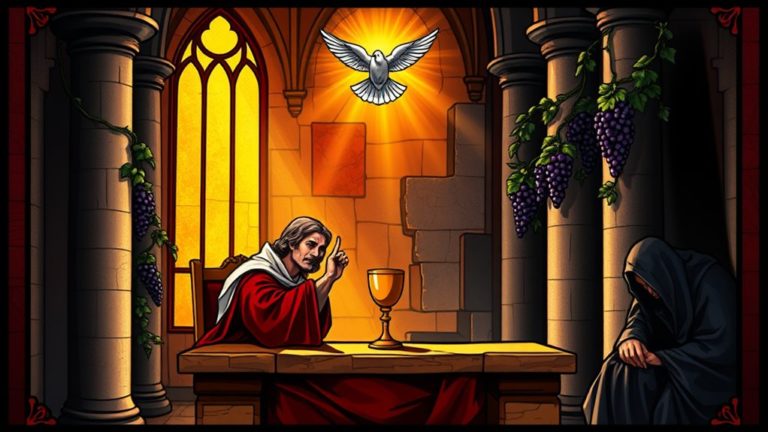









The Bible treats hatred as a serious moral and spiritual condition rooted in the heart, not merely outward behavior. Jesus linked contempt toward others with serious accountability in Matthew 5:22, and 1 John 3:15 equated hatred with murder in the heart. Scripture also distinguishes sinful hatred toward people from righteous hatred directed at evil. Those curious about what God says on the subject — including whether God himself hates — will find the answers worth exploring.
Key Takeaways
- The Bible treats hatred as a serious heart-level sin, with 1 John 3:15 equating it to murder in the heart.
- Jesus warned in Matthew 5:22 that contempt toward others carries significant moral and spiritual accountability before God.
- Scripture distinguishes sinful hatred toward people from righteous hatred of evil, which Psalm 97:10 links to loving God.
- Hatred is listed among the works of the flesh in Galatians 5, alongside sins excluding people from God’s kingdom.
- Christians are called to love enemies and do good to those who hate them, as taught in Luke 6:27.
What the Bible Says About Hatred and Why It Matters

The Bible treats hatred as far more than a passing mood or minor fault. Scripture frames it as a heart-level judgment that reveals deep moral and spiritual conditions.
Jesus connected contempt toward others with serious accountability in Matthew 5:22, while 1 John 3:15 described hatred as equivalent to murder in the heart.
First John 2:9-11 placed it within the category of spiritual darkness, signaling fellowship damage between the believer and God.
Proverbs 10:12 noted that hatred stirs up conflict rather than peace. Regular engagement in daily Bible reading helps surface and address these hidden attitudes.
Biblical teaching consistently points inward, treating hidden motives as morally significant.
Hatred, according to Scripture, does not remain private.
Hatred never stays contained within a single heart — it bleeds outward, shaping relationships and communities in its wake.
It spreads into relationships, communities, and the inner life, making it a subject the Bible addresses with consistent seriousness and a steady call toward love. Galatians 5 lists animosities, rivalries, and factions among the works of the flesh, placing relational hatred in direct opposition to the fruit of the Spirit.
Jeremiah 17:9 describes the heart as deceitful above all things, underscoring why Scripture traces the root of hatred to inner corruption rather than outward circumstance.
The Difference Between Sinful Hatred and Righteous Hatred

Although the Bible consistently warns against hatred, it does not treat all hatred as the same moral category. Scripture draws a clear line between hatred aimed at people and hatred directed toward evil itself.
Psalm 97:10 states, “You who love the Lord, hate evil,” presenting the hate evil maxim as an expression of love for God rather than hostility toward others.
Proverbs 8:13 reinforces this by connecting hatred of evil with reverence for God. This kind of sin focused discernment targets conduct and character of wrongdoing, not human beings as image-bearers.
Sinful hatred, by contrast, is personal and retaliatory.
Romans 12:9 summarizes the biblical standard simply: abhor evil, hold fast to good. The Old and New Testaments together contain 31,102 verses that develop these ethical themes across Scripture.
The distinction preserves both holiness and love simultaneously. Galatians 5:20 identifies hatred as a work of the flesh, placing it among sins that exclude a person from inheriting the kingdom of God.
Genuine love for God produces both a love for what is good and a hatred of evil, meaning the two are necessary consequences together that cannot be separated in the life of a faithful believer.
Does God Hate People? What the Bible Actually Says

Few questions about God stir more discomfort than whether he hates people. Scripture does address this directly, though the answer requires careful reading.
Psalm 5:5 names evildoers as objects of divine hatred, and Psalm 11:5 specifically mentions those who love violence. The Old Testament was primarily written in Hebrew, with some portions in Aramaic, reflecting the original language of many of these passages.
Malachi 1:2–3 adds the striking example of Esau.
However, biblical scholars consistently note that this language reflects moral opposition to persistent wickedness rather than casual personal dislike.
Hosea 9:15 ties God’s hatred to covenant rejection, linking judgment to Israel’s unfaithfulness rather than identity alone.
Leviticus 20:23 connects God’s abhorrence to detestable practices among the nations.
The recurring pattern across these texts shows divine hatred rooted in holiness and justice.
Proverbs 6:16–19 presents a catalog of seven things the LORD hates, ranging from a lying tongue to hands that shed innocent blood, ending notably with one who sows contentions among brothers.
Scripture presents a God who opposes evil, while remaining open toward those who turn from it. In contrast, Psalm 11:7 assures that the upright shall behold his face, reflecting God’s favor toward those whose hearts are right.
How Christians Are Called to Respond to Hatred and Enemies

Understanding how God relates to evil shapes the question that follows naturally: how should those who follow him respond when they encounter hatred directed at themselves?
Scripture answers consistently.
Matthew 5:44 instructs believers to love enemies and pray for persecutors, framing active forgiveness as a core practice rather than an optional ideal.
Luke 6:27 adds concrete action, calling for good deeds toward those who hate.
Romans 12:14–20 builds a fuller picture, pairing godly nonretaliation with practical mercy, including feeding a hungry enemy.
Romans 12:18 qualifies the call to peace honestly, noting that reconciliation depends partly on others.
Matthew 5:47 challenges believers to go beyond greeting only their own people, pointing out that even pagans do that.
Underlying all these instructions is a single principle: the response to hatred reflects God’s own patience and generosity toward people who do not deserve either. A careful reading of the Gospels and historical context also shows Jesus’ life occurred in the late first century BC–AD transition, which helps frame how early Christians applied these teachings.