
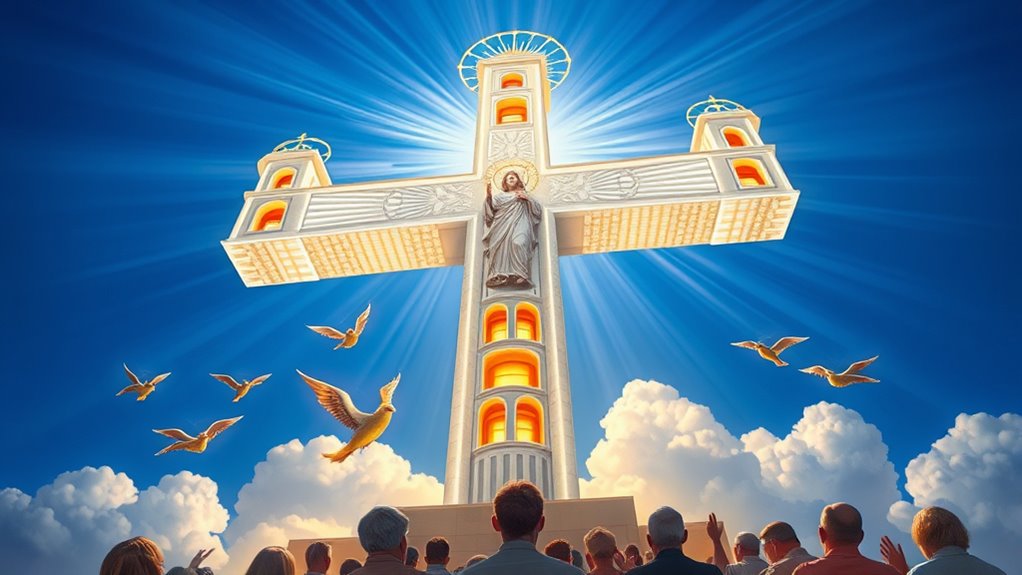
The Basílica de la Sagrada Família in Barcelona reached a defining milestone with the installation of a 17-meter white cross atop the Tower of Jesus Christ, completing the structure at 172.5 meters and making it the world’s tallest church. The cross, built in Germany using prefabricated panels and clad in white enameled ceramic and glass, features a double-twist geometry matching Antoni Gaudí’s column designs throughout the basilica. Completed in stages between October 2025 and February 2026, the gleaming pinnacle fulfills Gaudí’s vision for a beacon visible across the city, with visitor access planned from 2028 once interior work concludes.
After 144 years of construction, the Sagrada Família has reached a defining milestone with the completion of its tallest element, the Tower of Jesus Christ, now crowned by a 17-meter white cross that makes the basilica the world’s tallest church at 172.5 meters. The cross, equivalent in height to five storeys and spanning 13.5 meters in width, sits atop a 29-meter pinnacle that combines a 12-meter base with the cross itself, surrounded by four Evangelists towers linked by bridges.
After 144 years, the Sagrada Família becomes the world’s tallest church at 172.5 meters with its completed Tower of Jesus Christ.
The cross features four corrugated arms clad in glass and white enameled ceramic, following a geometry based on the double twist that matches Gaudí’s distinctive columns throughout the basilica. Each arm shifts from a square section at its outer end to an octagonal section at the inner end, with hollow interiors containing fluted windows that allow light to pass through. At the base, an inscription reads “Tu solus Sanctus, tu solus Dominus, tu solus Altissimus.”
Construction of the tower’s shaft began in October 2018 at 85 meters height, reaching its final level of 142.5 meters in December 2024. The base pinnacle section started in May 2025, followed by installation of the lower arm on October 27, 2025, and the upper arm on February 20, 2026. The cross was built in Germany using a tensioned-stone system with prefabricated panels, then transported in modules by ferry and trucks. The white enameled ceramic and glass came from Catalonia.
Installation occurred on a platform 54 meters above the central nave in seven stages, assembling the lower arm, core, four lateral arms, and upper arm. The core alone weighs 16.5 tonnes with six octagonal sides measuring 4.7 meters each, while each horizontal arm weighs 12.8 tons. An Agnus Dei sculpture by Andrea Mastrovito is planned to be installed inside the upper arm of the cross, positioning the Lamb of God at the center as Gaudí envisioned, visible from within the structure.
Materials were chosen to shine day and night according to Gaudí’s vision, with spotlights on surrounding towers providing illumination. The design team referenced Gaudí’s other works, including Casa Batlló, Park Güell, and Torre Bellesguard, which feature similar cross styles. The exterior of the Jesus Christ tower is now finished, though scaffolding currently covers the cross for interior work scheduled through 2027-2028. Visitor access to the tower and cross is planned from 2028. The completed cross and its symbolic placement emphasize themes of incarnation and worship that resonate with the basilica’s religious purpose.