
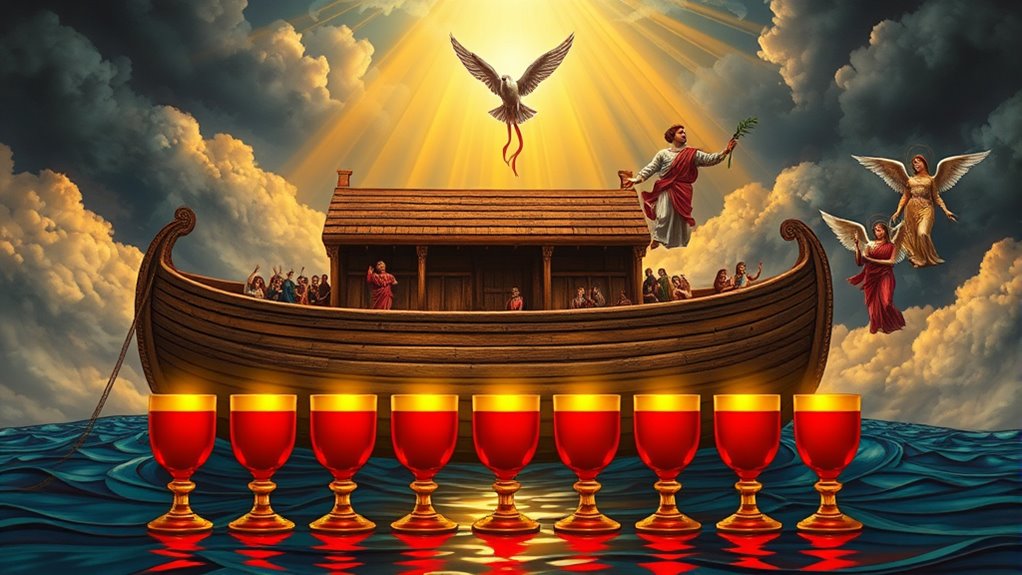
A social media claim suggests the eight people on Noah’s Ark—Noah, his wife, their three sons, and three daughters-in-law—each carried one of today’s eight major blood types. While human blood does combine ABO groups (A, B, AB, O) with Rh factors (positive or negative) to yield eight common types, genetics shows that four couples with varied alleles could produce this diversity through normal inheritance patterns. The claim oversimplifies both biblical text and blood science, since scientists recognize over 350 red-cell antigens and 47 typing systems beyond the basic eight. A closer examination reveals how genetic variability operates.
How could just eight people aboard Noah’s Ark account for the wide variety of human blood types observed today? A claim circulating on social media suggests that the eight survivors—Noah, his wife, their three sons, and three daughters-in-law—perfectly correspond to the eight major blood types recognized in modern medicine. However, geneticists note that this notion oversimplifies both biblical text and blood science.
The ABO blood system classifies human blood into four types based on antigens present on red blood cells. Type O requires two recessive O alleles, while A and B alleles act as dominant over O. Type AB results from inheriting one A allele and one B allele. The Rh factor adds another layer, with Rh positive dominant over Rh negative, creating eight common combinations when paired with ABO types.
Blood types arise from dominant and recessive alleles combining with the Rh factor to create eight common variations in human populations.
The claim that eight ark passengers produced exactly eight blood types ignores critical genetic details. Scientists have identified over 350 antigens beyond ABO on red blood cells and recognize 47 distinct blood typing methods. Additionally, the Rh system itself involves two genes, one with a single variant and another with four, suggesting complexity beyond simple matching.
Genetic models demonstrate that diverse blood types could emerge from four couples without requiring each person to carry a unique type. Using Punnett squares, researchers show how one couple with AB negative and O positive genotypes could produce children with A positive, B positive, A negative, and B negative types. These children, carrying hidden O alleles, could then produce all major blood types within two generations through various pairings.
Geneticists propose that type O originated from a point mutation in an ancient A allele, representing a loss of genetic information rather than evolutionary gain. This aligns with creation models suggesting Adam and Eve possessed different blood types, providing foundational diversity. Rh factor variants may have developed after the flood, possibly near the time of Babel’s dispersion.
While the exact eight-type correspondence remains technically incorrect, genetic variability from ark survivors could indeed account for modern blood type diversity through natural inheritance and post-flood mutations. Many readers also weigh such claims against broader biblical principles about human origins and diversity body as temple.