

Archaeological evidence places Jesus in verifiable history—a first-century fishing boat from Galilee, the Pilate Stone confirming the governor who ordered his execution, and a crucifixion victim’s heel bone pierced by an iron nail all anchor the Gospel accounts in physical reality. Yet these artifacts document where Jesus lived and how he died, not who he claimed to be. The historical record establishes the stage, but his identity requires examining what he taught, the authority he assumed, and the response he demanded. Further exploration reveals how his words and actions point beyond the archaeological fragments to profound questions about purpose and truth.
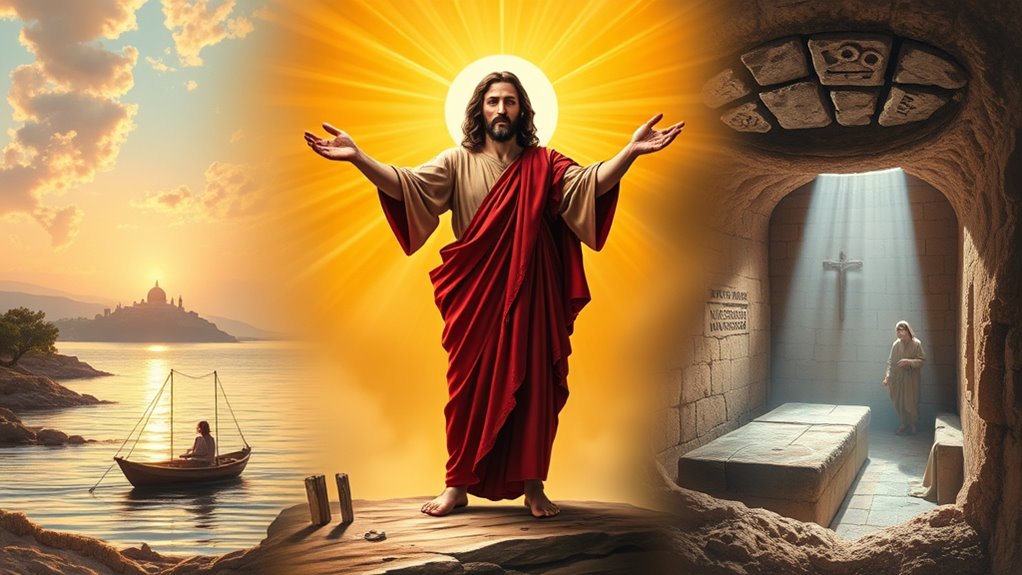
In the decades following Jesus’ death, the ground beneath Jerusalem and the villages of Galilee began yielding quiet confirmations of the world he inhabited. Archaeologists have recovered a first-century fishing boat from the Sea of Galilee, matching the type Jesus and his disciples would have used. At Magdala, excavators unearthed synagogue remains from what was likely Mary Magdalene’s hometown. These discoveries anchor the Gospel narratives in physical reality.
The ground beneath Jerusalem and Galilee yields quiet confirmations of the world Jesus inhabited, anchoring Gospel narratives in physical reality.
The Pilate Stone, found at Caesarea Maritima in 1961, confirms the Roman governor who sentenced Jesus to death. An ossuary containing the bones of a sixty-year-old man, dated after 43 AD, bears the name of Caiaphas, the high priest involved in Jesus’ trial. Perhaps most striking is the heel bone of a man named Jehohanan, dated between AD 7 and 66, still pierced by an iron nail driven sideways through the bone, demonstrating exactly how crucifixion was carried out in first-century Judea.
The census that brought Mary and Joseph to Bethlehem finds support in the Res Gestae Divi Augusti inscription, which details Caesar Augustus’ decree for empire-wide registration. The Lapis Venetus inscription confirms that Quirinius conducted a census in Syria during the period described in Luke’s Gospel. At Bethsaida, excavations reveal first-century residential districts, marketplaces, fishing harbors, and four Jewish ritual baths, painting a detailed picture of Galilean life during Jesus’ ministry.
Even the tomb traditionally associated with Jesus’ burial carries archaeological weight. Hadrian built a temple over the site in the second century, which was later excavated by Constantine in the fourth century. Recent restoration of the tomb’s edicule removed mortar dated to the mid-fourth century, consistent with Constantine’s work.
Non-Christian sources corroborate key details. Tacitus recorded that Christus was executed by Pilate during Tiberius’ reign. Josephus and Philo also mention Pilate alongside the Gospel accounts. No first-century evidence disputes Jesus’ existence. The archaeological record neither proves nor disproves his resurrection, but it consistently affirms the historical framework within which the Gospel writers placed their extraordinary claims about who Jesus was. Additional inscriptions and records also link these events to broader imperial actions and regional governance, including references to Roman administration that help situate the Gospel narratives in their wider historical context.