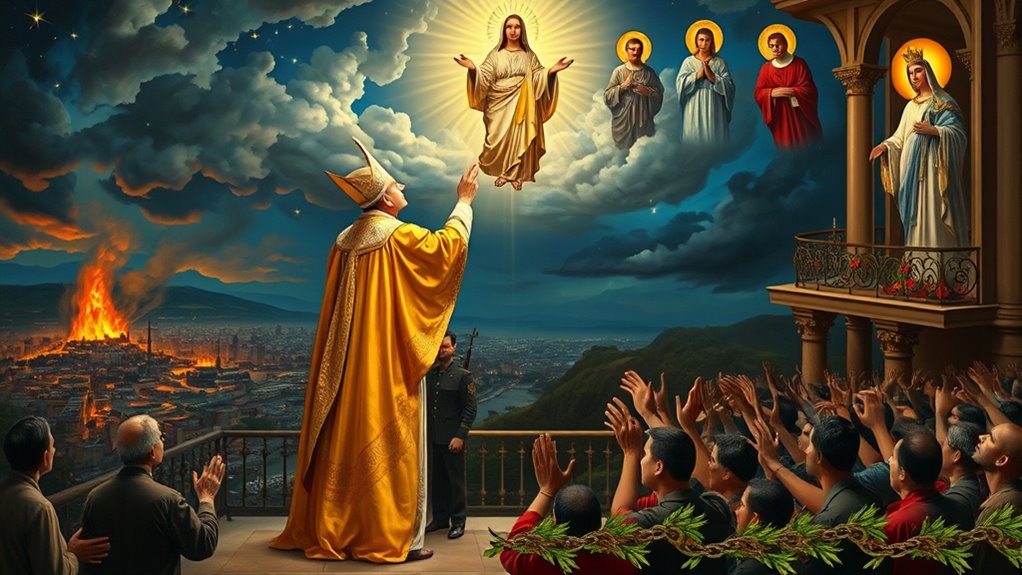
Pope Leo XIV responded to the January 4, 2026, U.S. military raid that captured Nicolás Maduro by calling for restraint, justice, and prayer rather than taking sides in the operation that killed at least 40 people. Speaking at Sunday Angelus in St. Peter’s Square, he emphasized respect for human rights, Venezuela’s sovereignty, and the rule of law while entrusting the nation to Our Lady of Coromoto. His measured tone contrasted sharply with divided global reactions, as Brazil, China, and Russia condemned the action while the Venezuelan diaspora celebrated. The full context reveals additional layers of his diplomatic approach.
Following the dramatic U.S. military operation that captured Venezuelan President Nicolás Maduro and his wife Cilia Flores in Caracas on January 3, 2026, Pope Leo XIV addressed the crisis during his Sunday Angelus at St. Peter’s Square the following day.
The pontiff expressed deep concern over the nighttime raid, which reportedly killed at least 40 people and struck multiple military bases before extracting Maduro to face narco-terrorism conspiracy charges in New York.
Speaking to gathered faithful on January 4, Pope Leo stated that “the good of the beloved Venezuelan people must prevail over every other consideration.” He emphasized that he had been following developments with a “heart full of concern,” urging all parties to overcome violence and pursue paths of justice and peace.
The good of the beloved Venezuelan people must prevail over every other consideration, Pope Leo declared with deep pastoral concern.
The Pope’s remarks carefully balanced acknowledgment of the crisis with calls for restraint and respect for legal frameworks.
Central to the Pope’s message was a series of specific appeals. He called for prayer and respect for human rights throughout Venezuela, while emphasizing the need to guarantee the country’s sovereignty and self-determination.
He insisted on ensuring the rule of law enshrined in the Venezuelan Constitution and highlighted respect for the human and civil rights of all persons involved.
The pontiff urged Venezuelans to build a “serene future of collaboration, stability, and harmony.”
Pope Leo gave special attention to the poorest Venezuelans suffering from the country’s economic situation. He entrusted the nation to Our Lady of Coromoto and recently canonized saints José Gregorio Hernández and Carmen Rendiles, inviting Catholics worldwide to unite in prayer for Venezuela. He also reminded the faithful of the Church’s teaching on stewardship and generosity, urging that care for the poor guide political and economic decisions. The papal response came just one day after Pope Leo had delivered a video message to thousands of young adults at the SEEK 2026 Conference, which opened on January 1.
The papal statement came amid sharply divided global reactions. Brazilian President Lula called the arrest an affront to sovereignty, while China and Russia condemned the operation.
The Venezuelan bishops issued their own statement urging serenity and wisdom, advising citizens to avoid streets and unverified information. Archbishop Jesús González de Zárate of Valencia prayed for the Venezuelan people while closely following the events.
Trump announced the U.S. would manage Venezuela until a suitable transition, while the Venezuelan diaspora largely celebrated Maduro’s detention as an opportunity to recover democracy.