

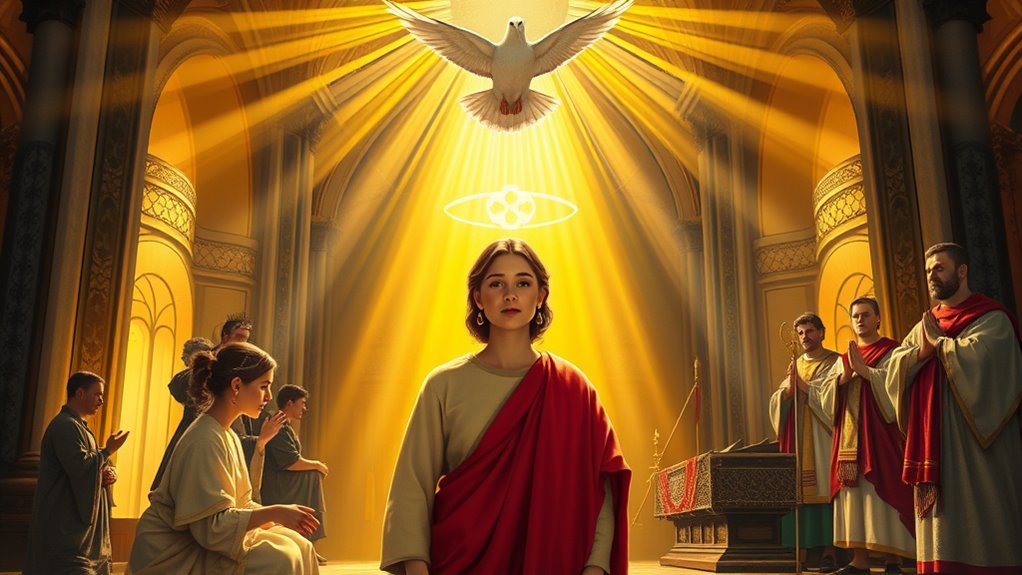

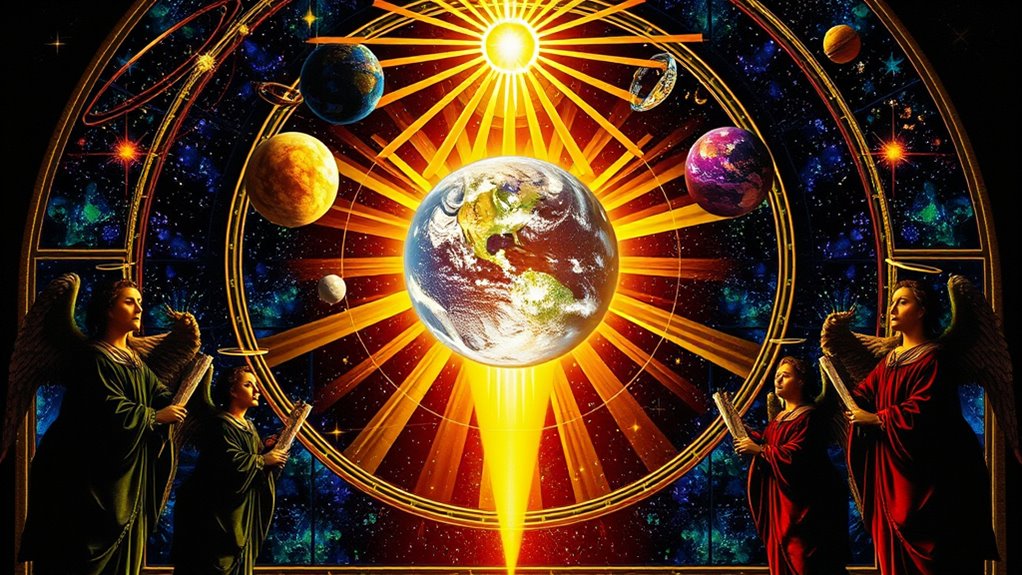
The Bible does not directly mention intelligent life on other planets, focusing instead on God’s relationship with humanity on Earth. Scripture emphasizes Earth’s unique purpose and Christ’s incarnation in human form to accomplish redemption. This silence does not necessarily rule out extraterrestrial life, as the Bible leaves many scientific topics unaddressed while providing complete spiritual guidance. Medieval theologians proposed God could create other worlds, and modern scholars note that discovery of alien beings would not inherently contradict core Christian doctrines. The sections below explore these theological considerations further.
Key Takeaways
- The Bible does not explicitly mention intelligent extraterrestrial life or civilizations on other planets.
- Scripture focuses on God’s relationship with Earth and humanity rather than addressing beings beyond our planet.
- Biblical passages about celestial bodies emphasize God’s creative power, not the existence of alien life.
- Christian theology remains open to extraterrestrial life since the Bible’s silence allows interpretive flexibility.
- Discovery of alien life would not necessarily contradict core Christian doctrines like creation or resurrection.
Why Doesn’t the Bible Mention Extraterrestrial Life?

The Bible’s silence on extraterrestrial life stands as one of its most conspicuous omissions for modern readers pondering humanity’s place in the universe.
Scripture contains no specific references to intelligent beings inhabiting other planets, focusing instead on God’s interactions with Earth-based humanity. Passages occasionally interpreted as evidence of aliens, such as Ezekiel’s visions or Christ’s mention of “other sheep” in John 10:16, require significant reinterpretation to support such claims.
When biblical authors reference stars and celestial space, they do so exclusively to glorify God’s creative power rather than hint at alien civilizations.
This absence parallels other unmentioned modern realities like DNA or the Internet, suggesting the topic falls outside Scripture’s redemptive scope, which centers on providing everything necessary for spiritual life and godliness, as stated in 2 Peter 1:3.
Scholars note that the original biblical languages—Hebrew, Aramaic, and Koine Greek—shaped how authors described the cosmos and life beyond Earth, affecting what was written about the heavens and inhabitants therein, including the use of Koine Greek.
What Does the Bible Say About Earth’s Unique Purpose?

While Scripture remains silent on life beyond our planet, it speaks extensively about Earth’s distinct role within creation. According to Psalm 115:16, God gave Earth to humanity as their dwelling place. Isaiah 45:18 describes how God formed the planet specifically to be inhabited. The text emphasizes Earth’s unique conditions, water, atmosphere, and food sources that sustain human life naturally, features absent on other planets in our solar system.
Genesis establishes humanity’s mandate to steward creation, beginning in Eden’s garden. This responsibility extends to caring for animals, preserving endangered species, and maintaining Earth’s ecosystems. Psalm 37:29 indicates the righteous will possess the Earth perpetually.
Second Peter 3:13 and Isaiah 65:17 reference a future renewed Earth where righteousness dwells, suggesting God’s original purpose for the planet ultimately finds fulfillment. The Bible also emphasizes God’s transcendence and spirit nature, so descriptions of divine action toward Earth often use symbolic imagery rather than literal physical details.
Why Did Jesus Take Human Form Instead of Alien Form?

According to Christian theology, Jesus’ incarnation as a human being represents the central axis around which all creation revolves, making human form essential rather than optional for God’s redemptive plan. Biblical doctrine positions humans as created in God’s image, establishing unique dignity within creation.
The New Covenant presents Jesus as the Word who became flesh to enter human history, demonstrating humility by taking the form of a servant. Human physicality enabled genuine suffering, death, and resurrection—components Christian theology deems essential for salvation.
The cosmic order was designed for the incarnate Son to reign as man, not as any other being. Alternative physical forms would contradict Scripture’s principle that all creation must be summed up in Christ’s humanity. Jesus was ethnically Jewish, living within first-century Palestinian society and participating fully in Jewish religious life ethnically Jewish.
Could Intelligent Alien Life Exist Outside Scripture’s Focus?

Whether intelligent life exists elsewhere in the cosmos remains a question the Bible does not directly address, leaving room for thoughtful Christians to contemplate possibilities beyond Earth’s borders.
Scripture provides complete relational knowledge with God rather than an exhaustive universal catalog.
The Earth-centric narrative emphasizes humanity’s unique redemptive focus, with celestial bodies serving purposes tied to Earth’s days, seasons, and signs.
Medieval theologians, including John Buridan, proposed God could create other worlds with intelligent life.
Discovery of alien beings would not contradict core doctrines like creation, fall, or resurrection.
God’s infinite nature allows for variety in intelligent life forms.
The Bible’s silence on extraterrestrials suggests neither confirmation nor denial, permitting theological openness while maintaining Earth’s central role in redemption history.
Theological reflection often relies on doctrines like the Doctrine of the Trinity to maintain monotheism while allowing for diverse created persons.