The Bible does not mention Christmas trees, as the tradition developed more than a millennium after the biblical texts were completed. While Jeremiah 10:3-4 describes cutting trees and decorating them with silver and gold, the passage refers to carved wooden idols, not festive decorations. The concern is idolatry—worshiping the tree itself or attributing divine power to it—rather than using evergreens as simple decorations that point toward Christ’s birth. The following sections explore when decorative trees cross into forbidden territory and when they remain permissible expressions of celebration.
Key Takeaways
- The Bible does not explicitly mention Christmas trees; the tradition developed centuries after biblical texts were written.
- Jeremiah 10:3-4 describes decorating trees but refers to carved wooden idols, not festive holiday decorations.
- A Christmas tree becomes idolatrous only when worshiped, treated as sacred, or given divine attributes or power.
- Trees used purely as decorations without religious veneration or prayers directed toward them remain biblically permissible.
- Scripture uses trees positively as metaphors for God’s provision and restoration, distinct from condemned idol worship.
What Does the Bible Actually Say About Christmas Trees?
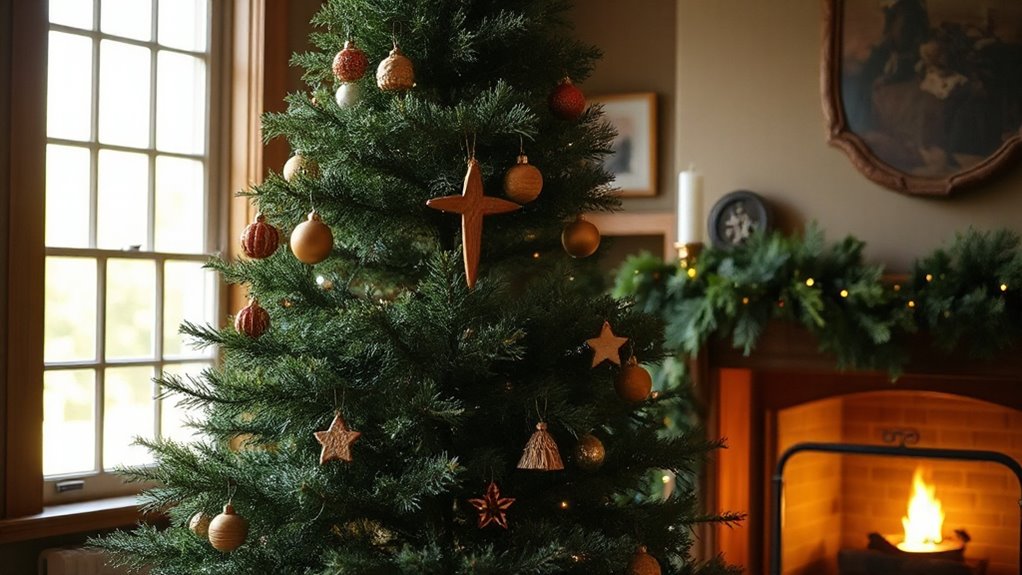
When Christians decorate evergreen trees each December, few pause to contemplate whether Scripture addresses the practice directly. The Bible contains no explicit mention of Christmas trees, since the holiday tradition emerged centuries after the text was written. Jeremiah 10:3-4 describes cutting trees from forests and decorating them with silver and gold, but the context reveals wooden idols carved by craftsmen, not festive decorations. The passage contrasts lifeless statues that “stand upright like palm trees” and “cannot speak” with the living God.
Other Old testament warnings target pagan worship practices involving sacred trees near altars, not household celebrations. Meanwhile, positive tree imagery appears throughout Scripture, from Hosea’s green pine symbolizing God’s provision to Isaiah’s promised cedars representing restoration. The long history of Christian veneration at specific holy sites, such as the Church of the Nativity, shows how later traditions shaped Christian practices.
When Christmas Trees Become Idolatry (And When They Don’t)

Understanding what Scripture condemns helps clarify the line between acceptable tradition and spiritual danger. Idolatry occurs when individuals worship a Christmas tree, bow before it, or attribute divine power to its presence. Treating the tree as a sacred object in religious rituals, or equating it with spiritual authority, mirrors the practices Deuteronomy 12:29-32 forbids. Excessive attachment that views the tree as a luck charm or prosperity symbol also shifts focus toward material worship.
Conversely, trees remain permissible when functioning simply as decorations without religious veneration. Absence of prayers, offerings, or deification prevents idolatrous use. Christian symbolism connecting evergreens to Eden’s tree of life or Christ’s cross redeems the tradition. Modern idolatry more closely resembles reliance on smartphones over God than seasonal decorations, provided the celebration maintains its focus on Christ’s birth rather than the object itself. The Bible also emphasizes that God is spirit and invisible, reminding believers that worship should be directed to God’s spiritual nature rather than material objects.