
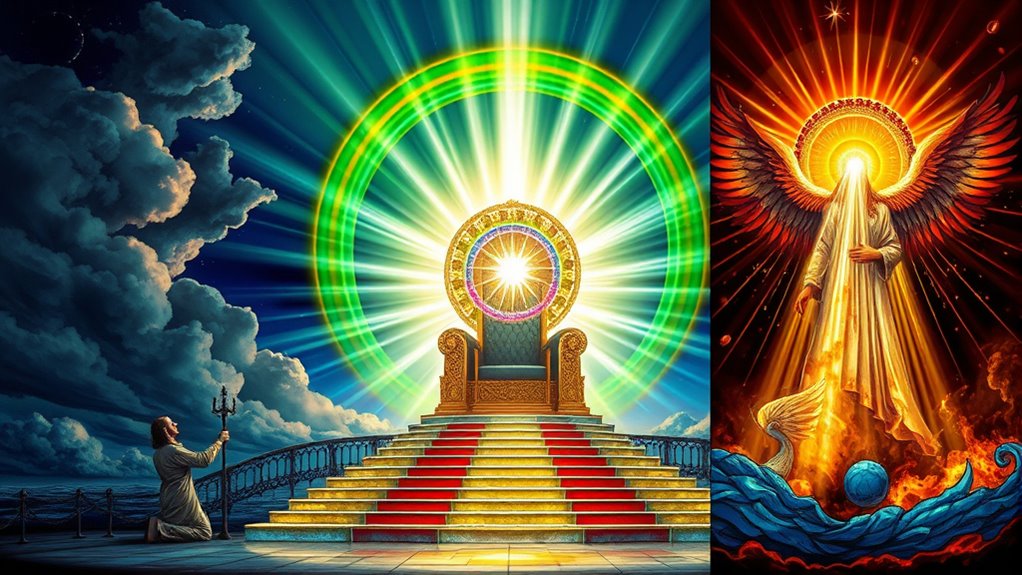
In Genesis 9, God establishes a covenant with Noah, his descendants, and every living creature, designating the rainbow as an everlasting sign that no flood will again destroy all flesh. The Hebrew term for rainbow means “war bow,” suggesting God set aside the weapon of judgment. Later, Ezekiel 1:26–28 and Revelation 4:2–3 portray a rainbow encircling God’s throne, representing divine faithfulness and mercy amid judgment. Early interpreters connected this imagery to Christ as mediator of grace. The rainbow consequently conveys hope, patience, and unmerited favor across Scripture’s narrative arc.
Key Takeaways
- The rainbow first appears in Genesis 9 as God’s covenant sign promising never to destroy all flesh with a flood again.
- God designated the rainbow as an everlasting covenant with Noah, his descendants, and every living creature on earth.
- The rainbow symbolizes divine hope, mercy, and grace—God’s patience and faithfulness despite humanity’s sin and deserved judgment.
- In Ezekiel and Revelation, rainbow imagery surrounds God’s throne, representing His faithfulness and glory amid judgment.
- Christians interpret the rainbow covenant as ultimately fulfilled in Christ, who mediates God’s grace and restrains divine wrath.
The Rainbow Covenant in Genesis

After the floodwaters receded and Noah’s ark came to rest on dry ground, God established a covenant with Noah, his descendants, and every living creature that had survived the deluge.
This agreement, described in Genesis 9, promised that never again would a flood destroy all flesh on earth. God designated the rainbow as the visible sign of this everlasting covenant. The Hebrew term for rainbow denotes a “war bow,” suggesting God had hung up His weapon of judgment. When clouds gather and the rainbow appears, God sees it and remembers His promise.
The covenant extended beyond humanity to include all animals—both clean and unclean—representing the universal scope of divine mercy for all creation across future generations. Modern biblical scholarship notes the text’s preservation across centuries and languages, supported by extensive manuscript evidence and textual integrity, which helps explain how this ancient covenantal tradition reached us.
What Rainbows Mean in the Bible: Hope, Mercy, and Grace

The appearance of a rainbow in Scripture carries layered meanings that extend beyond its role as a covenant marker, encompassing themes of hope, mercy, grace, renewal, and divine glory. After the flood, the rainbow signaled God’s mercy when wrath was deserved, reminding humanity of patience and inclusion in covenant promises.
It represents grace given despite great sin, paralleling how Christ’s sacrifice follows judgment like a rainbow follows storm. The symbol also conveys hope for renewal and spiritual uplift, encouraging gratitude for future gifts from God.
In Ezekiel 1:28 and Revelation 10:1, rainbow-like brightness surrounds divine figures, linking the phenomenon to God’s glory and the promise of salvation. Each appearance invites reflection on God’s faithfulness and unmerited favor. The connection between divine judgment and mercy is reflected in sacred locations such as the site of Jesus’ crucifixion at Golgotha, which stands outside the ancient city walls.
The Rainbow as a Symbol of Christ
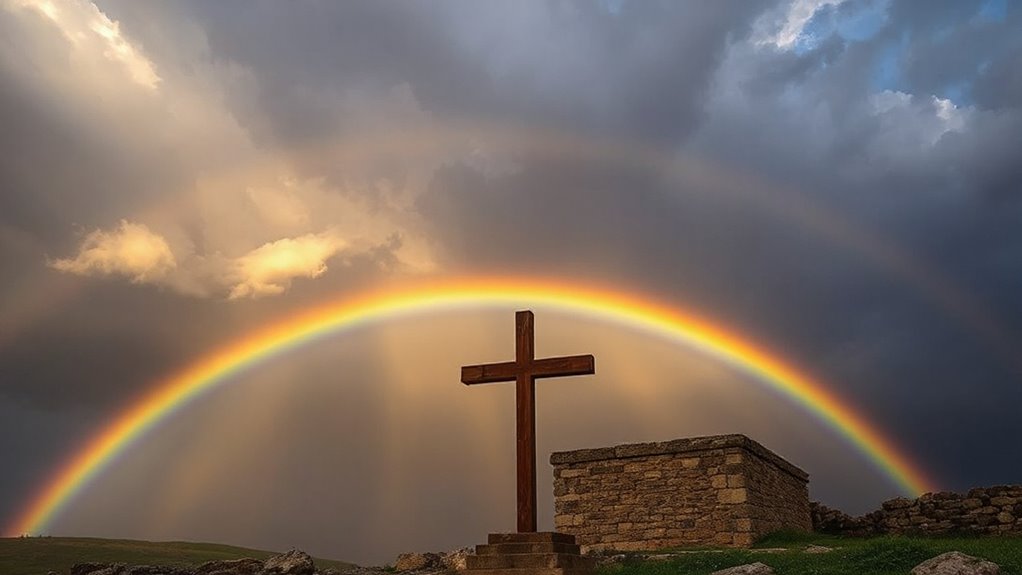
Throughout Scripture, the rainbow’s covenant significance finds its ultimate fulfillment in Christ, who serves as the mediator between God and humanity.
Ezekiel 1:26–28 describes a figure like a man on a throne surrounded by rainbow-like radiance, which early interpreters identified as Christ.
Similarly, Revelation 4:2–3 depicts an emerald rainbow encircling God’s throne, with Jonathan Edwards noting that emerald green symbolizes “lively divine grace.”
John Gill interpreted the rainbow’s varied colors as representing Christ being “full of grace and truth,” offering peace and reconciliation.
The rainbow consequently parallels Christ’s role in the covenant of grace, purchased through his death and resurrection.
Just as the rainbow assured Noah of God’s mercy, Christ presents believers faultless before God, restraining divine wrath while providing salvation.
The inclusion of deuterocanonical books like Wisdom in the Catholic canon underscores how early Christian Scripture—preserved in the Septuagint—shaped such covenantal imagery deuterocanonical books.
Rainbows Around God’s Throne in Ezekiel and Revelation
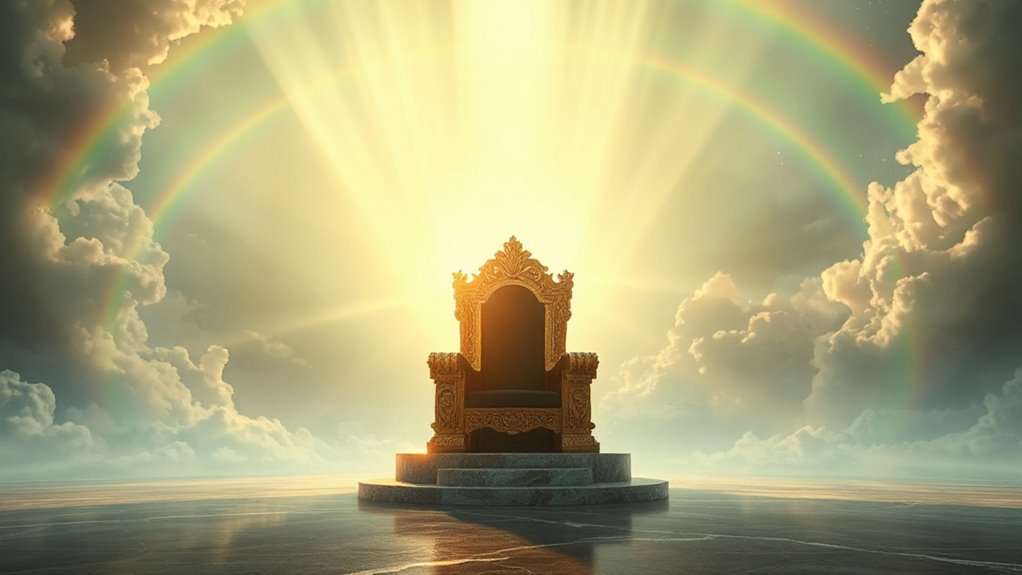
Within Ezekiel’s prophetic vision of divine glory, a rainbow-like radiance encircles the throne, evoking the covenant sign first given to Noah after the flood. The prophet describes this brightness as resembling a bow in the clouds on a rainy day, directly alluding to Genesis 9:13-16.
These are the only Old covenant passages pairing “bow” and “cloud” together. The radiance affirms God’s mercy enduring amid judgment.
Similarly, Revelation 4:2-3 depicts a rainbow like emerald encircling the heavenly throne, linking divine glory to covenant faithfulness. In Revelation 10:1, a mighty angel descends with a rainbow upon his head, echoing Ezekiel’s fire-rainbow imagery.
These visions consistently portray the rainbow as representing God’s faithfulness, offering hope grounded in divine perfection even during trials. The Bible contains a total of 31,102 verses across 66 books, which provides the canonical structure within which these rainbow images appear total verses.