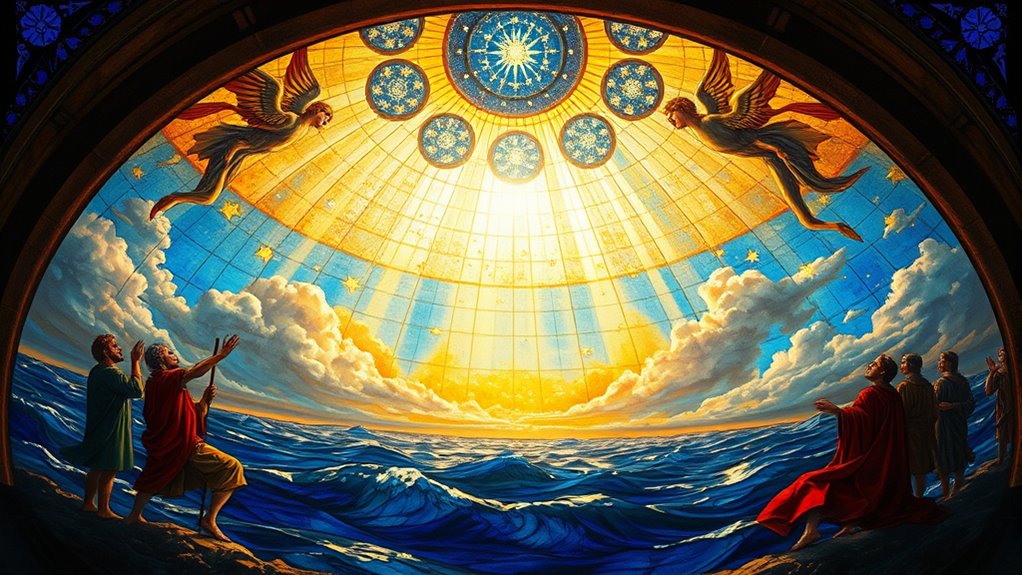
The Bible introduces the firmament in Genesis 1:6–8, where God creates an expanse to separate waters above from waters below, calling it “Heaven.” The Hebrew word *raqia* suggests something stretched or beaten flat, pointing to an ancient understanding of the sky as a structured boundary. Whether the Israelites viewed it as literally solid or more figuratively remains a meaningful question — one the outline above addresses carefully.
What Does “Firmament” Actually Mean in Hebrew?

The Hebrew word at the center of this discussion is *rāqīaʿ*, a term whose meaning has shaped centuries of debate about what the Bible actually describes when it speaks of the sky and heavens. It derives from the root *rqʿ*, meaning “to beat or spread out thinly,” conveying the image of hammering metal into a thin sheet.
Lexicographers Brown, Driver, and Briggs define the noun as “extended surface, (solid) expanse (as if beaten out).” A related Phoenician word from the same root refers to a tin dish, reinforcing the hammered-metal image. Modern Hebrew lexicons list “extended surface, expanse” as the primary definition. This range of meaning explains why translators have disagreed for centuries, with some choosing “firmament” and others preferring “expanse.”
The Davidson Analytical Hebrew and Chaldee Lexicon further notes that *rāqīaʿ* carries the sense of stamping with the feet or treading down, alongside the meaning of stretching and spreading out, illustrating how the term encompasses both forceful compression and expansive spreading in its semantic range.
A closely related noun, *riqquaʿ*, appears in Numbers 16.38, where it refers specifically to hammering metal into sheets, demonstrating that the concept of beaten or flattened material was consistently embedded in this family of Hebrew words.
How the Firmament Fits Into the Genesis Creation Account

Positioned on the second day of the six-day creation sequence, the firmament occupies a structurally significant place in Genesis 1. God commands its creation in verse 6, placing it amid primordial waters to divide them.
Verse 7 records the division itself—waters below separated from waters above—and verse 8 assigns the name Heaven to the completed structure. Crucially, the second day omits the repeated phrase “and it was good,” a distinction scholars frequently observe.
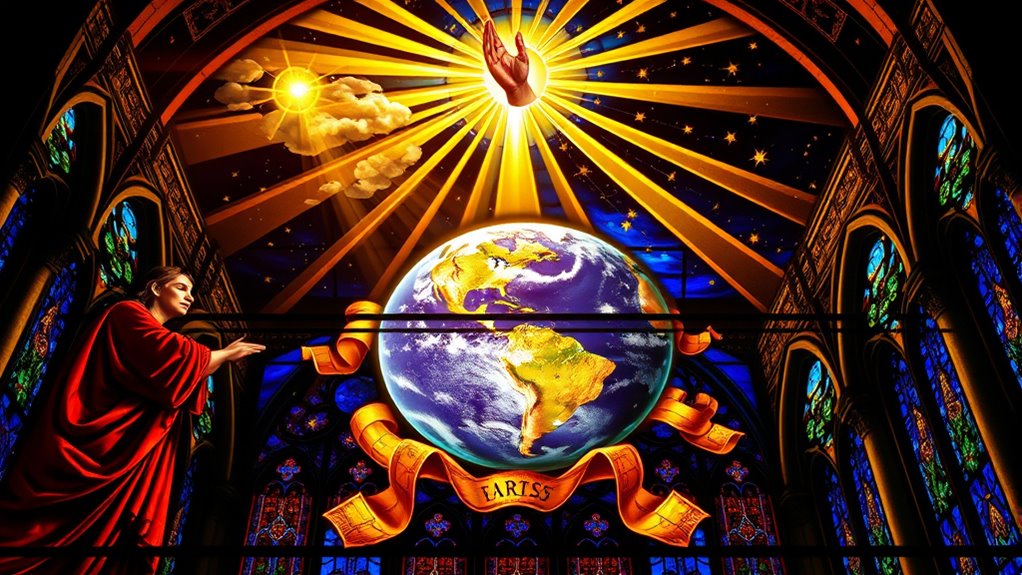
The firmament’s creation then enables Day 3‘s events: waters beneath it gather into one place, allowing dry land to emerge. This progression moves deliberately from division to consolidation, suggesting the firmament functions less as an isolated feature and more as a foundational stage preparing Earth for habitation. The word firmament itself derives from the Latin firmamentum, meaning “sky” or “expanse,” a term that reflects the structural and spatial role the concept plays throughout Scripture. God’s command that the waters gather to one place was the direct condition under which dry land appeared, marking the transition from a water-covered world to one capable of sustaining life.
What Was Above and Below the Firmament?

Once the firmament was set in place on the second day, the question of what it separated naturally follows.
Below the firmament lay the waters gathered into oceans, seas, rivers, lakes, and subterranean sources. These formed from the initial chaotic waters described in Genesis 1:2 and were later collected into seas on the third day.
Above the firmament, interpreters generally identify clouds and atmospheric vapor. Psalm 148:4 praises “waters above the heavens,” while Psalm 104 connects those upper waters to clouds within the creation context. An alternative reading describes a heavenly sea resting above a solid dome.
Both positions agree on one point: God exercised sovereignty over all waters, whether above or below, establishing order from what was once formless and undefined. Some creation scientists have proposed a vapor canopy theory to explain the pre-flood environment and the mechanism behind the global flood described in Genesis 7.
Scholars such as Basil, Augustine, and Calvin historically favored the view that the waters above the firmament referred to clouds and atmospheric phenomena rather than a literal ocean held back by a solid dome.
Did the Ancient Israelites Think the Firmament Was a Solid Dome?

Among the more contested questions in biblical studies is whether ancient Israelites pictured the sky as a solid, physical dome. Many scholars, including Paul Seely, argue that all ancient peoples understood the sky as a firm, physical structure. Pre-Copernican Jewish commentators consistently treated the rāqîaʿ as solid, and the Talmud even debates its thickness. The Greek translation rendered rāqîaʿ as stereōma, meaning something steadfast and firm.
However, other scholars, like Vern Poythress, caution that Genesis language is phenomenological rather than scientific. Some researchers note that the Old Testament also references rain from clouds, suggesting awareness beyond a simple solid-dome model. Poythress further argues that no good evidence exists that ancient Near Eastern peoples actually held the solid-dome and heavenly-sea view. The evidence points toward genuine uncertainty, and careful readers are encouraged to weigh multiple scholarly perspectives before reaching firm conclusions.
Seely also contends that the Hebrew word ʿasah, meaning “made,” used for the rāqîaʿ implies a tangible manufactured solid, yet critics point out that no Old Testament textual comparisons are provided to demonstrate that ʿasah would be inappropriate for the creation of gases or similar matter.