

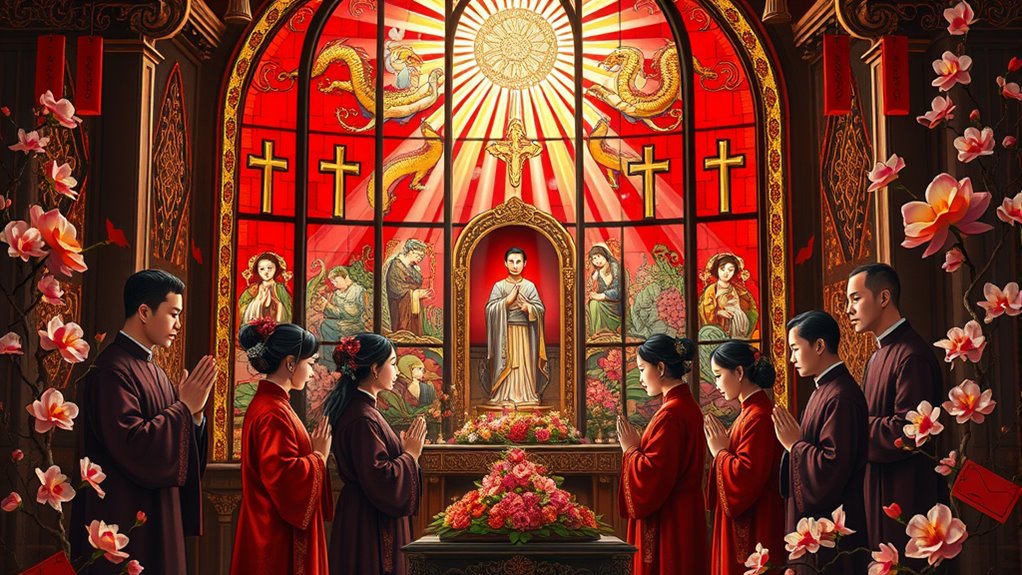
Asian Catholics across multiple countries integrate Lunar New Year traditions with their faith through practices that honor both heritage and devotion. Vietnamese Catholics prepare through confession and charitable works, while Filipino-Chinese parishes distribute red envelopes and hold anticipatory Masses that blend Chinese customs with Catholic liturgy. Home observances include placing traditional dishes on altars alongside Catholic prayers for the departed, replacing superstitious elements with spiritual meaning. These adaptations, spanning from Korea’s Seollal to Vietnam’s Tết, help parishes affirm ethnic identity across generations while maintaining religious commitment, creating a distinctive cultural-spiritual expression that reflects the experiences of approximately 2 billion celebrants worldwide.
Each year, as the first new moon rises between late January and mid-February, approximately 2 billion people across the globe prepare to celebrate the Lunar New Year, a 15-day festival that marks both cultural heritage and spiritual renewal.
In 2026, the Year of the Horse begins on February 17, with celebrations spanning multiple Asian countries where the holiday carries both cultural and religious significance.
For Asian Catholics, the festival presents an opportunity to blend ancestral traditions with Christian faith.
Catholic dioceses in the United States and churches worldwide now recognize Lunar New Year as a significant observance, adapting celebrations to honor both spiritual practice and cultural identity.
Vietnamese Catholics prepare through confession, charitable works, and organizing packages of stuffed sticky rice cakes for communities living in poverty.
These charitable actions, viewed as bringing blessings to families, replace superstitious elements while maintaining cultural meaning.
At home, families place traditional dishes on altars, incorporating Catholic prayers for the departed alongside cultural observances.
In the Philippines, the Filipino-Chinese Catholic parish in Binondo prepared red envelopes for parishioners during the 2026 celebration.
Cardinal Jose Advincula presided over an anticipatory mass on February 14, deliberately blending Chinese tradition with Catholicism.
The celebration affirms Filipino-Chinese identity across generations, particularly visible in Chinatown communities.
Traditional symbols remain central to observances.
Red envelopes are exchanged from older to younger family members, while dragon and lion dances symbolize wisdom, power, and wealth.
Fireworks ward off the legendary beast Nian, and families clean homes to sweep away misfortune before decorating with red couplets and bright orchids.
Regional variations reflect local customs.
Vietnam celebrates Tết with peach and kumquat trees in the North, while Korea observes Seollal with charye rituals where families prepare food and serve ancestors.
Thailand integrates ancestral remembrance with church-adapted traditions, and Indonesia features dragon puppets and drum displays.
Diaspora communities organize parades and cultural performances to maintain connections to their heritage.
The economic impact extends beyond cultural significance.
The San Francisco Chinese Chamber of Commerce identifies the celebration as Chinatown’s biggest economic driver, while DoorDash reported over 75,000 daily fried rice orders during the Lunar New Year period across the United States.
The festival is also known as Chinese New Year or Spring Festival, names reflecting its widespread recognition across cultures.
Some Asian Catholic communities also consider pastoral guidance on funerary practices such as cremation vs burial when integrating cultural rites with Church teaching.