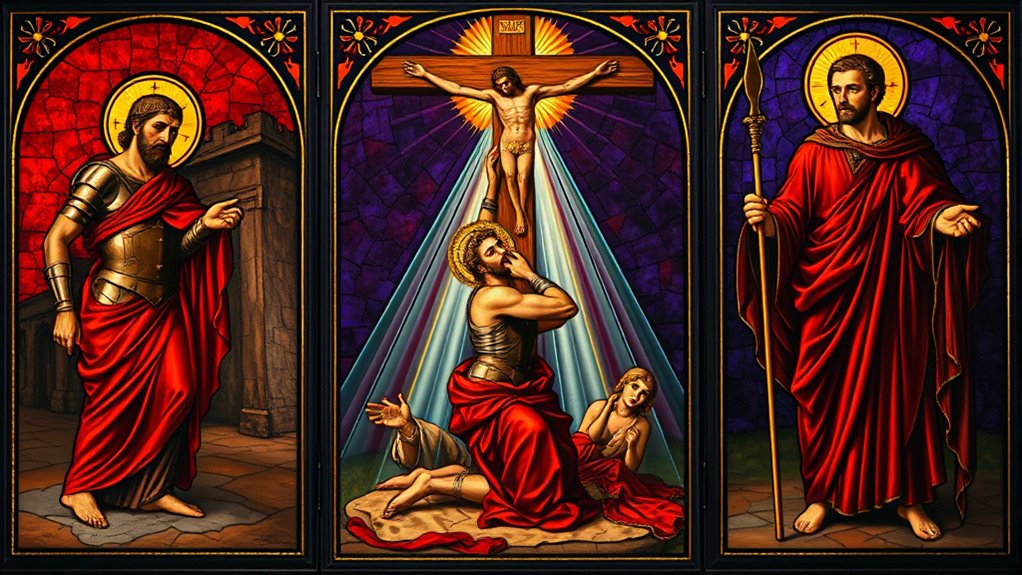
St. Longinus was the Roman centurion who, according to Christian tradition, pierced Jesus Christ’s side with a spear at the crucifixion to confirm his death. The Gospel of John records that blood and water flowed from the wound. Longinus, reportedly suffering from an eye ailment, experienced healing when the liquid touched his eyes, leading to his conversion to Christianity. He later left the Roman army, received baptism from the apostles, and became a monk in his native Cappadocia, where he preached the Gospel and converted many. His evangelistic activities eventually led to his arrest and martyrdom, with his feast day celebrated on October 16 in both Catholic and Orthodox traditions. The full account of his transformation reveals a remarkable journey from executioner to saint.
Who was the Roman soldier who stood at the foot of the cross and proclaimed Jesus the Son of God? According to Christian tradition, his name was Longinus, the centurion who commanded soldiers at Golgotha during the Crucifixion. The Gospel of John records that he pierced Jesus’ side with a spear to confirm his death, observing blood and water flow from the wound. After witnessing the earthquake, darkness, and other miraculous events surrounding the death, Longinus declared Jesus the Son of God, as noted in Mark’s Gospel.
Before this pivotal moment, Longinus reportedly suffered from near-blindness or an eye infection that troubled him greatly. When blood and water from Jesus’ side touched his eyes, his sight was miraculously restored in one eye. This healing reinforced his faith immediately and marked the beginning of his conversion to Christianity.
Following the Crucifixion, Longinus guarded Jesus’ tomb and witnessed the Resurrection. He refused bribes from Jewish authorities who wanted him to deny what he had seen. After leaving the Roman army, he received baptism from the apostles and abandoned both paganism and military violence. He then traveled to his native land of Cappadocia, where he took further instruction in the faith.
In Cappadocia, Longinus became a monk and lived as a hermit while evangelizing nearby communities. He preached the Gospel with dedication, converting many pagans and destroying idols despite facing torture from local governors. He later withdrew to his father’s estate to continue his religious life.
His former comrades eventually arrested him for his faith. During his torture, soldiers pulled his teeth and cut out his tongue, yet he miraculously continued speaking clearly. He was beheaded in Jerusalem on orders from Pilate. Even at his execution, the soldiers showed reluctance to kill him, but Longinus insisted they carry out their duty.
Today, both Catholic and Orthodox traditions venerate Longinus as a saint, celebrating his feast day on October 16. He is depicted in Byzantine art holding a spear and serves as patron of finding lost items. The story of Longinus is often cited in discussions of servant leadership as an example of transformation from military duty to humble Christian service.