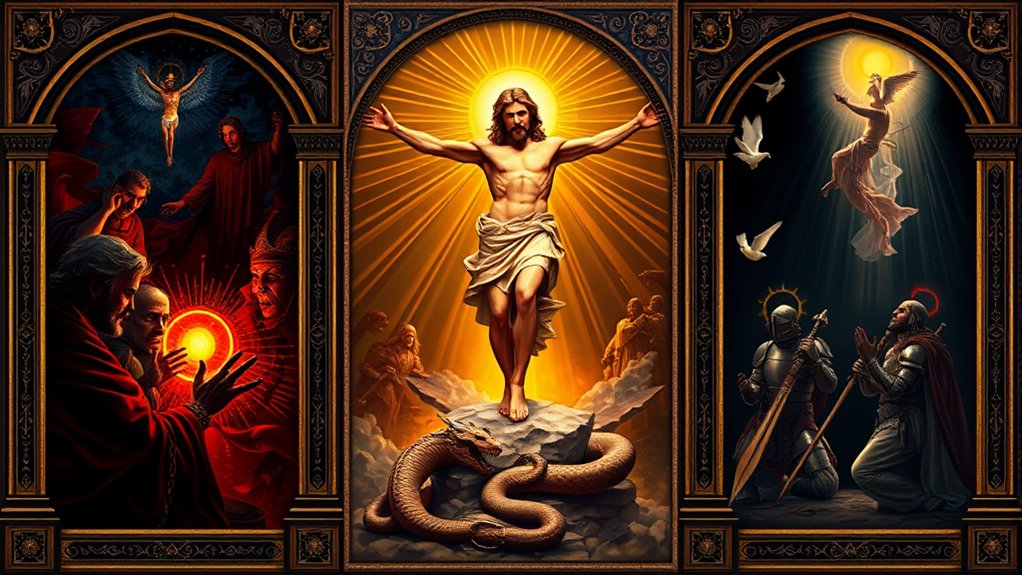
The Bible identifies demons as fallen angels who rebelled against God and were cast from heaven, as described in Revelation 12:7–9. Their primary activities include deceiving people about the gospel, promoting false teachings, and opposing God’s kingdom through spiritual warfare. Scripture records instances of demonic possession causing physical torment and altered behavior, though Christ’s victory on the cross established authority over these forces. Believers can resist demonic influence through submission to God, while the biblical account offers both explanation of spiritual conflict and assurance of ultimate triumph for those who explore these teachings further.
Key Takeaways
- Demons are fallen angels who rebelled against God, with Satan and one-third of angels cast from heaven.
- Demons actively deceive people, promote false teachings, and oppose God’s kingdom and the gospel of Christ.
- Demonic manifestations include possession, physical torment, superhuman strength, and involvement in occult practices and idolatry.
- Jesus defeated demonic powers through His death and resurrection, securing ultimate victory over evil forces.
- Believers resist demons by submitting to God, relying on Christ’s authority, and engaging in spiritual warfare.
Who Demons Are: Biblical Origins and Fallen Nature

According to traditional Christian theology, demons originated as angels who rebelled against God and were cast out of heaven. Revelation 12:7-9 describes this cosmic conflict, identifying the dragon as Satan and his angels who were expelled from heaven. The passage in Revelation 12:4 mentions one third of the stars swept to earth by the dragon’s tail, which theologians interpret as symbolizing these fallen angels. These rebellious spirits are collectively referred to as “Satan and his angels” in scripture. Many biblical writings about angels and demons were composed across centuries, reflecting a development of these ideas from roughly 1500 BC to 100 AD, including the Septuagint translation that helped transmit Hebrew concepts into the wider Greek-speaking world. Some ancient Jewish texts, including the Book of Enoch, propose an alternative origin involving the Nephilim—giants born from unions between angels and humans in Genesis 6:1-4. However, mainstream Christian teaching emphasizes the angelic rebellion as the primary explanation for demonic origins.
What Demons Do: Deception, Destruction, and Spiritual Warfare

Understanding the origins of demons provides the foundation for examining their activities throughout Scripture.
Examining demonic origins equips believers to understand the spiritual warfare and destructive patterns revealed throughout biblical history.
The Bible describes demons pursuing two primary goals: deception and destruction. According to 2 Corinthians 4:3–4, they blind unbelievers to the gospel, while 1 Timothy 4:1 warns they promote false doctrine. Deuteronomy 32:16–17 and 1 Corinthians 10:20 connect them to false religions and occult practices.
Their destructive aims include attacking faith in Christ, opposing God’s kingdom, and harassing believers, as noted in Ephesians 1:9–10 and 1 Peter 5:8. Matthew 8:16 and Acts 19:16 document cases of possession causing physical torment and superhuman strength.
Yet Scripture offers hope: Colossians 2:15 declares Christ defeated them at the cross, and James 4:7 affirms they can be resisted through submission to God. The doctrine that God and Jesus are distinct persons yet one in essence is relevant here, since Jesus’ divine authority over demons flows from the unity of the divine essence.