



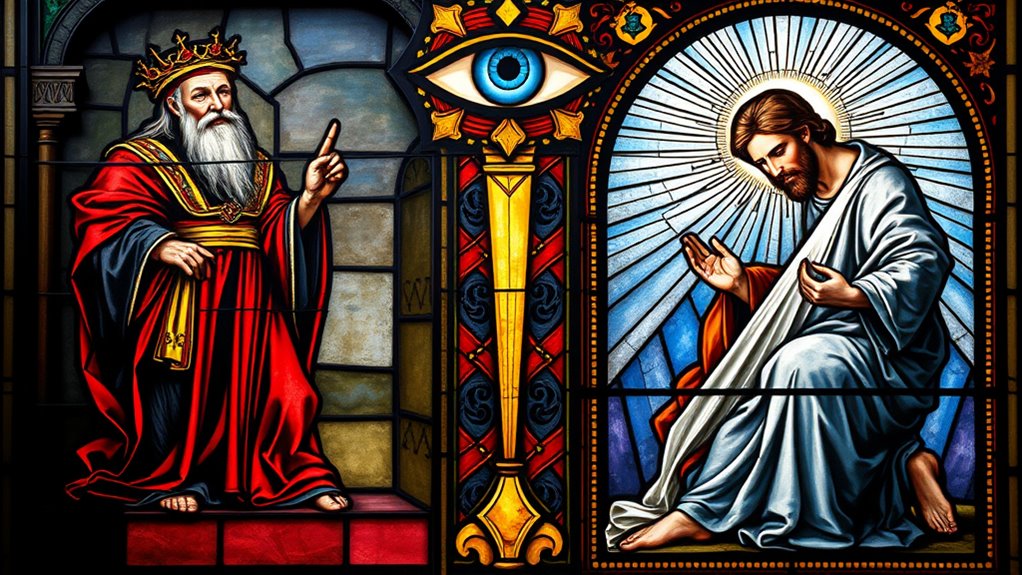
The Bible consistently presents humility as essential for receiving God’s grace, with James 4:6 declaring that “God opposes the proud but gives grace to the humble,” echoing Proverbs 3:34 and repeated in 1 Peter 5:5. Pride blocks relationship with God by elevating self over divine sovereignty and preventing genuine repentance, while humility opens the path to grace through recognizing dependence on God rather than personal resources. The passages below explore how to identify pride’s subtle manifestations and embrace the posture that invites divine help.
Key Takeaways
- God gives grace to the humble but opposes the proud, as stated in James 4:6 and 1 Peter 5:5.
- Humility requires acknowledging God’s sovereignty and recognizing our need for divine help rather than self-reliance.
- Pride blocks relationship with God by preventing repentance and elevating self above dependence on Him.
- Humble people accept correction willingly, while the proud scoff at reproof and resist submitting to authority.
- Jesus modeled humility through His life and teaching, showing the path to receiving God’s grace.
Why God Opposes the Proud but Gives Grace to the Humble

Throughout the Bible, a consistent message emerges about the relationship between human pride and divine response, captured most clearly in James 4:6, which states that “God opposes the proud but gives grace to the humble.” This verse, which James draws from Proverbs 3:34, appears again in 1 Peter 5:5, establishing it as a foundational principle repeated across both Old and New Covenants.
Scripture explains that pride prevents people from seeking God because the proud elevate themselves and refuse to acknowledge God’s sovereignty. Psalm 10:4 describes how pride consumes a person’s thinking, leading them to deny God entirely.
This attitude blocks salvation by rejecting repentance, inflating self-view while diminishing God and others. In contrast, God extends grace to the humble, those who recognize their need for divine help and submit to His authority rather than relying solely on themselves. The Christian doctrine of the Trinity also teaches that the Father, Son, and Holy Spirit are distinct persons who share one divine essence, highlighting how worship of Jesus is compatible with monotheism and the call to humility toward one divine essence.
How to Recognize Pride in Your Own Heart

Recognizing pride in one’s own heart presents a particular challenge because pride naturally disguises itself, convincing the proud person that their attitudes and actions stem from legitimate concerns rather than self-elevation.
Pride hides in plain sight, masking self-elevation as righteous concern and blinding us to our own spiritual condition.
Scripture identifies specific warning signs. Proverbs 15:12 notes that scoffers reject reproof and avoid wise counsel, while defensiveness when receiving correction often signals underlying pride. An insatiable craving for honor, glory, and attention—such as seeking prominent positions like the Pharisees—reveals self-focus. Proverbs 16:5 warns that those wise in their own eyes face greater hopelessness than fools.
Additional indicators include taking credit for accomplishments that belong to God, finding fault in others habitually, and maintaining fierce independence that resists depending on others or submitting to authority.
Psalm 10:4 observes that pride-driven self-consumption pushes thoughts of God far away.
Jesus lived and taught within Jewish traditions, demonstrating humility in a first-century Jewish context.