The Bible addresses space across dozens of passages, touching on Earth’s shape, celestial function, and cosmic origins. Isaiah 40:22 references a circular earth, while Job 26:10 describes a boundary between light and darkness. Genesis presents the sun, moon, and stars as purposeful creations marking time and seasons. Hebrews 11:3 suggests creation from nothing. Scholars note at least eleven verses describing God “stretching out the heavens,” a phrase some connect to modern cosmological expansion. More specific answers follow below.
Key Takeaways
- The Bible describes God as sitting above the “circle of the earth,” suggesting awareness of Earth’s spherical shape.
- Genesis 1 presents the sun, moon, and stars as purposeful creations governing time, seasons, and sacred calendar events.
- At least eleven Bible verses describe God “stretching out the heavens,” which some scholars align with modern cosmic expansion.
- Prophetic books use celestial darkening imagery to communicate divine judgment, sparking debate over literal versus symbolic interpretation.
- Psalm 19 portrays the cosmos as natural revelation, declaring God’s glory and communicating the Creator’s nature to observers.
Does the Bible Describe Earth’s Shape and Position?

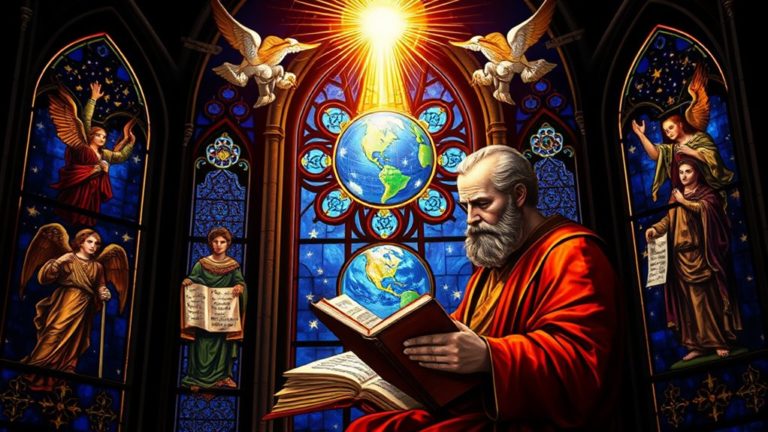
Among the questions Bible readers and scientists alike have explored is whether ancient scripture anticipated the spherical shape of Earth long before modern tools confirmed it. Several passages suggest an awareness of Earth’s geometry. Isaiah 40:22 references God sitting above the “circle of the earth,” using the Hebrew word *khûg*, meaning roundness, applicable to both circle and sphere. Medieval scholars translated this term using *sphaera* and *globus*, reinforcing spherical interpretation.
Job 26:10 describes a circular boundary separating light from darkness, consistent with how a globe appears from space. Genesis 1 implies Earth began as water gathering into a sphere through surface tension. Phrases like “four corners of the earth” are understood as idiomatic, not literal geographic claims about Earth’s shape.
Science has long corroborated this biblical picture, with mathematical proofs of a spherical earth established as early as the sixth century B.C. Notably, Hebrew lacks an original term equivalent to “sphere,” with modern Hebrew borrowing the loanword *s’fîrāh*, suggesting that biblical vocabulary itself does not straightforwardly assert precise geometric claims about Earth’s shape.
What Does the Bible Say About Stars, the Moon, and the Sun?

From the opening pages of Genesis, the Bible treats the sun, moon, and stars as purposeful creations rather than independent powers. Created on the fourth day, the sun governs daylight while the moon governs night. Together with stars, they mark seasons, days, and sacred calendar events. According to a footnote on Genesis 1:14, the Israelites relied on the sun and moon to determine when months and years began.
God is described in Job as commanding the sun and sealing up the stars, suggesting active governance over celestial movement. Psalm 148 calls the sun, moon, and stars to praise God, framing them as participants in worship rather than objects of it.
Prophetic books introduce a darker register: Isaiah, Joel, Ezekiel, and Matthew each describe celestial darkening as judgment imagery. Whether literal or symbolic, these references consistently portray celestial bodies as subject to divine authority rather than operating independently. In Isaiah 40:26 and Jeremiah 31:35, God is shown calling stars by name and establishing the fixed order of the moon and stars as expressions of his sovereign creative power.
Did the Bible Predict Universe Expansion?
Whether ancient scripture anticipated one of modern science’s most striking discoveries is a question that has drawn serious attention from both religious scholars and scientists.
Whether ancient scripture foretold modern cosmology remains a question commanding genuine attention from theologians and scientists alike.
At least eleven Bible verses, written by five different authors, describe God stretching out the heavens. Isaiah, Job, Jeremiah, and Zechariah each reference this imagery, some dating back 3,500 years. Edwin Hubble confirmed universe expansion in the 1920s by observing galaxies receding proportionally to their distance. Some scholars argue the biblical language aligns remarkably with modern cosmology.
Critics, however, contend those passages describe God constructing a habitable space for humanity, not cosmological expansion. They caution against reading scientific meaning into poetic ancient texts.
Most astronomers today accept expansion through general relativity, independent of any scriptural interpretation. If the universe is expanding, it logically implies the universe had a definite beginning, a conclusion that once troubled scientists like Einstein, who initially resisted the idea before eventually accepting it.
As the universe expands, it stretches light traveling through it, causing the wavelengths of that light to increase and shift toward the red end of the spectrum, a phenomenon known as redshift proportional to distance, which Hubble’s observations confirmed and which general relativity naturally explains.
How Did God Create Space, According to the Bible?
How God created space, according to the Bible, centers on a single foundational idea: the universe came into existence through divine command rather than from any pre-existing material.
Hebrews 11:3 describes matter forming from nothing visible, suggesting creation was not a rearrangement of existing elements but an entirely new beginning.
Genesis 1 presents a structured sequence. Earth appears first, followed by light, land, sea, and vegetation. The sun, moon, and stars arrive on the fourth day. The Hebrew word for stars in that account includes planets, comets, and asteroids, treating them as a collective formation.
Beyond mechanics, the Bible assigns purpose to this process. The vast cosmos, according to Psalm 19, was designed to reflect God’s creative power and serve his broader plan for humanity. Psalm 19:1 is cited by theologians as evidence that creation itself functions as natural revelation, declaring the glory of God without words. Isaiah 48:13 describes God stretching out the heavens by His own hand, affirming that divine creative authority extended across the entirety of what exists beyond Earth.
Why Did God Create Space?
The Bible’s answer to why God created space points less toward human benefit and more toward divine purpose. Psalm 19:1 states that the heavens declare God’s glory, suggesting the universe functions as a display of who God is rather than simply a backdrop for human life. Psalm 8:3 reinforces this, presenting the vast cosmos as evidence of an immense Creator. The use of cosmic imagery often employs symbolic imagery to communicate divine attributes rather than literal physical descriptions.
Yet divine glory and human purpose remain connected. Genesis 1 describes creation as sacred space where God dwells among image-bearers. Titus 1:2 notes that eternal life was promised before creation existed, indicating a long-planned fellowship between God and humanity. Revelation 21:1 points toward a renewed cosmos where that fellowship reaches completion, framing the entire universe as a theater for an eternal divine-human relationship.
Genesis 1:1 records the absolute beginning of time, space, and matter simultaneously, affirming that before creation, only God existed and nothing else preceded his creative act.
R.C. Sproul described creation as a grand theater of divine revelation, capturing the idea that the universe was intentionally designed not merely to exist but to communicate the nature and glory of its Creator.