
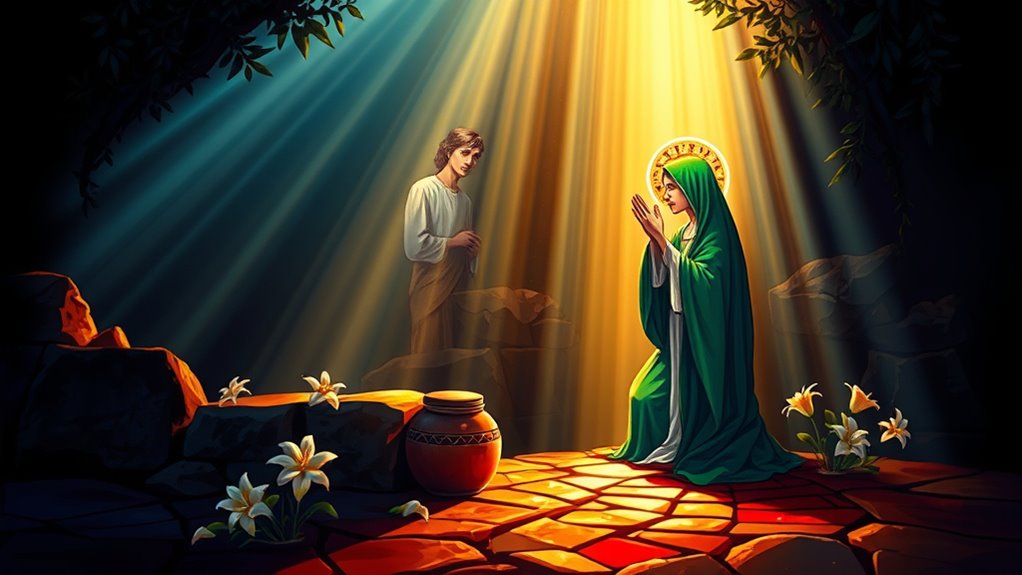
Mary Magdalene arrived at the tomb before sunrise, found the stone rolled away, and immediately assumed the body had been taken. She informed Peter and another disciple, then returned alone, weeping. She mistook Jesus for a gardener until He spoke her name. That single word, “Mary,” broke through her grief. She responded with “Rabboni,” meaning Teacher. Her encounter made her the first witness to the resurrection, a role the early church called Apostle to the Apostles. More awaits ahead.
What Mary Magdalene Saw Before Anyone Else Arrived
Before the sun had risen on the first day of the week, Mary Magdalene made her way to the tomb alone, arriving while it was still dark. What she found upon arrival was immediately significant: the stone had been rolled away from the entrance. No other individuals were present at that moment. She did not yet look inside or encounter any angels. Instead, she processed what she saw and quickly concluded that something had gone wrong. Her first response was to find Simon Peter and another disciple, reporting that the Lord’s body had been removed and its location was unknown. Her role as first witness of the risen Christ would later be affirmed across multiple gospel accounts, underscoring the remarkable nature of her testimony in a culture that dismissed women’s words in legal settings. Notably, when Jesus did appear to Mary, he addressed her by name alone, a single spoken word that carried the full weight of personal, intentional address and set the entire sequence of resurrection revelation into motion. Many theologians point to this moment as reflecting the broader biblical emphasis on covenantal commitment and restored relationship.
When Did Mary Magdalene Recognize the Risen Christ?
After Peter and the other disciple inspected the empty tomb and left, Mary Magdalene remained outside, weeping. She bent to look inside and saw two angels, who asked why she was crying. She turned and saw Jesus standing nearby but did not recognize him, mistaking him for a gardener (John 20:14–15). This moment echoes how appearances in apocalyptic and gospel narratives can mask true identity until a revealing word or sign is given, a theme found elsewhere in scripture and interpretation of symbolic figures like the beast imagery. Recognition came only when Jesus spoke her name: “Mary.” She immediately turned and responded, “Rabboni,” meaning Teacher (John 20:16). That single spoken word became the turning point. Mark 16:9 confirms she was the first person to see the risen Christ.
Jesus then commissioned Mary to bring word to the disciples that He had not yet ascended to the Father (John 20:17), making her the first messenger of the risen Lord. Her emotional distress and weeping outside the tomb, combined with the expectation of finding a dead man rather than a risen Savior, had obscured her recognition until that single, personal word cut through her grief.
Why Jesus Called Her by Name at the Tomb
The moment of recognition at the tomb hinged not on sight but on sound.
According to John 20:16, Jesus said simply, “Mary,” and she responded immediately with “Rabbouni,” an Aramaic word carrying greater intimacy than the standard “Rabbi.”
Prior to that single word, he had addressed her generically, asking why she wept and whom she sought.
The personal name cut through her grief and confusion where nothing else had.
Scholars note this exchange echoed John 10, where the shepherd calls sheep by name.
That deliberate, quiet address restored her identity and repositioned her as the first witness to the resurrection. Before arriving at the tomb that morning, Mary had endured a sleepless night, driven by desperation and a deep desire to see Jesus one final time.
She had not arrived at that tomb as a stranger to suffering, having previously lived what could only only be described as a spiritual battleground, with seven demons cast out of her before she became one of Jesus’ most devoted followers.
Her transformation also reminds readers of the ongoing work of the Holy Spirit in bringing new life and assurance to believers.
What Jesus Meant by “Do Not Hold On to Me”
Several details clarify His meaning:
- She was actively grasping Him when He spoke
- His ascension to the Father remained incomplete
- His earthly presence was temporary, not permanent
- She carried an urgent message for the disciples
- The Spirit would later enable a deeper connection
Mary had previously been delivered from seven demons and had followed Jesus throughout His ministry. The early church consistently taught about the reality of demons and spiritual opposition, emphasizing spiritual warfare in the life of believers.
The Holy Spirit, whom Jesus would send only after ascending to the Father, would serve as the revealer of Christ, guiding believers into all truth and glorifying the Son by declaring what is His.
The instruction was less a rebuke than a gentle reassignment.
What Mary Magdalene Proclaimed and Why Her Witness Mattered
Spoken to the gathered disciples, the announcement carried immediate theological weight, transforming her private encounter into a foundational claim for the early Christian community.
Early church tradition granted her the title “Apostle to the Apostles,” recognizing her unique role as primary messenger.
Her witness aligned with Romans 10:9, connecting belief in the resurrection to salvation.
Though the disciples initially rejected her account, her testimony proved reliable, demonstrating that faithful proclamation can precede institutional acceptance. The Church celebrates her memory each year on July 22, a feast day elevated in recognition by Pope Francis in 2016.
Alexander Ivanov captured this singular moment in his 1835 painting, depicting the two life-size figures at the instant of recognition between Mary and the risen Christ. The scene also echoes the Bible’s promise of eternal life offered through Christ’s victory over death.