





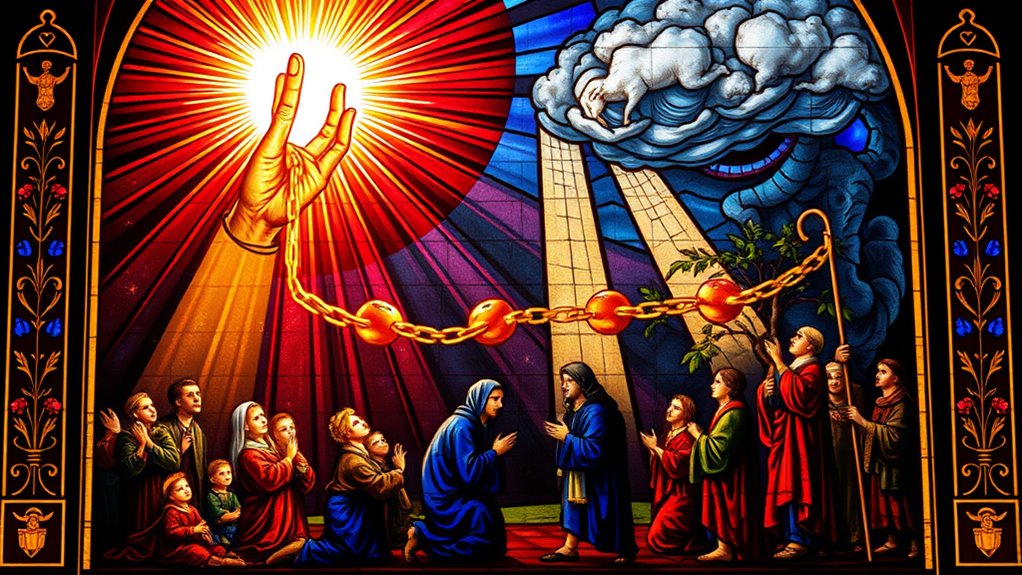
The Bible presents salvation as a secure, unbreakable chain rather than a fragile agreement. John 10:28 uses the present tense “I give” alongside an absolute Greek double negative, indicating believers possess eternal life immediately and permanently. Romans 8:30 traces an unbroken sequence from foreknowledge to glorification, with no gap allowing reversal. The Holy Spirit serves as a deposit guaranteeing inheritance (Ephesians 1:13–14). Those who depart were likely never genuinely regenerate (1 John 2:19), and exploring each passage further clarifies where true security stands.
What Does “Eternal Life” Actually Mean in John 10:28?
The promise recorded in John 10:28 carries weight that depends heavily on what the word “eternal” actually means in its original context. The Greek phrase *eis ton aiōna* translates as “into the age,” signaling unending duration rather than a temporary condition. Jesus uses the present tense *didōmi*, meaning “I give,” suggesting believers receive eternal life immediately upon faith. John 5:24 and 1 John 5:13 confirm this present possession. The Greek double negative *ou mē apolōntai* further intensifies the promise, making “never perish” an absolute guarantee across all time—not a conditional outcome dependent on continued human effort. The word *apolontai* itself carries the meaning of loss, condemnation, or death, making the negation of it a sweeping rejection of every form of spiritual destruction for those who belong to Christ. Critically, the same Greek term *aioniōs* used to describe eternal life for believers is also applied to God Himself in Romans 16:26, where He is called the eternal God, demonstrating that the duration intended by the word is not figurative or limited but identical in quality to God’s own existence. This continuity echoes the Bible’s broader teaching that death, while resulting from sin in Genesis, is ultimately overcome by Christ’s promise of resurrection and eternal life.
Who Are the Apostasy Warnings Actually Written For?
Understanding who receives the apostasy warnings in the New testament helps clarify what those warnings actually mean. Scholars note that Hebrews addresses professing Christians — people inside the faith community who may lack genuine, saving belief. Hebrews 6:4–6 describes individuals who experienced spiritual exposure without authentic commitment.
Similarly, Matthew 7:22–23 records Christ rejecting those who claimed his name yet remained unknown to him. These warnings serve a practical purpose: prompting self-examination before final rejection occurs. Rather than unsettling true believers, they target those drifting toward apostasy, equipping congregations to recognize false profession through its most telling indicator — absent fruit. Those who genuinely belong to Christ bear the marks of true saving faith, as love for others and spiritual fruit distinguish authentic belief from mere profession (1 John 4:7–8; Galatians 5:22–23).
The pastor writes with the whole congregation in mind, including himself among those addressed, as seen in passages like 3:14, 4:13, and 12:25, reflecting a shared pastoral accountability that binds the community together under the weight of these warnings. This pastoral tone also aligns with New Testament emphasis on gentle restoration and avoiding judgmentalism while calling people to holiness.
Can a True Believer Ever Lose Eternal Security?
Having identified who the apostasy warnings actually target, a related question naturally follows: can someone who is genuinely saved ever lose that salvation?
Scripture suggests the answer is no. Romans 8:30 presents an unbroken chain—predestination, calling, justification, glorification—with no one dropping out. Ephesians 1:13-14 describes the Holy Spirit as a deposit guaranteeing the believer’s inheritance, meaning God Himself underwrites the promise. Eternal life, by definition, cannot be temporary. First John 2:19 further clarifies that those who depart were never truly regenerate. Security, then, rests not on human endurance but on God’s unchanging grip. Assurance is grounded not in human perfection but in God’s faithfulness, as affirmed in 1 Corinthians 1:7-9. Nothing can separate a child of God from the Father’s love, and no power can remove the believer from God’s hand, for Romans 8:38–39 and John 10:28–29 stand as twin pillars of divine keeping that no circumstance or enemy can overturn. This understanding coheres with the Bible’s teaching that true faith is demonstrated through belief, obedience, perseverance.
Why Romans 8:29–30 Makes Salvation Impossible to Reverse
Few passages in the New Testament compress so much theological weight into so few words as Romans 8:29–30.
Theologians often call it the “golden chain,” five links—foreknew, predestined, called, justified, glorified—each connected by the phrase “he also.”
According to Thirdmill.org, each link logically necessitates the next, leaving no gap where human failure could interrupt the sequence.
Especially, glorification appears in past tense, treating a future event as already secured.
SW Outfitters observes that salvation remains controlled by God, not human effort.
That structure, scholars suggest, makes reversal not merely unlikely—but theologically impossible within Paul’s framework.
Those predestined were also called, those called were justified, and those justified were guaranteed future glorification, affirming that divine purpose initiated before creation carries the believer through to its completion.
The sequence originates in divine love and grace, with God’s foreknowledge reflecting not mere prior knowledge but His initiating, loving choice set upon individuals before the foundation of the world.
This emphasis on both human responsibility and divine sovereignty shapes how Scripture presents assurance and accountability.
How Eternal Security Applies to Genuine Faith vs. False Profession
The golden chain of Romans 8:29–30 raises a natural follow-up question: does that security extend to everyone who calls themselves a Christian, or only to those with genuine faith? Scripture draws a careful line. First John 2:19 notes that those who permanently depart reveal they never truly belonged.
- True believers face God’s chastening, which draws them back
- False professors leave without remorse, exposing shallow roots
- Genuine faith produces an obedient, transformed life
- Eternal security comforts those persevering, not mere professors
The doctrine offers quiet assurance to those whose faith bears visible, lasting fruit. Both Calvinism and Arminianism agree that a transformed, faithful life should characterize any person making a genuine claim to salvation. In ambiguous cases, only time will reveal whether a soul is backsliding or was never genuinely converted. Churches are called to practice loving discernment and restoration rather than quick condemnation.