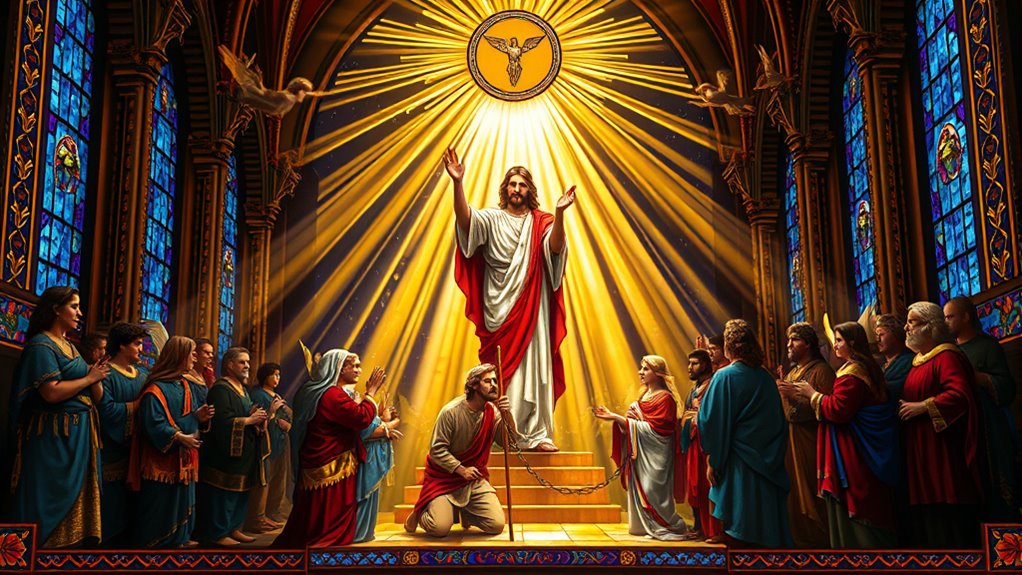

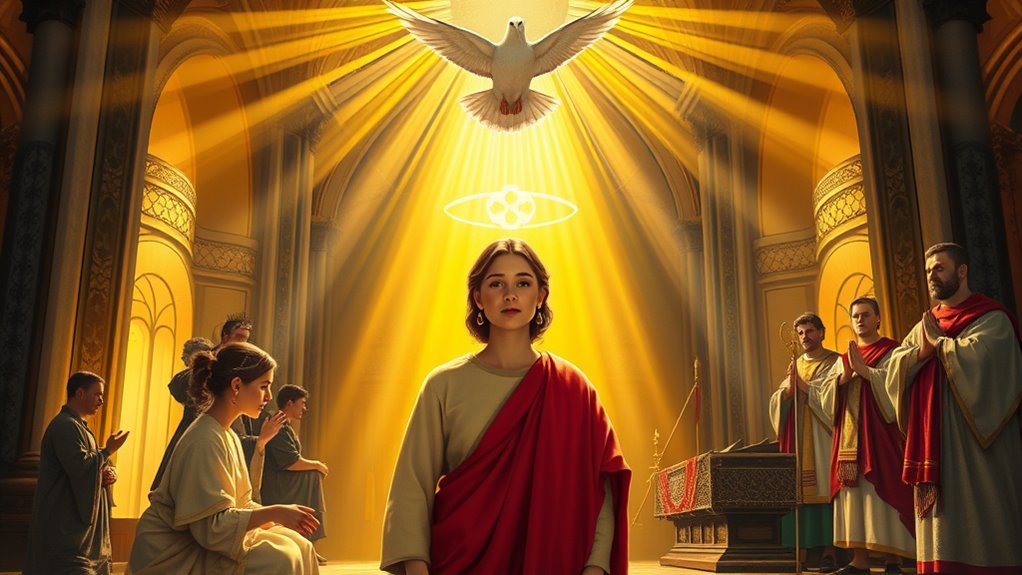

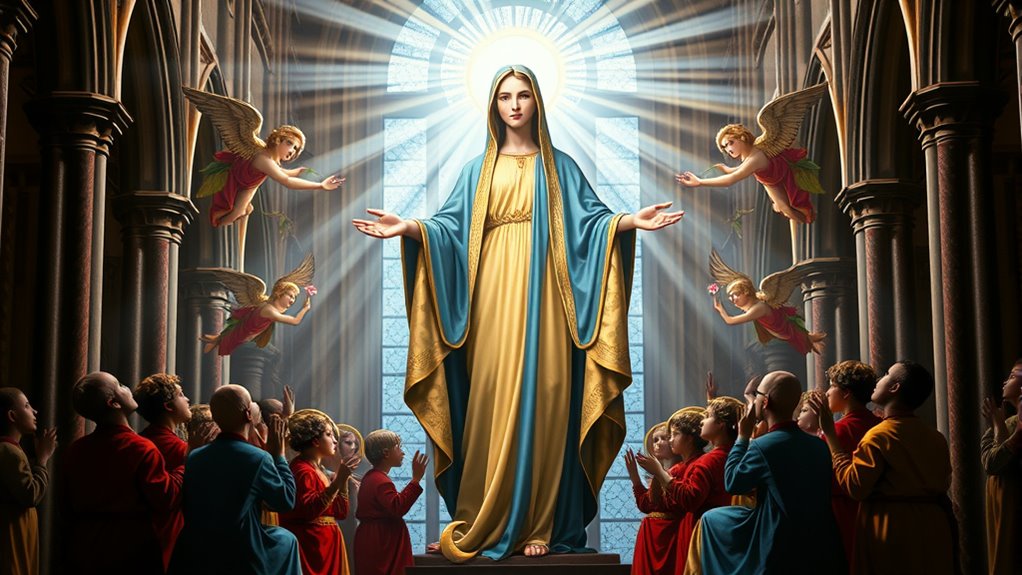
Catholic teaching describes Mary as Mediatrix in a carefully limited sense: she receives grace from Christ and channels it to believers, but Christ alone remains its source. *Lumen Gentium* 62 situates her role as maternal and intercessory, subordinate to his unique mediation. Her cooperation began at the Annunciation and continued through Calvary. A 2025 Vatican doctrinal note reaffirmed this subordinate framing. Those exploring her full role in devotion and doctrine will find considerably more ahead.
The Title Mediatrix: What It Means and Why the Church Permits It
Catholic teaching insists all grace originates in Christ alone. Mary, in this framework, receives grace first and channels it, participating in salvation in a real but subordinate way. The Church permits the title when that distinction remains clear.
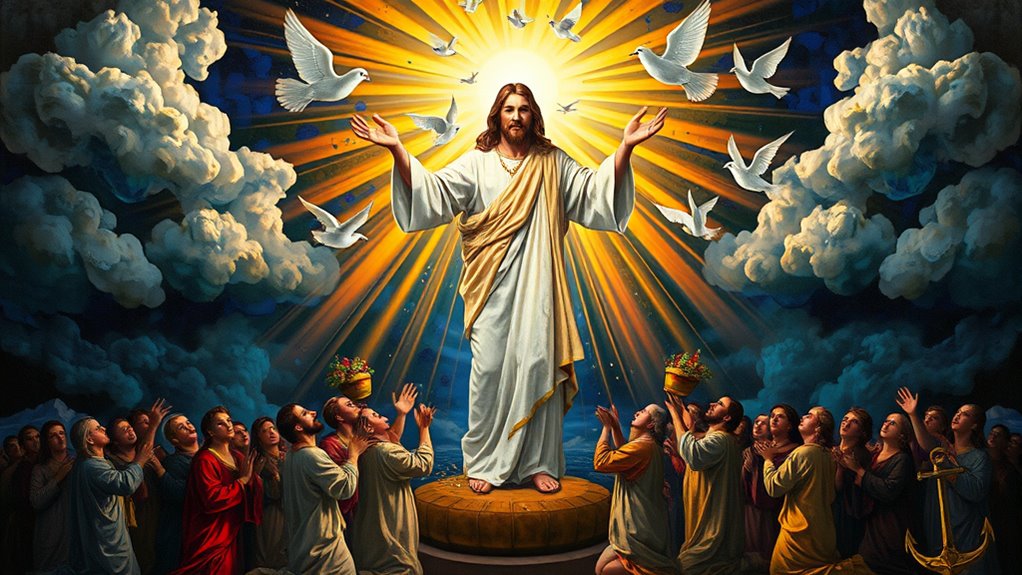
Pope Leo XIII described a threefold course of grace flowing from God to Christ, from Christ to the Virgin, and from the Virgin to us.
A 2025 doctrinal note issued by the Dicastery for the Doctrine of the Faith, titled Mater Populi Fidelis, reaffirmed that any application of the term “Mediatrix” to Mary must be understood in a strictly subordinate sense, adding no efficacy or power to the unique mediation of Jesus Christ. This clarification echoes longstanding distinctions about mediation found in discussions of tithing practices and mediatory roles in Scripture.
How Mary’s Cooperation Brought the Redeemer Into the World
- Her consent was freely given through faith and obedience
- She provided Christ the body through which redemption was accomplished
- Her mediating role remains real but subordinate to Christ’s unique mediation
- Mary’s saving role began at the Annunciation and continued uninterruptedly until Calvary.
- At Cana, Mary served as the catalyst of Christ’s salvific activity, with her intercession recognized by the DDF as a mediating role in presenting human need and directing others to follow Christ.
- Her life exemplifies the effects of Godly discipline and perseverance in spiritual growth, reflecting the biblical connection between discipline and sanctification.
What Mediatrix of All Graces Actually Means
Theologians typically apply the title to *subjective redemption*—the distribution of Christ’s saving work to individuals across time—not to the original earning of salvation itself.
Christ remains the sole divine source.
Mary’s role, as described in *Lumen Gentium* 62, is maternal and intercessory, functioning beneath and within Christ’s unique mediation, not alongside it as an independent authority.
Leo XIII described grace as following a threefold course: from God to Christ, from Christ to the Virgin, and from the Virgin to us, identifying Mary as an administra of grace in its distribution to souls.
The feast of Mary, Mediatrix of All Graces was formally established in 1921 by Pope Benedict XV, responding to petitions from the bishops of Belgium and giving the doctrine wider liturgical recognition across the Church.
This understanding highlights the continuity between Christ’s mediation and Mary’s cooperation in salvation as expressed in biblical love.
What the Church Teaches About Mary’s Mediation and Its Limits
The Church’s official teaching on Mary’s role in salvation is built on a careful distinction: she participates in Christ’s mediation, but she does not share its source. The 2025 Vatican doctrinal note affirms that Christ alone remains the sole mediator, with Mary’s role described as subordinate cooperation through maternal intercession.
- Mary’s mediation is a participation, not an independent power
- The title “Mediatrix” requires careful qualification to avoid doctrinal confusion
- Titles like “Co-redemptrix” and “Mediatrix of All Graces” were formally rejected in 2025
Catholic teaching preserves Marian devotion while keeping all mediatorial language firmly Christ-centered. The document, titled “Mater Populi Fidelis”, was presented on November 4, 2025, at the Jesuit Curia in Rome in response to numerous requests and proposals received by the dicastery over recent decades. Scripture itself points to this subordinate role, as seen at Cana where Mary’s instruction to “do whatever he tells you” directs believers entirely toward Christ rather than herself. The note also reiterates the importance of worship according to the Bible as grounding proper devotional life.
How the Mediatrix Role Shapes Catholic Devotion to Mary
Because the title “Mediatrix” frames Mary’s role as intercessory and maternal rather than divine, it has shaped Catholic devotion in a distinctly relational direction. Rather than directing worship toward Mary herself, the title encourages petition, trust, and reliance on her intercession as a path toward Christ. Devotional practices built around this role—including Marian consecrations, feasts, and prayers—reflect a habit of approaching Jesus through his mother’s maternal care. The Bible affirms the legitimacy of governing authorities while also placing ultimate allegiance to God above any earthly ruler, a principle that has influenced how the Church balances public witness and devotion through faithful obedience. *Lumen Gentium* situates this within a Christological framework, ensuring Mary’s significance depends entirely on Christ’s saving work. Her role, as Catholic teaching presents it, is pastoral: fostering confidence in God’s grace. Popes from Leo XIII to Pius XI affirmed that nothing is imparted to us except through Mary’s hands, a conviction that has consistently animated the Church’s encouragement of Marian intercession.