
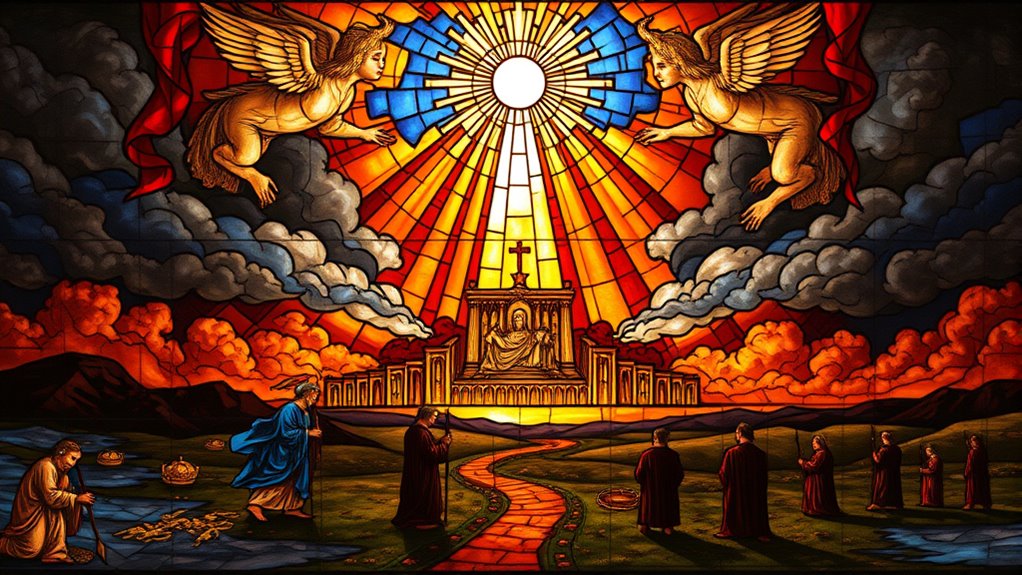
The Bible never uses the word “Iran,” but it references the same territory through ancient names like Elam, Persia, and Medo-Persia, with OpenBible.info counting more than 240 related passages across both covenants. Persian kings like Cyrus the Great, Xerxes I, and Artaxerxes I appear by name, and Ezekiel 38 places Persia within a significant end-time coalition. The full picture, spanning history, prophecy, and restoration, runs considerably deeper than most expect.
Key Takeaways
- The word “Iran” never appears in the Bible; the region is referenced through ancient names like Elam, Persia, and Parthia.
- Persian King Cyrus the Great is mentioned over 20 times, with Isaiah 45:1 calling him “God’s anointed.”
- In 539 BC, Cyrus released approximately 40,000 Jewish captives and personally funded reconstruction of the Jerusalem temple.
- Ezekiel 38 identifies Persia as part of an end-time coalition attacking Israel, with God directly intervening to destroy the invaders.
- Jeremiah 49:34–39 prophesies Elam’s scattering but concludes with a promise of future restoration of its people.
Is Iran Actually Mentioned in the Bible?
Technically, the word “Iran” never appears in the Bible. The name itself did not become the country’s official designation until centuries after the biblical canon was completed. It derives from “Aryanam,” meaning “Land of the Aryans,” a term entirely absent from ancient biblical contexts.
That absence, however, does not mean the region goes unacknowledged. Biblical texts refer to the same geographic territory using historical names — Elam, Persia, Medo-Persia, and Parthia — each representing a different era of the region’s long history. Scholars confirm that these names collectively describe the land modern maps identify as Iran. Aramaic-speaking populations in the region and surrounding areas also influenced the linguistic and cultural landscape reflected in some biblical references.
OpenBible.info counts more than 240 related references across both Covenants, suggesting the region plays a consistently significant role throughout the biblical narrative. Among the earliest of these, Genesis 10:22 identifies Elam as a son of Shem, connecting the region’s ancient inhabitants directly to the Semitic line through Noah.
On the Day of Pentecost, Acts 2:9 records that Parthians, Medes, and Elamites — peoples from the ancient region corresponding to modern Iran — were present in Jerusalem as witnesses to the birth of the church.
The Persian Kings the Bible Names Directly
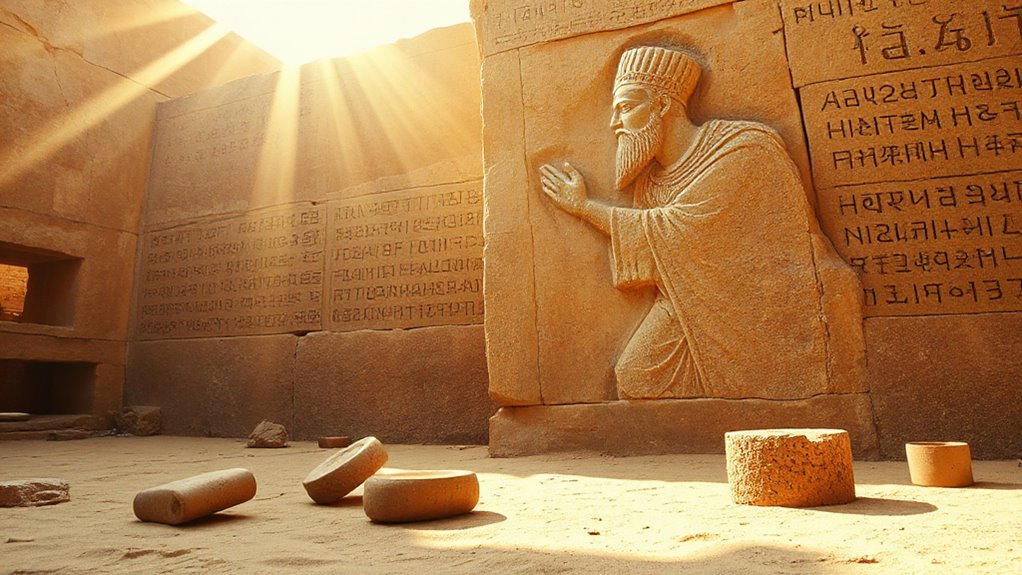
While the Bible never uses the word “Iran,” it records the names of actual Persian kings who ruled the region with striking historical precision.
Five kings appear by name across multiple Old Testament books. Cyrus the Great is mentioned over 20 times and is called God’s anointed in Isaiah 45:1. Darius I confirmed Cyrus’s decree and funded the Second Temple’s completion. The historical timeline of these references aligns with the broader timeline of biblical composition.
Cyrus the Great is named over 20 times in Scripture — even called God’s anointed in Isaiah 45:1.
Xerxes I, identified as Ahasuerus in Esther 1:1, ruled 127 provinces during the events that saved the Jewish people.
Artaxerxes I authorized Nehemiah to rebuild Jerusalem’s walls. Finally, Darius the Persian appears in Nehemiah 12:22, likely Darius II or III.
Archaeological records, including the Cyrus Cylinder and Persepolis tablets, consistently support these biblical accounts. The word “Persia” itself appears 29 times across 25 verses throughout the Old Testament, underscoring how central this empire was to biblical history.
The Persian Empire lasted over 100 years before being conquered by Alexander the Great, who ushered in the succeeding Greek empire, a sequence foretold in Nebuchadnezzar’s prophetic dream recorded in Daniel 2.
How Ancient Iran Played a Role in Saving the Jewish People
Few nations in the ancient world left as deep an imprint on Jewish survival as Persia, the civilization centered in what is now Iran.
In 539 BC, Cyrus the Great released approximately 40,000 Jewish captives from Babylonian slavery, personally funding the reconstruction of their temple in Jerusalem. Archaeological and textual evidence confirms Cyrus’s pivotal role in enabling the Jewish return and temple rebuilding, including references in multiple ancient sources and the Hebrew Bible that reflect his historical impact.
The Hebrew Bible honors him as a non-Jewish Messiah.
Centuries later, Queen Esther and her cousin Mordecai intervened to stop the Persian vizier Haman from annihilating Jews across 127 provinces.
King Ahasuerus ordered Haman’s execution, and Jewish communities survived.
Persian academies later sheltered Jewish scholars who compiled the Babylonian Talmud, preserving Jewish legal tradition for future generations. These scholarly centers were part of a broader Persian cultural milieu that fostered religious and intellectual exchange across the empire.
Across multiple eras, Persia repeatedly provided protection when Jewish survival remained genuinely uncertain. The tombs of Esther and Mordecai are traditionally believed to rest in what is now Hamadan, in western Iran.
The prophet Isaiah, writing roughly 150 years before Cyrus rose to power, identified him by name as God’s anointed shepherd appointed to fulfill divine purposes for Israel.
What Does Ezekiel 38 Say About Iran’s Role in End Times?
Persia’s protective role in ancient Jewish history stands in sharp contrast to what the Bible describes for the distant future.
Ezekiel 38 identifies Persia, the ancient name for modern Iran, as a member of a military coalition that attacks Israel in the last days.
The alliance is led by Gog, described in verse 2 as the prince of Magog, a figure many scholars associate with Russia.
According to verse 11, Israel will be living securely in unwalled villages when the invasion occurs.
However, the coalition does not succeed.
Ezekiel 38:18–19 describes God intervening directly with earthquake and fury, destroying the advancing forces.
Ezekiel 39:7 states the outcome will cause nations to recognize God as the Holy One in Israel.
Iran’s current Supreme Leader, Ali Khamenei, has publicly called for Israel to be eliminated, aligning his stated goals with the very aggression Ezekiel 38 foretells.
This passage reflects the Christian doctrine that the Son and Father are distinct yet united in purpose, emphasizing the Trinity in divine intervention.
What Does the Bible Say Happens to Iran in the End?
Beyond the coalition invasion described in Ezekiel 38, the Bible addresses Iran’s end-time fate through an older prophecy found in Jeremiah 49:34–39, which targets Elam, the ancient name for the region corresponding to modern-day Iran. The passage describes God scattering Elam’s people to the “four winds,” dispersing them as outcasts across every nation.
Jeremiah 49:36–37 specifically foretells the collapse of Elam’s ruling leadership, leaving the nation without its traditional governing authority. Despite this severe judgment, the prophecy carries a measured note of restoration.
Jeremiah 49:39 promises that in the “latter days,” God will bring Elam’s captives back to their homeland. Many scholars connect this predicted scattering to the Iranian diaspora beginning after the 1979 Islamic Revolution, when millions fled the country following the regime’s rise to power. Taken together, these verses present a pattern of divine judgment followed by deliberate restoration, suggesting Iran’s end-time story concludes not with permanent ruin but with reconciliation. A number of scholars also place these events within a broader first-century BC to first-century AD prophetic context.