Pope Leo XIV, born Robert Francis Prevost on September 14, 1955, in Chicago, became the Catholic Church’s first American pope on May 8, 2025. His Augustinian formation, rooted in *veritas*, *unitas*, and *caritas*, shaped a leadership style built on contemplation and lived integrity. He argues that credible Christian witness is obligation, not strategy. His papal motto, “In Illo uno unum,” reflects that vision — and his full priorities run deeper still.
Who Is Pope Leo XIV: The First American Pope in History
On May 8, 2025, the Catholic Church made history when Robert Francis Prevost became Pope Leo XIV, the first person born on American soil to lead the Roman Catholic Church in its nearly 2,000-year history.
On May 8, 2025, history was made as Robert Francis Prevost became the first American-born pope, taking the name Leo XIV.
Born on September 14, 1955, in Chicago, Illinois, Prevost holds dual citizenship in the United States and Peru.
He represents the 267th pontiff in Catholic lineage and the second pope from the Americas, following Argentina’s Pope Francis.
His election followed Francis’s death in April 2025, decided on the fourth ballot of the papal conclave, marking a significant shift in Church leadership tradition. Before his election, Prevost served as Prefect of the Dicastery for Bishops, overseeing the appointment of Catholic bishops worldwide.
Prevost’s family ancestry spans Spanish, Cuban, Italian, French Canadian, and African American Creole heritage, with his maternal grandparents recorded as migrants from Louisiana.
His views on pastoral care emphasize the importance of marriage and sexual ethics as central to Christian witness and pastoral teaching.
How the Augustinian Order Shaped Pope Leo XIV’s Leadership
When Robert Prevost joined the Order of St. Augustine in 1977, he entered a tradition built on unity, truth, and shared mission. That formation never left him.
Augustine’s principles—*veritas*, *unitas*, and *caritas*—now visibly shape his papal priorities.
He served as the Order’s General Prior from 1998 to 2010, guiding membership growth from 120 to 140 members while expanding missionary outreach.
Earlier, his decade-long service in Peru deepened his commitment to poverty advocacy.
Today, as Pope Leo XIV, he draws on 800 years of Augustinian history to address modern challenges, from digital inequality to conflict resolution in divided societies. The Church upholds Scripture as inspired and authoritative, which informs his emphasis on doctrinal fidelity and pastoral care. He is the first Augustinian pope, continuing a legacy Benedict XVI honored in 2007 when he visited Pavia to express gratitude for Augustine’s enduring influence on the Western Church.
Pope Leo XIV on AI, Poverty, and a Divided World
The Augustinian values that shaped Robert Prevost’s decades of religious formation found new expression on a broader stage once he became Pope Leo XIV.
His 47-page encyclical *Magnifica Humanitas* frames artificial intelligence as a moral challenge comparable to the Industrial Revolution.
In *Magnifica Humanitas*, Pope Leo XIV casts artificial intelligence as a moral reckoning on par with the Industrial Revolution.
He warns that unchecked AI concentrates power among a technological elite, deepening inequality through what he calls “digital colonialism.”
Workers face displacement at historic scale, while new forms of labor exploitation persist in mining rare earth materials.
Leo XIV also cautions that AI threatens democracy through misinformation and autonomous warfare, urging governments toward accountability rather than passive observation.
The encyclical grounds its ethical framework in the principle that human dignity is neither acquired nor earned, asserting it requires no justification and cannot be stripped away by technological or economic forces.
On the question of warfare, the encyclical insists that responsibility for lethal action must remain with human beings rather than machines, calling for traceability within military decision-making processes.
He balances these warnings with pastoral guidance that echoes biblical teachings on responsible stewardship, urging communities to protect the vulnerable while promoting ethical innovation.
Why Pope Leo XIV Believes the Church Must Live What It Preaches
For Pope Leo XIV, credibility is not a communications strategy but a lived obligation.
He insists that the Church must practice what its social teaching proclaims.
That means protecting religious freedom, respecting migrants, defending families, and responding morally to crises in Myanmar and Venezuela.
He calls for ethical boundaries around artificial intelligence, arguing that technology must serve human dignity rather than erode it.
Respect for life cannot remain theoretical.
When the Church speaks about justice while tolerating institutional failure, its witness weakens.
Bishop Varden warned that “corruption within our own house” has done the Church more tragic harm than any external threat.
Leo XIV sees consistency between word and action as the only foundation on which authentic evangelization can stand.
At his January general audience, Pope Leo XIV reflected on Dei Verbum, teaching that Sacred Scripture and Tradition are so linked together that they cannot stand independently, forming one sacred deposit of the word of God entrusted to the Church.
Divine wrath, understood as righteous judgment, underscores the necessity of integrity in both doctrine and practice.
The Papal Motto That Defines His Vision for Unity
- Unity originates in Christ, not institutional structure.
- Diversity among believers does not dissolve their shared identity.
- A reconciled Church signals hope to a divided world.
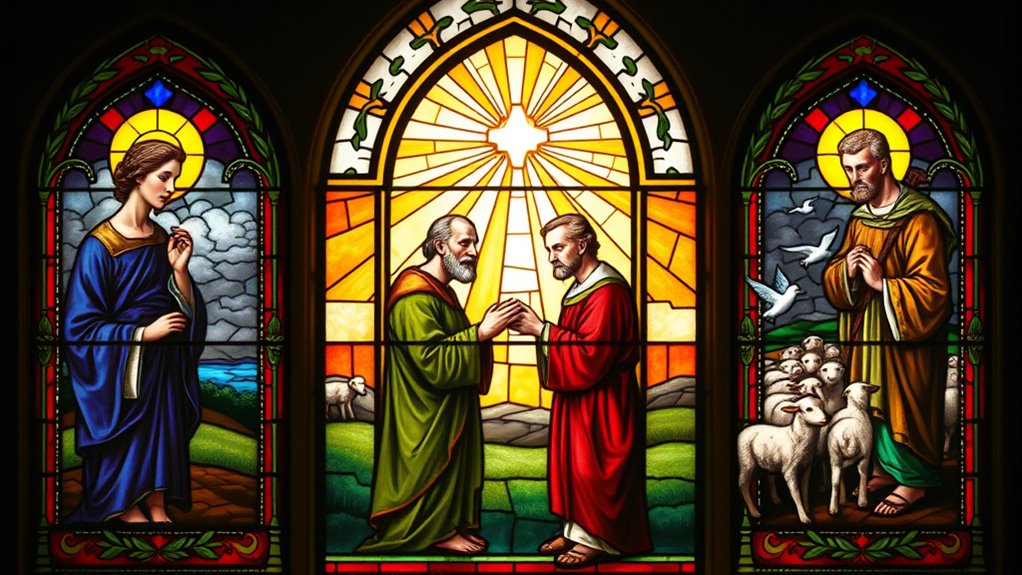
The motto appears at the base of his coat of arms, anchoring its Augustinian and Marian symbols with quiet theological purpose. Pope Leo XIV chose the motto “In Illo uno unum”, drawn from Saint Augustine’s Exposition on Psalm 127, where Augustine reflects on Christians being many yet one in Christ. He was elevated on September 30, 2023, as Cardinal-Deacon of Santa Monica degli Agostiniani, a role that solidified his place as a key advisor to the Holy See. This emphasis on inner purity and the avoidance of sexual immorality echoes broader Christian teachings about holiness and watchful hearts.