
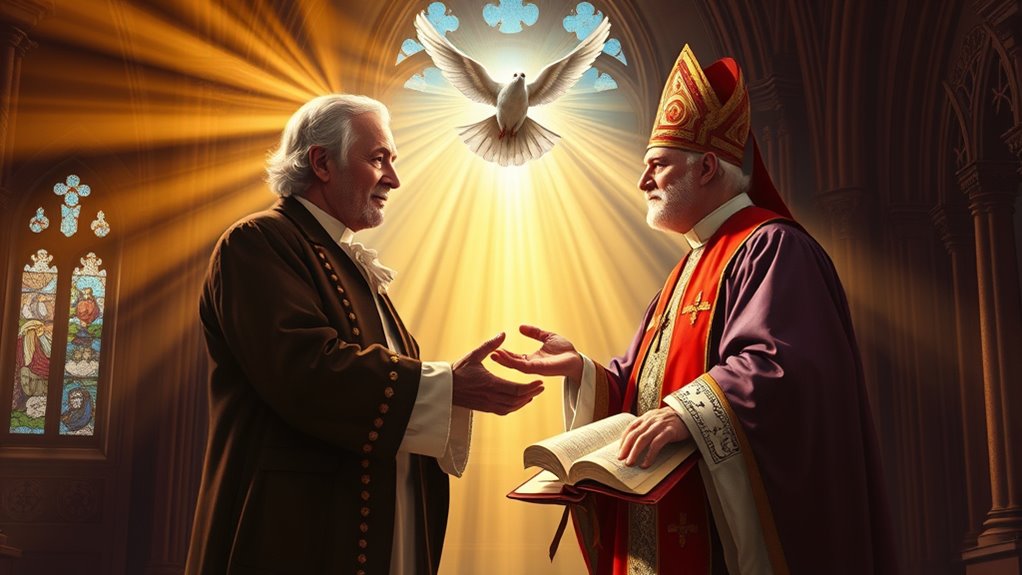
In 1784, Vatican representative Archbishop Giuseppe Doria Pamphili consulted Benjamin Franklin about selecting an American Catholic leader. Franklin privately praised Father John Carroll, citing his patriotism, his cousin Charles Carroll’s signing of the Declaration of Independence, and his personal care during Franklin’s illness in 1776. The Vatican named Carroll Superior of the Missions that year. By 1789, 24 of 26 priests elected him bishop, and Pope Pius VI approved the Diocese of Baltimore. The full story reveals much more.
How Franklin and Carroll’s 1776 Bond Shaped American History
When Benjamin Franklin and John Carroll set out together for Canada in the spring of 1776, neither man likely anticipated that the failed diplomatic mission would forge a friendship capable of shaping American religious history. Carroll helped nurse Franklin through illness on the return journey, and Franklin never forgot that kindness. Their later collaboration also reflected shared values about governance and institutional development in the new nation, including evolving attitudes toward religious leadership structures.
Years later, when Rome sought advice on appointing Church leadership in America, Franklin recommended Carroll directly. Carroll was confirmed Superior of the Missions on June 6, 1784. That appointment became the foundation for establishing the first formal Catholic hierarchy in the United States. Further details about Carroll’s legacy can be found through Catholic Encyclopedia on Wikisource, where records related to his contributions have been preserved.
John Carroll had joined the Quebec mission in part because his cousin Charles Carroll was also selected, with Charles’s fluency in French and Catholic background regarded as key qualifications for negotiations with French Canadians.
Why the Vatican Asked Franklin to Weigh In on Church Leadership
Franklin’s role in Carroll’s 1784 appointment as Superior of the Missions did not happen by accident.
In July 1783, Papal Nuncio Archbishop Giuseppe Doria Pamphili sent Franklin a note requesting his opinion on American Catholic leadership.
In July 1783, the Papal Nuncio wrote to Franklin seeking his recommendation on American Catholic leadership.
The Vatican recognized Franklin as a diplomat with significant influence during the Republic’s formation.
Doria Pamphili met Franklin again on July 1, 1784, to discuss the Pope’s plans.
Franklin clarified that Congress held no authority over religion, preventing any official government preference.
Still, the Vatican wanted a leader acceptable to Americans, and Franklin seemed well-positioned to identify one. At the time, the United States had about 25,000 Catholics but no bishop to ordain priests or celebrate confirmation. The Kansas City-St. Joseph diocese later became an international symbol of church failings in the sexual abuse crisis.
Leaders in both church and state were urged to pursue justice and mercy as part of their responsibilities, reflecting broader expectations about accountable governance.
What Franklin Privately Told the Vatican About Carroll’s Fitness as Bishop
Behind closed doors, Franklin did more than simply confirm that the American government had no preference in church appointments. He warmly praised Father John Carroll as someone Americans would genuinely accept.
Carroll was a patriot with deep ties to the country — his cousin had signed the Declaration of Independence. Franklin also remembered something personal. In 1776, Carroll had nursed him through illness during a difficult voyage, care Franklin credited with saving his life.
That combination of public credibility and private virtue made Carroll, in Franklin’s quiet estimation, the right man to lead the American Church. The Vatican’s formal inquiry had come through Cardinal Giuseppe Doria Pamphili, the papal nuncio of France, who sought Franklin’s counsel while he served in Paris as American Minister to France. Franklin also considered Carroll’s reputation for steadfast faith and pastoral care when recommending him.
How the American Clergy Voted Carroll Into Office
In April 1789, the priests of Maryland cast their votes for the man who would lead the American Catholic Church. Acting under a papal directive from Pope Pius VI, 26 priests participated in the election. The results were clear:
- 24 priests voted for John Carroll
- 1 priest voted against him
- 1 priest abstained entirely
- The recommendation was formally sent to Rome
Pope Pius VI approved Carroll’s appointment on November 6, 1789, establishing the Diocese of Baltimore that same day. Carroll was later consecrated in England on August 15, 1790. The new diocese held jurisdiction east of the Mississippi River, encompassing the vast majority of the young nation’s territory. At the time of its establishment, the diocese served upward of 40,000 Catholics spread across more than 3 million square miles. Many of the clergy considered civic responsibilities and principles like stewardship important when participating in such elections.
How Franklin’s Support Set Carroll on the Path to Archbishop
When Benjamin Franklin recommended John Carroll to Vatican officials in the early 1780s, he set in motion a sequence of events that would shape American Catholicism for decades. Pope Pius VI named Carroll Superior of the Missions in 1784, reportedly to honor Franklin’s endorsement.
Carroll became Baltimore’s first bishop in 1789, then its first archbishop in 1808.
Franklin’s influence, rooted partly in personal gratitude from Carroll’s care during the 1776 Canadian mission, opened ecclesiastical doors that might otherwise have remained closed.
Historians acknowledge that Franklin’s European standing gave Carroll’s appointment a credibility that extended well beyond American borders. Before his endorsement, American Catholics still fell under the ecclesiastical authority of the Catholic bishop in London. Carroll’s older brother Daniel was one of the rare individuals who signed both the Articles of Confederation and the Constitution, reflecting the family’s deep involvement in the founding of the American republic. His leadership exemplified servant leadership as he balanced pastoral care with institutional development.