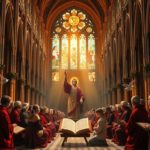









Religion has historically supported literacy rather than opposed it. When Roman schools collapsed, monasteries became the main centers of learning from the 5th to the 8th century, according to Britannica. Cassiodorus built Vivarium as a place of study, preserving both scripture and classical texts. Faith communities also create structured reading habits through weekly services and study groups. Research confirms gains in foundational skills, though outcomes vary depending on method—and the full picture runs deeper.
Religion Was Built on Reading Long Before Schools Were
Long before governments built schools or reformers pushed for universal education, religious communities had already made reading central to daily life.
Surviving religious texts date to roughly 3,400–3,500 BC, suggesting written scripture appeared very early in human history.
Judaism, Christianity, and Islam each treated reading as essential to worship, law, and teaching.
When Roman educational structures collapsed across Western Europe, monasteries stepped in.
Britannica notes that from the 5th to the 8th century, monasteries became the main centers of learning.
Religion did not wait for schools to create readers.
In many places, it created the demand for schools itself.
Cassiodorus established a monastery at Vivarium and stipulated it as a place of study, providing guidance through his *Institutiones* that covered both religious and liberal arts texts.
Jerome instructed monks to copy books so that the hand labored for food while the soul was nourished through reading.
These efforts helped preserve scriptural texts and broader classical knowledge through turbulent centuries.
How Faith Communities Create Consistent Reading Habits
Most reading habits collapse not from lack of interest but from lack of structure. Faith communities quietly solve that problem.
Weekly services, Bible studies, and small groups create a repeatable schedule, removing the need to decide when or what to read. Group discussion rewards preparation and turns private intentions into public commitments.
Repeated exposure to text during worship builds familiarity with language and ideas over time. Churches often supply reading lists, study plans, and deadlines, reducing common barriers. Research shows that 40% of Protestant churchgoers fail to read the Bible even once a week, making structured community exposure especially critical. Gathering for worship and study also continues a long biblical tradition of communal reading and teaching from synagogue and church practices.
When reading becomes tied to community, it shifts from an isolated habit into a shared, self-reinforcing practice. Some churches reinforce this further by giving every family a book at Christmas, making reading a shared congregational moment.
What Research Actually Shows About Faith-Based Literacy Gains
When researchers look closely at what faith-based reading environments actually produce, the findings are encouraging but carefully limited.
Studies show consistent gains in foundational reading skills, particularly among children with the most intensive religious reading exposure.
One study found those children scored notably higher on basic reading tasks, yet showed no measurable improvement in writing, geography, or arithmetic.
Summer church literacy programs have reported average reading gains equivalent to roughly three months of learning within a single cycle.
The clearest pattern across studies is that faith-based reading reliably builds foundational skills, but does not consistently transfer into broader academic achievement.
These programs often incorporate practices like reading Scripture aloud and structured prayer that may support attention and motivation.
Why Rote Religious Reading Produces Weaker Results
Faith-based reading programs show real gains in foundational skills, yet those gains do not always extend into broader academic achievement. Research points to a specific pattern when rote methods dominate instruction:
- Fluency improves, but comprehension often lags behind
- Repeated reading raises speed without reliably building word recognition
- Memorized recitation limits inference and synthesis practice
- Meaning-focused reading produces stronger comprehension than repetition alone
- Generalization to new passages remains smaller than gains on practiced text
When reading functions primarily as performance, deeper literacy development can stall. Students recite accurately while independent interpretation skills remain largely underdeveloped. A study of high school students with reading disabilities found no statistically significant differences across repeated reading, wide reading, and typical instruction conditions, suggesting that fluency-focused practice alone is insufficient for severely impaired readers. Repeated reading is designed for students who have developed initial word reading skills but demonstrate inadequate reading fluency for their grade level, meaning it targets a narrow band of learners rather than serving as a universal solution. Prayer also models communication with God as an ongoing, relational practice that can inform classroom approaches to reflection and meaning.
What Makes Faith-Based Reading Programs Actually Work
The programs that produce real literacy gains in faith-based settings tend to share a recognizable set of features. Consistent, repeated practice matters most. Daily recitation sessions and short literacy blocks build habit and retention more reliably than occasional events. Skilled instruction also plays a significant role. Programs offering direct coaching, specific feedback, and structured correction of pronunciation and letter sounds show stronger outcomes than loosely organized alternatives. Family involvement extends learning beyond the program itself, with caregivers reporting more shared reading at home after participation. Together, these elements transform religious reading from passive ritual into something measurably productive. Research from madrasah settings confirms that stakeholder support and adequate literacy facilities strengthen both reading interest and active participation in literacy activities. Evidence from North Carolina’s rural summer literacy initiative shows that certified teachers working in small classes of 10 to 12 students produced about three months of learning on average for participating early elementary students. Faith-based literacy efforts also benefit when they connect instruction to a broader sense of service and vocation, helping learners see reading as participation in communal and redemptive work.