





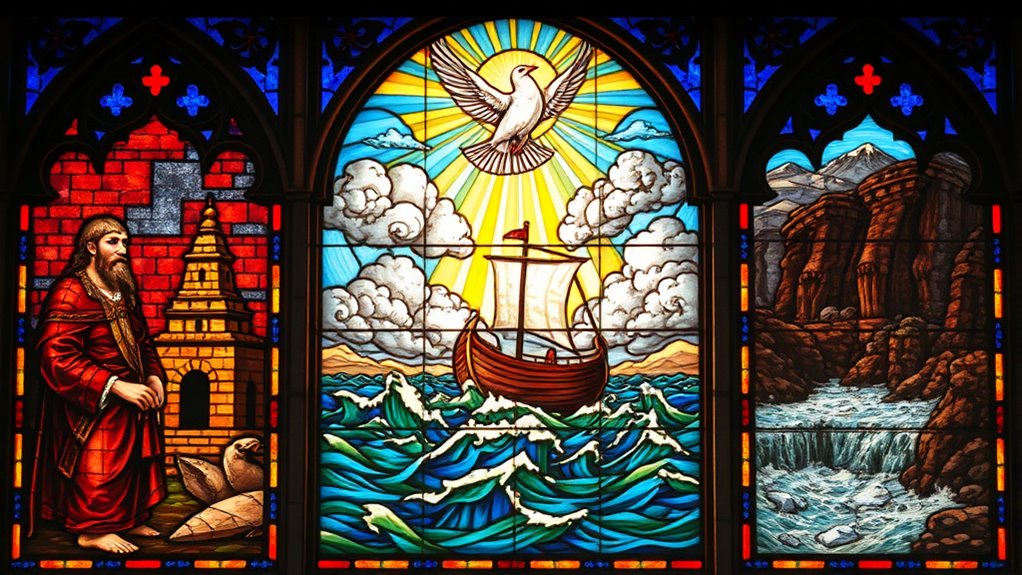
Noah and Gilgamesh describe strikingly similar floods, though they probably reflect a shared tradition rather than one memory. Both stories feature divine judgment, a favored man warned in advance, a large boat, birds sent to test the waters, a mountain landing, and a sacrifice. Yet Genesis names one God and a forty-day flood, while Gilgamesh shows quarreling gods and a six-day storm. Older Sumerian and Babylonian texts, explored below, show how these accounts may connect.
What Do the Noah and Gilgamesh Flood Stories Share?
At the center of both the Noah and Gilgamesh flood stories is a catastrophe that ends ordinary human life and serves as the turning point of the narrative, not as a local storm.
Both accounts treat the flood as judgment for human wrongdoing, and each warns one favored man through divine communication. Flood traditions appear in hundreds of cultures worldwide, from Mesopotamia and Egypt to India, China, the Pacific Islands, and the Americas, and they repeatedly share a catastrophic flood, a favored family that survives, and advance warning.
Each man is told to build a large vessel, and the boat shelters his household along with animals, so life continues through the deluge. The Babylonian version of the Gilgamesh flood account is the most intact, missing only seven of its 205 lines.
Afterward, the vessel lands on a mountain, birds test receding waters, and a sacrifice is offered, ending in blessing and a new beginning. Scholars also note parallels between these accounts and Biblical narratives that reflect shared motifs across ancient Near Eastern literature.
How Do the Two Flood Stories Differ?
Despite these shared features, the two accounts diverge in ways that reveal different views of the divine and of human purpose. Genesis presents one God who judges wickedness and saves the righteous, while Gilgamesh shows a council of gods with competing interests. In the Gilgamesh account, the flood lasts only six days, whereas the Genesis flood lasts forty days and nights. Four contrasts stand out:
- Warning: Noah hears God directly, while Utnapishtim learns through a dream or secret message.
- Passengers: Noah brings family and animals; Mesopotamian versions may add a pilot and craftsmen.
- Chronology: Genesis follows a staged, orderly recession, while Gilgamesh compresses the storm into episodes.
- Outcome: Noah receives a covenant; Utnapishtim receives immortality.
Genesis restores humanity. After the flood, God accepts Noah’s burnt offerings and establishes the Noahic Covenant, promising never again to destroy the earth by flood, with the rainbow as its pledge. This hope of renewal echoes the biblical promise of eternal life given through faith in Christ.
Which Mesopotamian Flood Stories Came Before Gilgamesh?
Although the Gilgamesh flood story is the best known of the ancient Mesopotamian accounts, it was not the first, and scholars now trace the tradition through at least two earlier texts.
The Gilgamesh flood story is the best known Mesopotamian account, but it was not the first; scholars trace the tradition through at least two earlier texts.
The oldest is the Sumerian Flood Story, or Eridu Genesis, in which the king Ziusudra survives a divine flood; it may date to the third millennium BCE.
The Atrahasis Epic follows, with tablets from the 17th century BCE, though its story likely circulated orally earlier. The most complete surviving recension is an Old Babylonian copy from around 1650 BCE, published with many other texts by Wilfred G. Lambert and Alan Millard in 1965.
Its hero builds a boat after a warning. Unlike the other Mesopotamian flood texts, its age rests on a dated colophon in which the scribe Ku-Aya recorded the twelfth year of King Ammi-ṣaduqa, around 1635 BCE, rather than on handwriting style alone.
These texts show the flood motif was established before Utanapishtim told his version in Gilgamesh. The enduring influence of these stories shapes discussions of death, divine judgment, and eternal life across later religious traditions.
Did the Genesis Flood Borrow From Mesopotamia?
How did a story about one sovereign God and one righteous man come to resemble Mesopotamian tales of quarrelling gods and a boat-building hero?
Many scholars see literary engagement, likely during the exilic or post-exilic period, with Atra-Hasis and Gilgamesh as older background. Readers who follow online links to these ancient texts may see a Page not found message if the link is outdated or the URL was typed incorrectly.
- Shared features: a chosen survivor, an ark, a catastrophic flood, and landing on a mountain.
- Earlier sources: the Eridu Genesis, dated to about 1600 BCE, predates Genesis’ final form.
- Differences: one God replaces competing deities, and the story centers on morality and covenant.
- Alternative view: similarities may reflect shared Near Eastern tradition, not direct one-to-one dependence.
The biblical presentation also emphasizes Scripture’s role in shaping moral instruction for the community.
Do Noah and Gilgamesh Point to a Real Flood?
Questions about where the Genesis flood came from lead naturally to a second one: whether any real event stands behind the stories of Noah and Gilgamesh. Many scholars think so, though only in a limited sense.
Geology rules out a worldwide deluge, since Earth lacks enough water to cover the highest mountains and its rock layers formed across many ages. A regional disaster remains plausible. Fieldwork on Tibet’s Tsangpo River shows how a regional flood can survive in memory, since sediment layers there record repeated ice-dam floods that local oral traditions appear to match.
One proposed flood horizon in southern Mesopotamia, dated to about 2950–2850 BCE, left a significant sediment layer at ancient sites. Such a flood, retold over generations, could plausibly explain both stories’ shared historical core. Yet the Shuruppak deposit is only about fifteen inches thick, and Kish levels average under ten inches, far less than the eleven feet Woolley reported at Ur, so neither obviously matches the catastrophic flood described in the literary and biblical accounts. The interpretation of such findings ties into broader questions about Israel’s origins and the covenantal promises that shape how biblical events are understood.