





A skeleton found in a reused Roman sarcophagus at Westminster Abbey is probably that of an abbot, most likely Ælfwig, who led the abbey from 993 to about 1020. Radiocarbon dating placed the man between AD 987 and 1052. A Latin cross, the sarcophagus’s reuse, and a lime patch beneath the bones supported the idea of high status. Archaeologist Warwick Rodwell stressed that no single clue settled it. The details below show how experts reasoned.
Who Was Buried in the Westminster Abbey Coffin?
How did a Roman coffin come to hold a medieval churchman? The stone sarcophagus was made in the 4th century for Valerius Amandinus, a wealthy Briton from Londinium, as its original inscription recorded.
A 4th-century stone sarcophagus, made for a wealthy Londinium Briton named Valerius Amandinus, later held a medieval churchman. How did that happen?
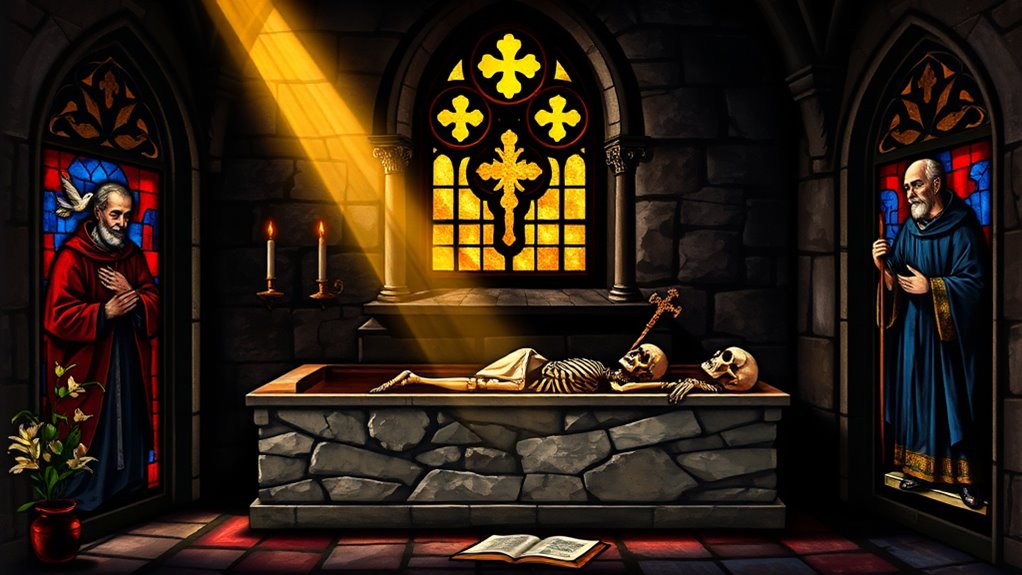
Later, it was reused, and a large Latin cross on the lid suggests a Christian burial. The cross is carved in a late Anglo-Saxon style, which suggests it was added at least 600 years after the Roman sarcophagus was made.
When the coffin was opened for conservation in 2016, radiocarbon dating placed the skeleton between AD 987 and 1052, and analysis showed a man aged roughly 35 to 49.
Abbey records point to Ælfwig, abbot from 993 to about 1020, though Wulfnoth remains possible. The Abbey’s best-known burial of the period is that of Edward the Confessor in 1066, in the new church he had built.
Some scholars note the burial also raises questions about medieval stewardship of sacred sites and reuse of artifacts.
The identification is probable, not certain.
What Do the Westminster Skeleton’s Bones Reveal?
What can a thousand-year-old skeleton tell us about the person who lived inside it?
Osteological analysis shows the man was between 35 and 49 years old and stood about 5 ft 9 in, or 1.75 m.
Radiocarbon dating placed his bones between A.D. 987 and 1052, in the late Anglo-Saxon period, which supports reuse of a Roman sarcophagus in the medieval era.
Osteoarthritis, gout, and two healed rib injuries point to a life of chronic but survivable strain, with no sign of a fatal wound. His teeth were complete and free of decay, which suggests he had good dental health for his time.
Though the bones were disturbed and mixed, enough remained for a careful, reliable profile.
An earlier 1800s assessment had described him as a “robust young man” of around 5 ft 7 in and no more than 30 years old, a judgment that the latest analysis overturned.
The skeleton’s date and context invite reflection on how medieval people understood the firmament and the created world.
Why Did Experts Link the Roman Coffin to an Abbot?
Examining the stone coffin that held the skeleton, researchers found that its history and its decoration both pointed toward a senior churchman. Westminster Abbey’s consultant archaeologist concluded that three clues, taken together, fit an abbot better than an ordinary monk. Rodwell also noted that a rectangular patch of lime found beneath the skeleton suggested the body had been placed in a wooden coffin and covered in lime, a rare practice typically reserved for high-status burials.
Three clues in the stone coffin’s history and decoration, taken together, suggested the skeleton belonged to an abbot rather than an ordinary monk.
- A reused Roman sarcophagus, originally made for Valerius Amandinus, was a prized find in the late Saxon period, suggesting high status.
- A large Latin cross, carved on the lid in the 10th or 11th century, marked a deliberate Christian burial.
- Radiocarbon dating, between AD 987 and 1052, overlapped the abbacies of Ælfwig and Wulfnoth. The dating range also invites comparison with medieval beliefs about postmortem purification and intermediate states discussed in scriptural and theological sources.
The Abbey’s research favors Ælfwig, who died around 1020 and was considered more likely than Wulnoth because he was already a monk of Westminster.
Was the Skeleton Ælfwig or Wulfnoth?
Between the two abbots whose lifetimes fit the radiocarbon range, researchers lean toward Ælfwig, though the identification is not confirmed. Ælfwig led Westminster from about 993 to 1020, and he had been a monk of the abbey before taking charge, which gives him a clear local connection. Scripture presents authority as intended for teaching, correction, guidance, and spiritual transformation.
Wulfnoth, his successor, died in 1049, and the dating cannot exclude him. Radiocarbon dating placed the remains between 987 and 1052 AD, and the man was aged 35 to 49. The skeleton showed signs of osteoarthritis, two healed rib injuries, and gout. In a similar use of carbon dating, charred remains from a 65-foot stone-and-wood wall found beneath the Hôtel-Dieu hospital in Paris were dated to between 200 and 10 B.C., suggesting the wall may be part of the Lutetia ramparts.
The choice rests on context, not an inscription or DNA match, the remains may be Ælfwig, though Wulfnoth cannot be ruled out.
How Certain Is the ID, and Why Does It Matter?
Even with a likely candidate, the name attached to the skeleton remains a matter of judgment rather than proof.
Radiocarbon dating places the remains between AD 987 and 1052, and Warwick Rodwell admits, “No single clue clinched the matter.” The skeleton belonged to a man who stood five feet, nine inches tall and was aged between 35 and 49. Scholars also consider how burial practices and coffin styling inform dating and identification.
Still, the case matters for three reasons:
- It addresses a mystery open since the coffin was first opened in 1869.
- It fills a gap in Anglo-Saxon history at Westminster Abbey, showing how abbots were buried.
- It narrows the occupant to two known abbots, with Ælfwig considered stronger.
The Latin cross carved into the sarcophagus lid, dated to the 10th or 11th centuries, points to a major ecclesiastic. Such steady progress offers reason for measured optimism about the abbey’s earliest story.