








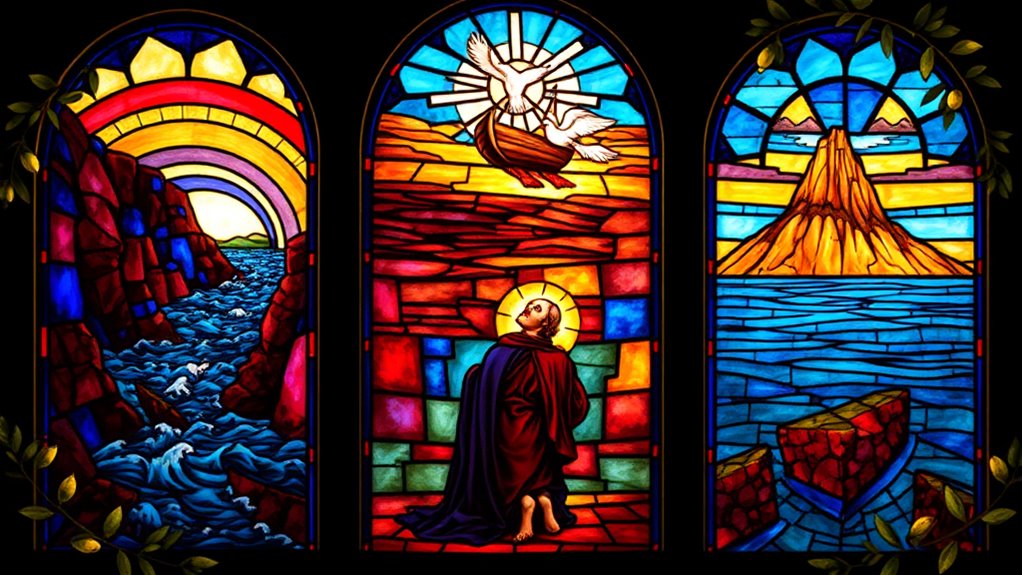
Flood geology, which holds that Genesis 6–9 describes a global flood that laid down most sedimentary rock in about a year, conflicts with the evidence. No single sediment layer spans all continents, and ice cores, varved lakes, and tree rings preserve thousands of annual layers. The USGS dates the Grand Canyon‘s carving to 5 to 6 million years ago, cutting older rock. Even catastrophic plate tectonics faces overheating problems. The details that follow explain why.
What Does Flood Geology Claim?
What did Noah’s Flood actually do to the Earth, according to those who take it as literal history? Flood geologists answer that Genesis 6–9 describes a global, catastrophic event, placed by biblical chronology within the last 5,000 to 10,000 years.
In their view, violent currents eroded, carried, and rapidly buried sediment across continents, producing most thick sedimentary layers and fossil-bearing rock in about one year.
Flood geologists claim violent currents eroded and buried sediment across continents, forming most thick rock layers and fossil beds within a single year.
Fossils mark sudden death and quick entombment, while vertical patterns reflect sorting by rising water. Yet the fossil record shows no ecological sorting, since corals and clams appear at all levels of the strata.
Some versions add volcanic and tectonic activity, with mountains rising late or afterward.
Flood geology was itself a seventeenth-century idea that was dropped in the late eighteenth and early nineteenth centuries because it didn’t make sense. Many Christians point to New Testament passages as influencing how biblical laws and narratives are interpreted today.
Mainstream geology does not accept it.
Where Is the Evidence for a Global Flood?
If Noah’s Flood reshaped the planet in a single year, the rocks and records of the Earth should show it, and geologists have spent more than two centuries looking. What they have found points elsewhere. In the early 1800s, Georges Cuvier and Alexandre Brongniart found alternating marine and terrestrial deposits in the strata around Paris, which indicated repeated advances and retreats of the sea rather than a single flood.
- No single, globally synchronous sediment layer spans all continents.
- Ice cores, varved lakes, and tree rings preserve thousands of annual layers.
- Paleosols, root traces, and evaporites show exposure to air and repeated drying.
- Species distributions, such as marsupials and lemurs, reflect long isolation.
Local flood deposits exist; none is worldwide. Modern studies of present-day flooding show how local the controls are, since coral reefs alone cut annual flood damages by half, and without them the costs would double. Together, the evidence fits deep time and plate tectonics better than one recent flood.
Can a One-Year Flood Explain Fossils?
Although a flood can bury animals quickly, fossils are more than buried bones, and that difference matters when the question is whether one year of rising water could account for the rock record.
Burial is only the first step. Fossils also need hard parts such as bones, teeth, or shells, because soft-bodied tissues rarely survive.
Burying a carcass is easy; turning it into a fossil takes minerals, pressure, and time that a single flood cannot supply.
Afterward, mineral-rich water must seep into remains, while pressure and heat turn sediment into rock.
Preservation may involve permineralization, molds, or casts, depending on chemistry.
Taphonomy, the study of these processes, shows that context shapes the outcome.
Fossils appear in rivers, lakes, deltas, and seas, sorted by environment. At Badlands National Park, somewhat weathered bones are found in sediments that underwent soil formation, showing that rapid burial on river floodplains was followed by further changes over time.
A flood may explain some mass burials, but not the full variety. The Bible’s teachings on death and hope provide comfort and perspective when considering mortality and the long timescales evident in geological records.
Does the Grand Canyon Support a Global Flood?
How old is the Grand Canyon, and does its age fit the story of a single year of floodwater? According to the U.S. Geological Survey and National Park Service, the canyon was carved about 5 to 6 million years ago, far later than the rocks it cuts through. The canyon’s mile-high walls display a largely undisturbed crust cross section extending back about two billion years, which is far longer than a single year could account for, and its layers include Paleozoic Era sandstone, shale, and limestone deposited between 550 and 250 million years ago.
Several findings stand out:
- The youngest canyon strata are close to 300 million years old.
- Supergroup rocks date from about 1,255 to 729 million years ago.
- Unconformities mark long gaps in deposition.
- Footprints and other features suggest stable environments, not turbulent flooding.
Mainstream geologists thus see slow incision by the Colorado River, and evidence such as the Hualapai Limestone, a lake deposit containing no river sediments and dated to about 6 million years ago, shows that the Colorado River could not have been flowing before that time. A variety of independent dating methods support an ancient age for the canyon and its strata.
Can Catastrophic Plate Tectonics Save Flood Geology?
Because the Grand Canyon’s rocks and the river that cut them point to millions of years, some young-earth creationists have turned to a different explanation, one that tries to squeeze the movement of whole continents into a single year. Yet plate motion as observed today is slow, with the Pacific Plate grinding past the North American Plate along the San Andreas fault at a steady, creeping pace in some segments, and locked in others for decades or centuries before releasing energy. Called catastrophic plate tectonics, the model proposes that oceanic lithosphere sank rapidly into the mantle during the Flood, breaking up a pre-Flood supercontinent. Critics point to heat: motion that fast would generate enough friction to overheat the oceans and crust, and the required weakening of mantle rock is considered implausible. Even John Baumgardner’s 1990 paper states openly that one three-dimensional run got its speeds by reducing mantle viscosity everywhere by nine orders of magnitude. Hawaii’s island chain, whose ages increase steadily, fits slow motion. Christians weighing these claims often balance geological evidence with theological considerations, and many advocates of a different approach emphasize peacemaking and care when discussing contested interpretations.