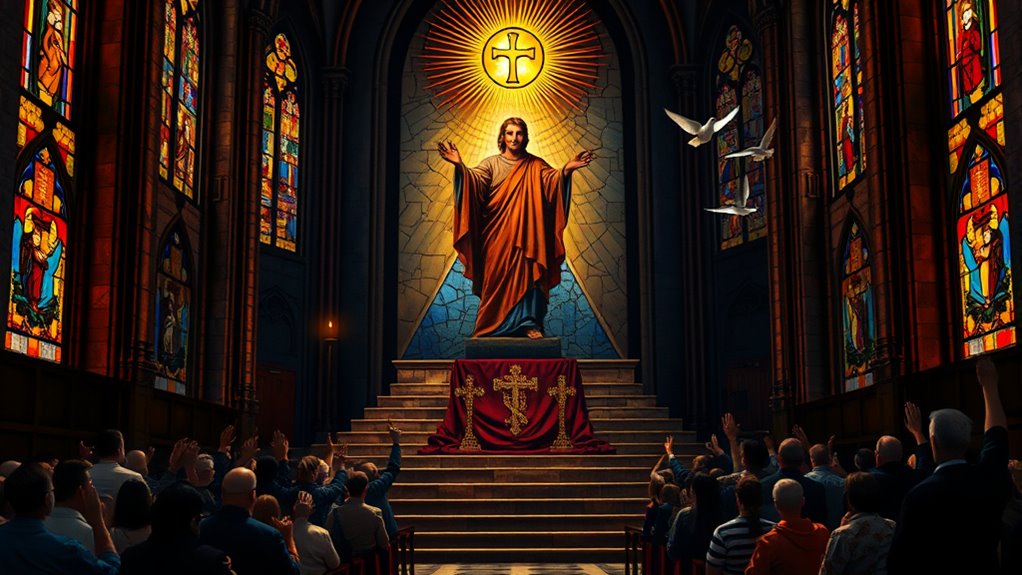
Kim Il-Sung’s family were devout Presbyterians rooted in Pyongyang, the city missionaries called the “Jerusalem of the East.” His mother served as a Bible woman, his father as a part-time missionary, and his grandfather built a Christian school. After seizing power, Kim systematically borrowed Christianity’s structures—sacred narratives, loyalty rituals, communal devotion—and redirected them toward a political personality cult built around his family. The full story behind that transformation reveals something unexpected about how modern totalitarianism is sometimes built.
Kim Il-Sung’s Family Were Among Korea’s First Presbyterian Converts
Kim Il-Sung, born Kim Song Ju on April 15, 1912, in the village of Mangyongdae near Pyongyang, came from a family that had embraced Presbyterian Christianity in its earliest days in Korea.
Northern Presbyterian missionaries arrived in the late 1880s and established a mission in Pyongyang by 1895. By 1910, the region counted over 60,000 Presbyterians, making it the most Christian area in Korea. Presbyterian missions played a significant role in education and social services in the region, influencing local elites and communities.
The Kim family, tracing its lineage to the Jeonju Kim clan, converted during this formative period. His grandfather built a Christian school, and his great-grandfather had already rooted the family in radical devotion generations earlier. His mother was known as a “Bible woman”, a role comparable to that of a deacon within the local church community.
His great-great-grandfather, Kim Ung U, organized local people to burn and sink the American SS General Sherman on the Taedong River in 1866, marking one of the earliest acts of anti-imperialist resistance in the family’s lineage.
How Pyongyang Became the Jerusalem of the East
The family that produced Kim Il-Sung did not emerge from a quiet backwater of Korean Christianity. By the early twentieth century, Pyongyang had become one of Asia’s most remarkable centers of Protestant faith.
Presbyterian missionaries arrived in 1895, planting churches, schools, and hospitals across the city. By 1907, Pyongyang reportedly housed more Protestant missionaries than any other Asian city.
That same year, the Great Pyongyang Revival began at Jangdaehyeon Church, where mass public repentance drew thousands of converts. The movement spread nationally, earning Pyongyang the title “Jerusalem of the East,” a name that reflected genuine historical weight, not mere sentiment.
Christianity’s arrival in Korea traces back to 1884, when American physician Horace Allen saved the king’s life and received permission to preach the Gospel, opening the door to the missionary influx that would transform Pyongyang into a regional center of Christian life. The city’s revival movement also shaped communal identities and social institutions linked to the broader narrative of covenant and peoplehood. Kim Il-sung himself was raised in this devout environment, with his father serving as a part-time missionary and his mother as a deaconess in the church.
The Pastors Who Helped Build North Korea’s Personality Cult
How much did local Christian leaders actually shape the early mythology surrounding Kim Il-sung? More than many historians initially assumed.
Before his rise to power in 1945, Kim encountered Pyongyang pastors who tested his scriptural knowledge. He reportedly quoted verses fluently, leaving them convinced of his genuine biblical understanding. North Korean accounts describe these pastors emerging transformed from such meetings.
Whether accurate or embellished, the interactions mattered practically. They gave Kim early access to religious rhetoric and community trust. Pastors effectively served as gatekeepers to Christian ideas, and Kim learned how those ideas moved people before systematically replacing them with himself.
Kim Il-sung, born Kim Song Ju, was raised by devout Presbyterian parents, grounding him in Christian teachings long before he ever stood before a congregation or a crowd. The cult that eventually emerged around Kim Il-sung has been described as surpassing Stalin and Mao in its pervasiveness and extreme nature, suggesting the machinery of devotion he built drew on every available source of influence, religious or otherwise. He also absorbed themes of stewardship and generosity that shaped how religious language could be repurposed for political devotion.
What Made Christianity So Useful to Kim Il-Sung’s Cult
Pastors may have opened early doors for Kim Il-sung, but Christianity itself offered something far more useful: a proven template for inspiring loyalty, organizing communities, and framing a leader’s life as something sacred. Having attended church regularly and observed American missionaries command deep respect from pulpits, Kim recognized faith’s practical power. Christianity gave his emerging cult three adaptable tools:
Christianity offered Kim Il-sung something invaluable: a proven template for loyalty, sacred narrative, and communal devotion.
- A sacred narrative, modeling his humble birth on Jesus’s story
- A communal ethic, redirecting Christian socialist ideals toward collective state-building
- A loyalty structure, channeling congregational obedience toward political authority
The religion didn’t need replacing. It needed repurposing. Once power was consolidated, the regime systematically erased its Christian origins, rebranding his parents as Communist heroes and pioneers while an estimated 300,000 Christians vanished under the new order. The cult’s mythology further entrenched this sacred architecture by casting Kim Il-Sung as the Father, Kim Jong-Il as the Son, and the Juche philosophy as a third element, akin to a Holy Spirit, completing a self-contained ideological trinity that mirrored the very religion it had displaced. This transformation relied on cultivating a form of confident expectation in the populace rather than mere wishful adherence.
How North Korea’s Personality Cult Absorbed and Destroyed Its Christian Origins
What began as a strategic borrowing eventually became something far more consuming.
Early on, Kim Il-sung’s regime recruited Christian pastors into state structures, using their networks to build legitimacy. Over time, those pastors were subordinated entirely to propaganda roles, their original faith redirected toward Juche worship.
Church-like study sessions replaced traditional worship, and the Ten Principles formalized confession-style rituals mirroring Christian practice. By 1972, Juche was constitutionally enshrined as the sole guiding ideology.
Independent Christian expression was eliminated.
What Christianity had once offered—community, moral authority, devotion—the personality cult now claimed entirely for the Kim family. This process erased alternative sources of moral authority and redirected communal life toward the state compassion and service.