

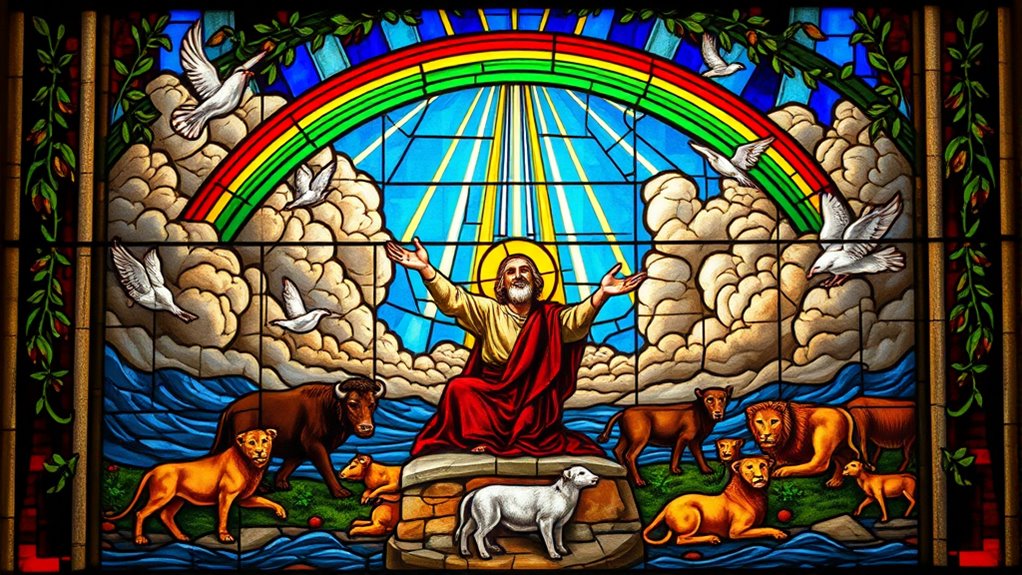
The Bible presents the rainbow as the sign of God’s covenant with Noah. In Genesis 9, God promised that floodwaters would never again destroy all life on earth, and he described the rainbow as an everlasting reminder of that promise, extended to every living creature. The rainbow also appears in Ezekiel 1:28 and Revelation 4:3, where it surrounds scenes of divine glory.
Key Takeaways
- The covenant covers every living creature and all future generations, not only humanity.
- God said the rainbow would prompt him to remember his promise of protection.
- In Ezekiel and Revelation, rainbow imagery surrounds God’s throne and signals majesty, holiness and presence.
- The rainbow shows mercy appearing after judgment, with God binding himself to a promise without requiring human merit.
What Does Genesis 9 Say the Rainbow Is For?
Most people recognize the rainbow as a natural weather phenomenon, but Genesis 9 gives it a specific covenant purpose. It marks God’s binding agreement with every living creature on earth, and the text calls it “the sign of the covenant.”
God said, “This is the token of the covenant which I make between me and you and every living creature that is with you, for perpetual generations: I set my rainbow in the cloud, and it will be a sign of a covenant between me and the earth.
Genesis 9:12-13 (WEB)
Here God names the rainbow as a sign and says he has set it in the clouds. Its appearance connects directly to restraint: floodwaters will never again destroy all life.
I will remember my covenant, which is between me and you and every living creature of all flesh, and the waters will no more become a flood to destroy all flesh. The rainbow will be in the cloud. I will look at it, that I may remember the everlasting covenant between God and every living creature of all flesh that is on the earth.”
Genesis 9:15-16 (WEB)
These verses state that seeing the rainbow prompts God to remember his promise. Verse 16 describes it as a reminder of “the everlasting covenant” between God and every living creature.
The covenant reaches beyond humanity to all living creatures and is described as everlasting, making the rainbow a continual, global marker of divine commitment to creation. It also explicitly includes “descendants after you”, extending its protection to future generations who would never witness the original flood. Scholars note that biblical language often reflects ancient Near Eastern imagery about the sky and earth, which can help explain how covenants like this were symbolized in nature.
What Did God Promise in Noah’s Covenant?
The covenant recorded in Genesis 8:20–9:17 begins right after Noah leaves the ark and offers a sacrifice, linking worship with the moment God makes his promise. The commitment extends not only to Noah and his sons but to every living creature and the earth itself.
The promise is specific. God pledged never again to destroy all life through floodwaters, and never again to use a flood to destroy the earth. This was not a broad guarantee against every future disaster; the language targets one particular form of total destruction. God calls the covenant everlasting and repeats the promise several times, underlining its permanence.
The rainbow was set in the clouds as the sign of the covenant, a visible token for all generations. The promise’s permanence reflects the biblical theme of God’s unchanging commitment to creation. God also provided “everything that moves” as food for Noah and his descendants, pairing the covenant’s protective scope with a new framework for human provision after the flood.
How Does the Rainbow Appear in Ezekiel and Revelation?
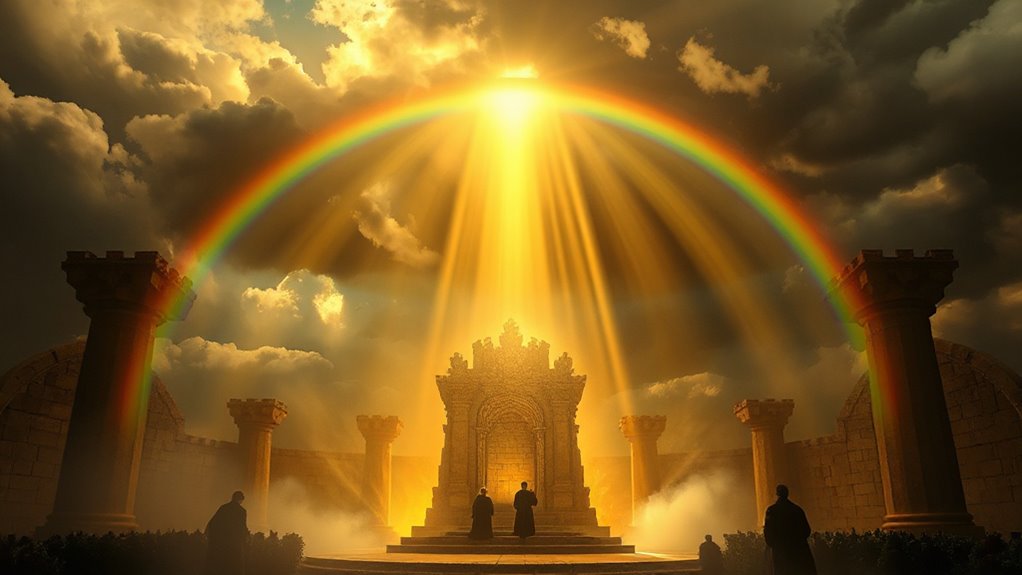
Beyond Genesis, the rainbow appears in Ezekiel and Revelation. In Ezekiel’s vision of God’s throne, the radiance around God’s presence resembles a rainbow on a rainy day.
As the appearance of the rainbow that is in the cloud in the day of rain, so was the appearance of the brightness all around. This was the appearance of the likeness of Yahweh’s glory. When I saw it, I fell on my face, and I heard a voice of one that spoke.
Ezekiel 1:28 (WEB)
The image is not decorative. It serves as an analogy for divine glory, appearing alongside fire, brightness and enthroned majesty, and Ezekiel responds by falling facedown in worship.
Revelation builds on this imagery. John sees a rainbow encircling the heavenly throne, emphasizing sovereign splendor.
Immediately I was in the Spirit. Behold, there was a throne set in heaven, and one sitting on the throne that looked like a jasper stone and a sardius. There was a rainbow around the throne, like an emerald to look at.
Revelation 4:2-3 (WEB)
Revelation 10:1 also places a rainbow above a mighty angel’s head, echoing Ezekiel’s storm-and-glory setting. Cross references for Ezekiel 1:28 connect it with Revelation 10:1 and Genesis 9:13, linking the rainbow’s appearances across both Testaments. Across these passages, the rainbow signals heavenly majesty, holiness and divine presence rather than simply marking weather.
What Does the Rainbow Reveal About God’s Character?
Taken together, the rainbow’s appearances trace a consistent portrait of God. From Genesis 9 onward, the sign communicates that God keeps his word across generations, not because humans remember it, but because he does. His covenant was extended to every living creature, making his reliability universal in scope.
The rainbow shows mercy appearing directly after judgment, suggesting that restraint, not continued wrath, defines God’s posture toward creation. It also reveals a God who takes the initiative, binding himself to a promise without requiring human merit. In Revelation 4:3, the rainbow appears around God’s throne, showing that covenant faithfulness surrounds his sovereign rule even in heaven.
The Hebrew word for “sign” in Genesis 9:13 carries the meaning of signal, beacon, or evidence, underscoring that the rainbow functions as visible proof of the covenant God established with the earth.
What Does the Rainbow Still Mean Today?
Genesis 9 frames the rainbow as covenant reassurance directed not only at Noah but at every living creature. The covenant explicitly extended to “every living creature”, including birds, livestock and every beast of the earth alongside humanity.
The sign appears after judgment, not before it, and God’s remembering is presented as a covenantal act rather than a passive response. For readers today, the rainbow remains a visible marker that destruction has defined limits. According to the text, judgment does not have the final word. Mercy does.
Common Questions About the Rainbow in the Bible
Does the rainbow promise that no disaster will ever happen?
No. The promise is narrow: God will never again destroy all life or the earth with a flood. The language targets one particular form of total destruction rather than every hardship.
Is the rainbow a sign for people or for God?
Genesis 9 emphasizes God’s side: he says that when he sees the rainbow, he will remember the covenant. It is also visible to every generation, so it serves as a lasting token for people as well.
Living Under the Sign of the Rainbow
The rainbow invites readers to see storms in light of a promise God made first and keeps by his own initiative. When you next see one, you can read Genesis 9 and let it remind you of a mercy that does not depend on human merit.