

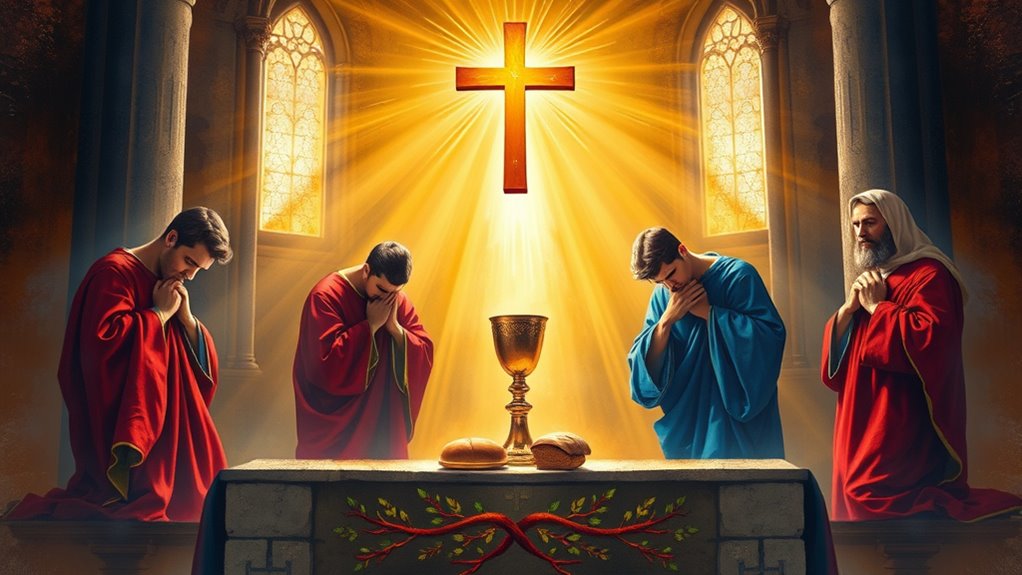



Every Catholic family can become a domestic church—what the Church formally calls *Ecclesia domestica*—by treating the home as a genuine site of faith, prayer, and Christian charity. Research consistently shows parental religiosity is the strongest predictor of children remaining religious into adulthood. Simple practices like grace before meals or a short bedtime prayer build that foundation without elaborate programs. Those who explore the Church’s full teaching on this discover how deeply household faithfulness connects to the health of the wider parish.
What Does “Domestic Church” Actually Mean?
The Catholic Church uses the phrase “domestic church” as an official doctrinal term, not simply a poetic expression.
The Catholic Church treats “domestic church” as a formal doctrinal term, not merely a metaphor or poetic flourish.
The Catechism of the Catholic Church describes the Christian family as a “specific revelation and realization of ecclesial communion,” meaning the family genuinely participates in the Church’s life, not merely resembles it.
The Second Vatican Council revived the ancient Latin term *Ecclesia domestica* to formalize this understanding.
Both the Catechism and the United States Catholic Catechism for Adults include it as standard doctrine.
The family home, in this view, becomes a real place where faith, prayer, and Christian charity take visible, daily form.
Parents are recognized as first heralds of faith with regard to their children, forming them through both word and example.
From the earliest centuries, the core of the Church was often constituted by believers together with their households, making families islands of Christian life in an unbelieving world.
This understanding finds roots in the biblical pattern of household worship where families historically gathered for prayer, teaching, and sacramental life.
Why the Home Is the First School of Faith
Among the strongest findings in the sociology of religion is a straightforward one: parents matter more than any other single influence in shaping a child’s faith. Research consistently identifies parental religiosity as the single strongest predictor of whether children remain religiously committed into adulthood.
The home provides what no weekly church service can fully replicate: constant, repeated exposure to religious language, prayer, and practice. The Bible also portrays the home as central to passing on faith through family discipleship and daily example.
One study found that children raised in households with frequent religious conversation were more than twice as likely to attend church as adults—roughly 20 percentage points more likely to identify as Christian and affirm belief in Jesus’ divinity.
In fact, data from the 2016 NCLS reveals that both parents attend church in roughly 69% of churchgoing children’s households, underscoring how profoundly the shared faith of a two-parent home shapes a child’s spiritual formation.
Researchers also emphasize that quality of relationship between parent and child proves even more important than specific faith practices or attendance at religious services, meaning that warmth and love in the home make all other faith formation possible.
How Parents Lead the Domestic Church at Home
Catholic teaching places parents at the center of the domestic church, not as optional guides but as its primary leaders. The Catechism identifies them as principal educators, first catechists, and witnesses of Christian life.
Their leadership takes several practical forms:
- Teaching faith through daily instruction and example
- Leading prayer and participating in sacramental life
- Modeling virtue through marital fidelity, forgiveness, and service
- Supporting vocations, including calls to religious life
This role, rooted in baptism and marriage, cannot be delegated entirely to schools or parish programs. Parents form their children by simply living faith at home.
Through baptism, parents and children share in Christ’s office of priest, prophet, and king, connecting their daily family life to a sacred identity that shapes how they live, sacrifice, and worship together.
Marriage itself holds two inseparable purposes—the unity of spouses and openness to new life—making the family’s foundation both a covenant and a calling.
Many biblical examples, from mothers who instructed their children to leaders who guided communities, show how women have contributed to the life of faith as part of the broader witness of the domestic church.
Simple Daily Practices That Build a Domestic Church
Building a domestic church at home does not require elaborate programs or lengthy daily schedules. Grace before meals, a short bedtime prayer, or a single decade of the Rosary each offer manageable starting points. Prayer, as the Bible teaches, is fundamentally communication with God that shapes the heart and home.
Families with young children benefit especially from short, consistent prayer rather than occasional lengthy sessions. Reading Scripture aloud paired with brief reflection connects faith to everyday concerns.
Research shows only 36% of Catholic parents pray daily, suggesting that intentional structure matters. Small rituals, repeated regularly, gradually shape household rhythms so that prayer becomes ordinary, reliable, and shared across different ages and schedules.
Families can also deepen connection through a 3-step nightly family prayer, sharing God’s blessings from the day, naming concerns for tomorrow, and closing together in both thanksgiving and petition.
Placing a crucifix in a prominent location, and in every bedroom, gives the home a visible, lasting sign that God dwells at the center of family life together.
How Your Domestic Church Builds Up the Wider Parish
Those small, repeated practices that shape a household’s rhythm do not stay contained within the home’s four walls. Each family that prays, serves, and witnesses faithfully becomes what the Church calls an “outpost of grace,” extending parish life into neighborhoods, schools, and workplaces. Many biblical teachings encourage such care for neighbors as a concrete expression of faith Compassion and Service.
Four ways domestic churches strengthen the wider parish:
- Forming durable faith that deepens parish catechesis beyond Sunday
- Modeling visible witness that supports parish evangelization efforts
- Nurturing vocations through generosity, reconciliation, and service
- Accompanying struggling families alongside parish pastoral care
Parishes grow steadier when households treat ordinary life as genuine mission. The family is recognized as the fundamental community of the parish, diocese, and universal Church, making each household’s faithfulness inseparable from the health of the broader ecclesial body.