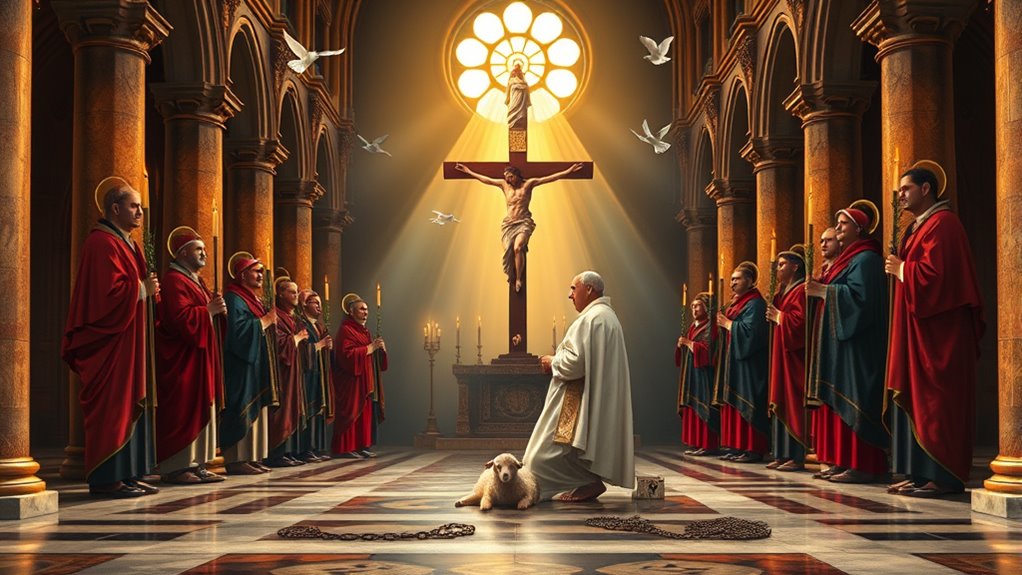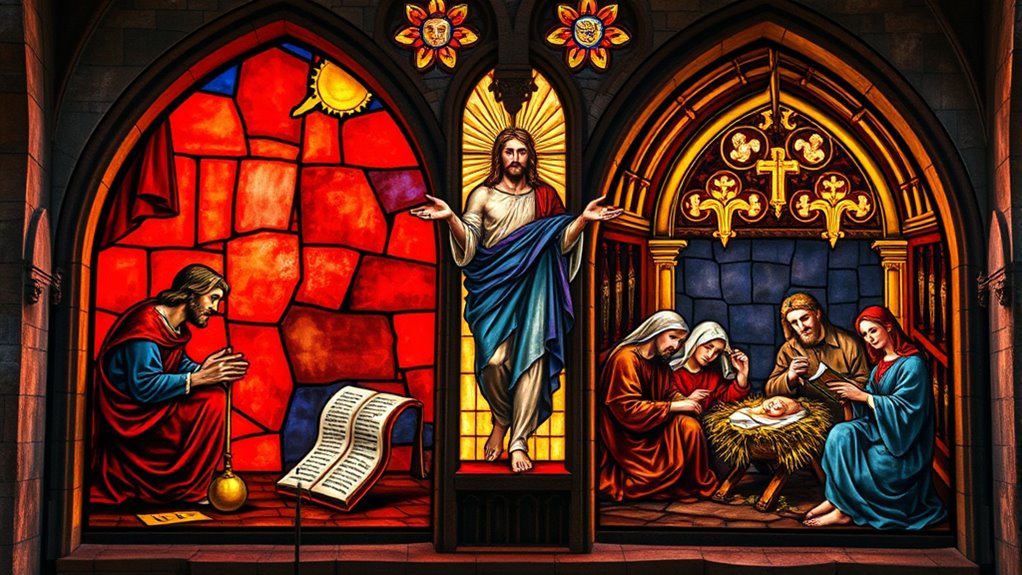

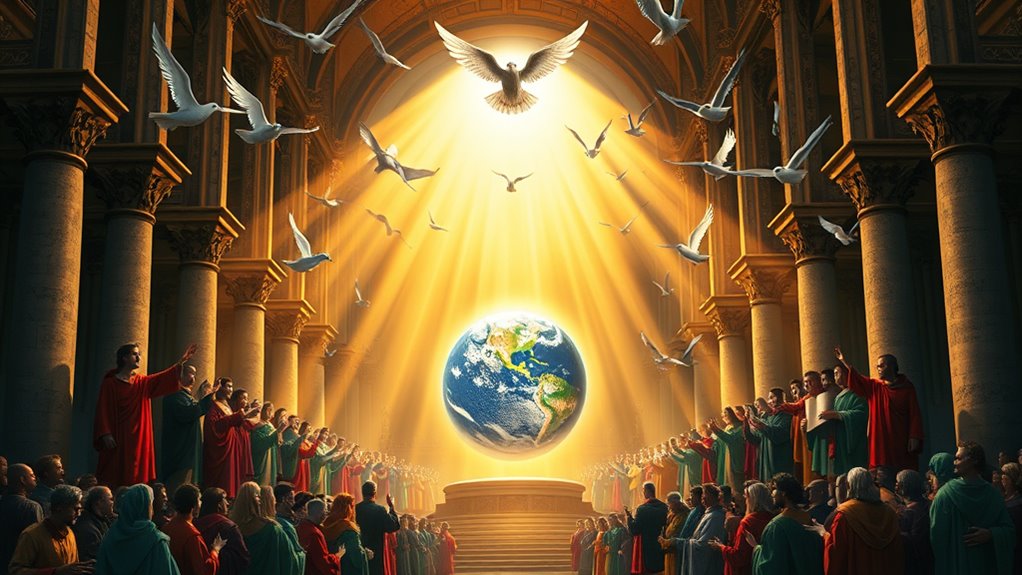
The Bible describes the church as the “Body of Christ,” emphasizing believers’ interdependence with Jesus as head (Ephesians 1:22–23). Scripture also presents it as God’s family, a holy temple built with living stones, and a flock needing the Good Shepherd‘s guidance. Christ leads this community through divine authority and sacrificial love, having declared in Matthew 16:18 his intent to build “my church.” When gathered, believers worship, study Scripture, practice baptism and the Lord’s Supper, and encourage one another. The church’s mission extends globally through the Great Commission, making disciples and serving communities. The sections below explore these biblical foundations further.
Key Takeaways
- The Bible uses metaphors like Body of Christ, Family of God, Temple of God, and Flock to describe the church’s nature.
- Christ is the church’s head and owner, exercising divine authority while loving the church sacrificially as a bridegroom loves his bride.
- Church membership provides accountability, enables biblical discipline, and clarifies pastoral care responsibilities within the local congregation.
- Believers gather for worship, Scripture teaching, fellowship, baptism, the Lord’s Supper, and encouragement in faith.
- The church’s mission includes proclaiming the Gospel globally, making disciples, establishing congregations, and serving those in need.
What Is the Church? Biblical Definitions and Metaphors

The New Testament employs several vivid metaphors to describe the church, each illuminating a different aspect of its nature and purpose. The “body of Christ” emphasizes interdependence among believers, with Christ serving as the head providing authority and direction (Ephesians 1:22–23).
This image unites Jews and Gentiles into one organism where each member functions as a crucial part. The “family of God” portrays believers as sons and daughters with God as father, sometimes elevating spiritual relationships over natural ones (Matthew 12:49-50).
The “temple of God” presents the church as a holy structure built with living stones, collectively indwelt by the Spirit (1 Corinthians 3:16-17).
Finally, the “flock of God” depicts believers as sheep dependent on Christ, the Good Shepherd, for guidance and protection (John 10:11–15). The church is understood within Christian doctrine as united to Christ through the shared divine life of the Trinity, with the Son and Father distinct yet one in essence shared divine essence.
How Does Jesus Christ Relate to His Church?
Central to Christian theology stands the relationship between Jesus Christ and His church, a connection the New Covenant presents through multiple dimensions of authority, love, and purpose.
The New Covenant reveals Christ’s relationship with His church through interwoven dimensions of divine authority, sacrificial love, and eternal purpose.
Upon His ascension, Christ took His position at God’s right hand while maintaining leadership over the church as its head, as described in Colossians. He sent the Holy Spirit to abide within the church as His temple, supplying its needs and operating through its members to spread the gospel.
In Matthew 16:18, Jesus declares His intention to build “my church,” the only earthly institution He claims with such possessive language.
This relationship mirrors spousal love, as Ephesians 5:25 states Christ “loved the church and gave himself up for her,” establishing a permanent union that empowers the church’s mission.
The church’s identity and mission are also shaped by the historical reality of Christ’s atoning work accomplished through his death at Golgotha, the place of the skull.
Why Does Church Membership Matter for Believers?

Throughout Christian history, formal commitment to a local congregation has served as the practical foundation for believers to live out their faith in community. Church membership establishes accountability structures where pastors and members maintain mutual expectations regarding attendance, giving, and service.
This framework enables biblical discipline processes outlined in Matthew 18:15-17 and 1 Corinthians 5:1-13, addressing unrepentant sin while protecting believers from spiritual drift. Membership clarifies who receives pastoral care during life’s challenges and who participates in church governance decisions.
The practice reflects New Testament patterns found in Romans 12:4-5 and 1 Corinthians 15:1-3, where believers function as interconnected members of one body. By identifying with a specific doctrinal position and community, members signal visible commitment to Christ before God and others. The Catholic Bible contains 73 books which illustrates how different Christian traditions define and preserve their authoritative teachings.
What Does the Church Do When Believers Gather?

When believers gather for corporate worship, they engage in five essential activities that both express and deepen their faith. First, worship occurs through prayer, singing psalms and hymns, and offering praise that proclaims God’s majesty (1 Timothy 2:1; Colossians 3:16).
Second, teaching and preaching center on reading and explaining Scripture, with elders responsible for proclaiming God’s Word to equip believers (Acts 2:42; Ephesians 4:11–16).
Third, fellowship provides encouragement and care as members strengthen one another’s faith through conversation and prayer (Hebrews 10:24–25).
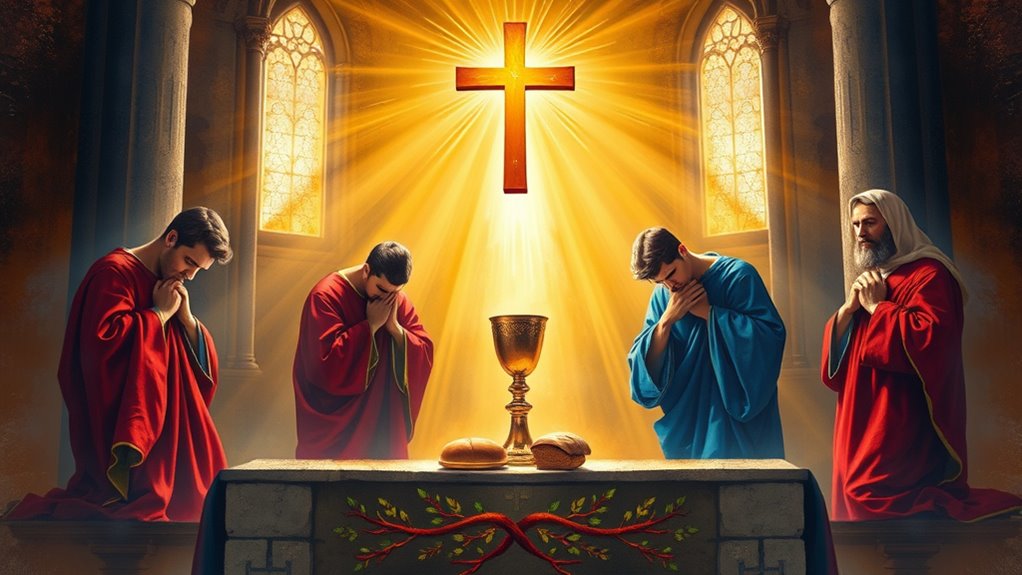
Fourth, the church administers ordinances—baptism as a public profession of faith and the Lord’s Supper to remember Christ’s death and the new covenant (Luke 22:19; Matthew 26:28–29).
Fifth, the gathered assembly serves as kingdom witness, proclaiming God’s excellencies and mobilizing believers for evangelism (1 Peter 2:9).
The church’s practices rest on scriptures formed over many centuries, including translations like the Septuagint translation that broadened access to the Hebrew scriptures.
What Is the Church’s Mission in the World?

While corporate worship strengthens believers within the church walls, the mission of the church extends far beyond its gathered assembly into the broader world.
The primary directive, known as the Great Commission, calls churches to share the Gospel with all nations and peoples. This work involves reaching unreached populations through partnerships with missionary organizations, some deploying over 700 missionaries across 100 fields.
Churches fulfill this mission by establishing new congregations, training local pastors, and providing discipleship to new converts. Mission work also includes practical service such as clean water initiatives, educational support, and care for displaced persons.
Local congregations increasingly take ownership of this global responsibility by sending gospel workers and connecting with missionary partners worldwide.
A consistent study schedule and practical tools like reading plans can help churches train and equip members for long-term mission engagement.