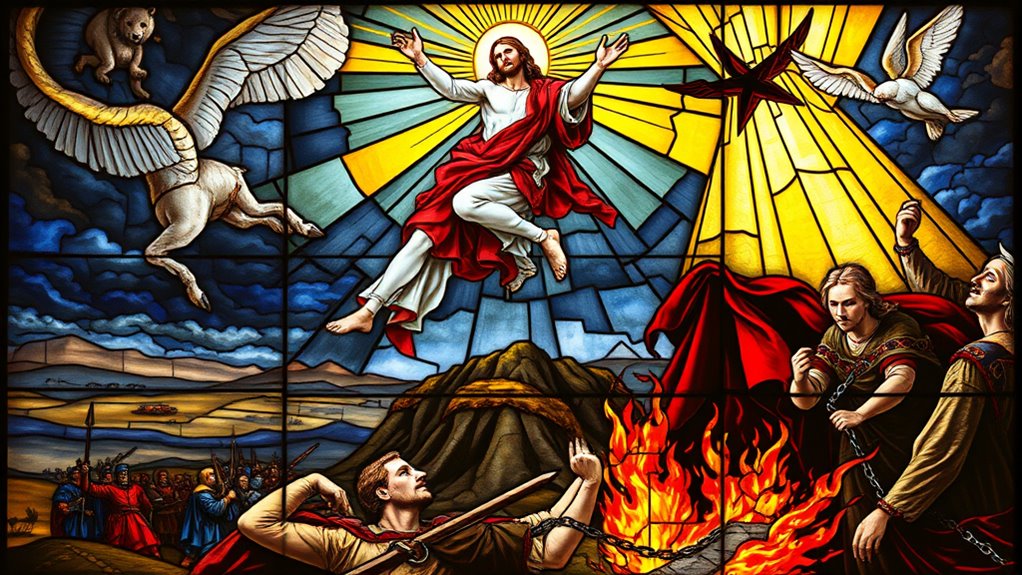
The Bible describes the end times as beginning with the Rapture, when believers are “caught up” to meet Christ in the air, followed by a seven-year Tribulation during which the Antichrist rises to power and demands global worship. This period divides into two halves, with intensified judgments in the final three and a half years. Christ then returns visibly at Armageddon to defeat the Antichrist and establish His millennial kingdom on earth. The sections below explore each stage in greater detail.
Key Takeaways
- The Rapture will suddenly catch believers up to meet Christ, with the dead rising first and living believers instantly transformed.
- A seven-year Tribulation period follows, divided into two halves, with escalating judgments including diseases, disasters, and wars.
- The Antichrist will emerge as a deceptive peacemaker, then demand worship, control commerce, and persecute believers during the Tribulation.
- Christ returns victoriously at Armageddon to defeat the Antichrist’s armies, casting evil leaders into the lake of fire.
- Satan will be bound for a thousand years as Christ establishes His millennial kingdom on earth.
What Is the Rapture and When Will It Happen?

The Rapture represents one of Christianity’s most discussed prophetic events, a moment when believers anticipate being suddenly caught up from earth to meet Christ in the air. The term derives from Latin *rapiemur*, translating the Greek *harpazo* in 1 Thessalonians 4:17, meaning “to catch up.”
According to Scripture, the dead in Christ will rise first with glorified bodies, then living believers will be instantly transformed and join them in the clouds. Many interpreters distinguish this event from Christ’s Second Coming, viewing the Rapture as occurring before a seven-year Tribulation period while the Second Coming follows it.
The timing remains uncertain, with proponents emphasizing its imminent nature—it could happen at any moment without warning, much like the sudden arrival of Noah’s flood. Archaeological and historical evidence supports the New Testament’s early composition and transmission, bolstering confidence in accounts like 1 Thessalonians authorship and dating.
How the Antichrist Rises to Power During the Tribulation

According to biblical prophecy, the Antichrist emerges not with immediate fanfare but through gradual, deceptive ascent during the seven-year Tribulation period.
Revelation 13:1 describes him rising from the sea, symbolizing the masses, initially appearing as a peacemaker who brokers a covenant with Israel.
At the midpoint, he breaks this agreement and subdues three of ten kings in a revived Roman Empire alliance, as detailed in Daniel 7:23-24.
His power accelerates when he seemingly recovers from a fatal head wound, drawing worldwide marvel. Satan, cast to earth with great wrath according to Revelation 12:12, empowers him fully.
The Antichrist then declares himself God, exercises authority over all nations for forty-two months, and controls global commerce through the mark 666, persecuting those who refuse worship.
The site of Jesus’ death, traditionally identified as the Church of the Holy Sepulchre, underscores the contrast between Christ’s sacrificial kingship and the Antichrist’s deceptive authority.
What Happens During the Seven-Year Tribulation Period
Understanding the Antichrist’s ascent provides necessary context for examining the broader events that unfold throughout the entire seven-year period known as the Tribulation. This future timeframe originates from Daniel 9:24-27, where one final week of years remains from the prophesied seventy weeks.
The period divides into two distinct halves. The initial 3.5 years begin when the Antichrist establishes a covenant with Israel, creating false peace while evil spreads without restraint.
At the midpoint, the Antichrist desecrates the temple by placing his image inside, demanding worldwide worship. The latter 3.5 years, called the “great tribulation,” bring intensified divine judgment through diseases, natural disasters, and wars.
Revelation 13:5 confirms this structure, specifying 42 months for the beast’s reign during the final half. The New Testament writings, composed between 45-100 AD, provide the core descriptions of these end-times events and were written in Greek, helping spread these teachings across the ancient world via the Septuagint.
How Christ Returns and Defeats the Antichrist at Armageddon

When the seven-year Tribulation reaches its climax, Christ returns visibly and victoriously to confront the assembled forces of evil. Revelation 19:11 describes Him descending from heaven on a white horse, judging in righteousness.
His feet touch the Mount of Olives, splitting it to form an escape valley for Israelites, as stated in Zechariah 14:4. Armies from all nations gather at Armageddon, the plain of Esdraelon, directed by demonic spirits to battle against God (Revelation 16:14-16).
The Antichrist and false prophet lead this coalition. Christ defeats them instantly with a sword from His mouth, casting both alive into the lake of fire (Revelation 19:20-21).
Satan is then bound for a thousand years, and Christ establishes His millennial kingdom on earth. The descriptions of Christ’s return use vivid symbolic imagery that emphasizes His divine authority and holiness divine authority.
Related Posts